Today's Friday • 9 mins read
Diogenes of Sinope (c. 404-323 BCE) was perhaps the most idiosyncratic philosopher who walked this earth. He found outrageous ways to teach Cynic philosophy.
Plato once called him a “Socrates gone mad.” Many called him by his nickname, “Diogenes the Dog,” due to his highly eccentric and provocative ways of explaining Cynicism.
Despite these nicknames, there was a method to his madness. His sharp tongue critiqued the hypocrisy in society and spoke truth to power.
Famously, he even brushed aside Alexander the Great.
Diogenes remains a fascinating figure because of his wild life stories.
Diogenes, Lantern, And A Dog
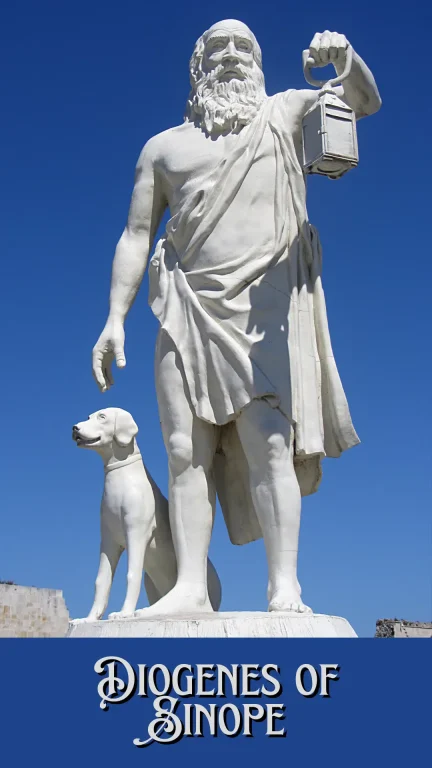
There is a statue of Diogenes in Sinope on the Black Sea coast of Turkey. Standing at the narrowest point of the Sinop Peninsula isthmus, it is a famous tourist attraction.
Made of bronze, painted white, it has Diogenes standing on a barrel, holding a lantern in his left hand, with a dog at his feet. The barrel, lantern, and dog are key symbols of his philosophy.

- The Barrel: Diogenes lived simply and publicly, often in a large jar or barrel. His ascetic poverty showed his self-sufficiency, defiance of luxury, and commitment to Cynicism. The barrel represents his deliberate rejection of material comforts and social norms.
- The Lantern: Diogenes walked around Athens with a lantern in the daytime. He would hold it close to the faces of the citizens, telling them he was searching for an honest man. The ‘lamp of reason’ in Diogenes’ statue still berates us, as if he is still searching for an honest man in a morally corrupt and hypocritical society.
- The Dog: The dog at his feet is a nod to his nickname, “Diogenes the Dog,” and his association with the Cynic philosophy. Diogenes rejected artificial human behaviors and lived a simple life like a dog, without any possessions or heed to the conventions of society.
How Diogenes Lived (Like A Dog)
Many times, Diogenes actually acted like a dog.
Diogenes was born in Sinope, in ancient Asia Minor (modern-day Turkey), around 412 BCE. He was taken by Cilician pirates in his youth and sold as a servant.
He later settled in Corinth, where he lived and taught his Cynicism until his last days. He is said to have authored over ten books, a volume of letters, and seven tragedies. But none of his writings survive.
Diogenes was nicknamed “the Dog” equally for his Cynic philosophy and his deliberate acts imitating the natural, unrestrained life of a dog. The term “Cynic” itself comes from the Greek word “kynikos,” meaning “dog-like.”
Diogenes did not own anything, except a tattered gown and a cup. Whenever he needed something, he begged for it. He slept in a wine barrel in the marketplace. And ate onions to offend people with his foul breath.
Some infamous examples of his “dog-like” antics:
Barking at People
Diogenes unabashedly embraced his nickname “the Dog,” and often provoked people by barking like a dog at them.
He would bark out loud when someone he didn’t want to talk to approached him, or when he wanted to mock a person’s behavior.
Cynic philosophers often barked to shock people. It was an effective ‘doggone’ way to remind society of how artificial their behaviors and pretenses have become.
Living in a Barrel
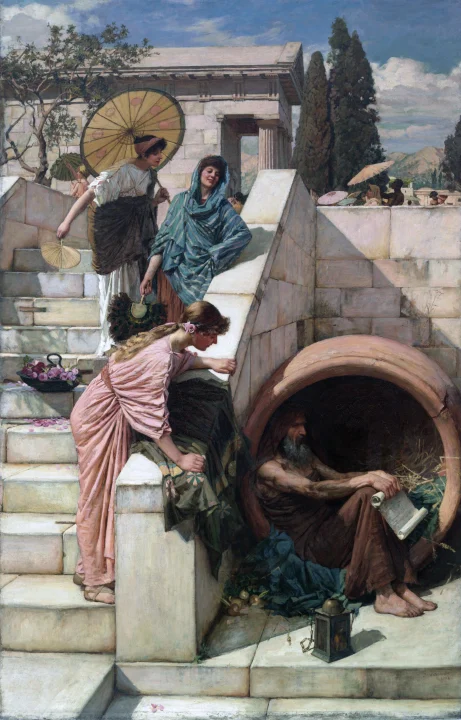
Perhaps his most famous “dog-like” behavior was his choice to live in a large cask (wine barrel), rejecting the need for a house or possessions.
Like a stray dog, Diogenes embraced homelessness and simplicity, showing that true happiness did not depend on material wealth.
When people mocked his living conditions, he responded with biting humor, often pointing out how much freer he was than they were, burdened as they were by their belongings and social obligations.
Eating in Public
Ancient Greece considered eating in public as highly improper. But Diogenes being Diogenes, he defied this norm as well.
He would sit in the marketplace, eating whatever scraps he had, just like a stray dog would. When people criticized him for it, he quipped, “If eating is natural, why should it be done in private?”
Though not a dog-like behavior, legend has it that Diogenes would often go on a diet almost exclusively of onions. It was his way to offend unwarranted people with his breath.
Those who truly wanted to hear him had to first tolerate his onion breath.
Public Treatment of Bodily Needs
Diogenes believed people should live in line with nature rather than social convention. To make this point, he sometimes handled basic bodily needs in public without hesitation.
On one occasion, he directed a stream of urine toward a man who had insulted him. It was undeniably rude, yet for Diogenes, it was a statement that he placed no value on the man’s opinions.
He was also known to relieve his bowels in open spaces, much as animals do, to challenge society’s idea of what is considered acceptable.
His argument was simple: we do not shame animals for answering nature’s call in public, so why should the same action by a human be treated as unnatural or disgraceful?
Relieving Bodily Urges in Public
One of Diogenes’ most shocking and discussed acts was his habit of addressing private bodily urges in public spaces. When people reacted with outrage or disgust, he answered with his typical sharp wit:
“If only it were as easy to relieve hunger by rubbing my stomach.”
He used this to criticize what he saw as society’s unnecessary shame around natural human functions.
He felt humans had complicated their lives with excessive rules, and should return to a simpler, more direct way of living.
Why Did Diogenes Act Like A “Dog”?
Diogenes wasn’t just being crude for the sake of it. His dog-like act was to show three main principles of Cynic philosophy:
- Simplicity: Dogs live with minimal needs, and so did Diogenes.
- Indifference to Shame: Dogs feel no embarrassment about natural acts, and neither did Diogenes.
- Directness in Dissent: Dogs bark at things or people they see as threats or disturbances. Similarly, Diogenes openly criticized and challenged civil norms and authority figures he saw as hypocritical or needless to society.
When someone mocked him for acting like a dog, Diogenes reportedly said,
“I fawn on those who give me something, I bark at those who refuse, and I bite scoundrels.”
When Diogenes Defied Alexander the Great
One of the most famous encounters in ancient philosophy is the meeting between Diogenes of Sinope and Alexander the Great.
It’s a story of two vastly different lives crossing paths. Diogenes, the ragged, defiant Cynic philosopher, and Alexander the Great, the most powerful man in the known world.
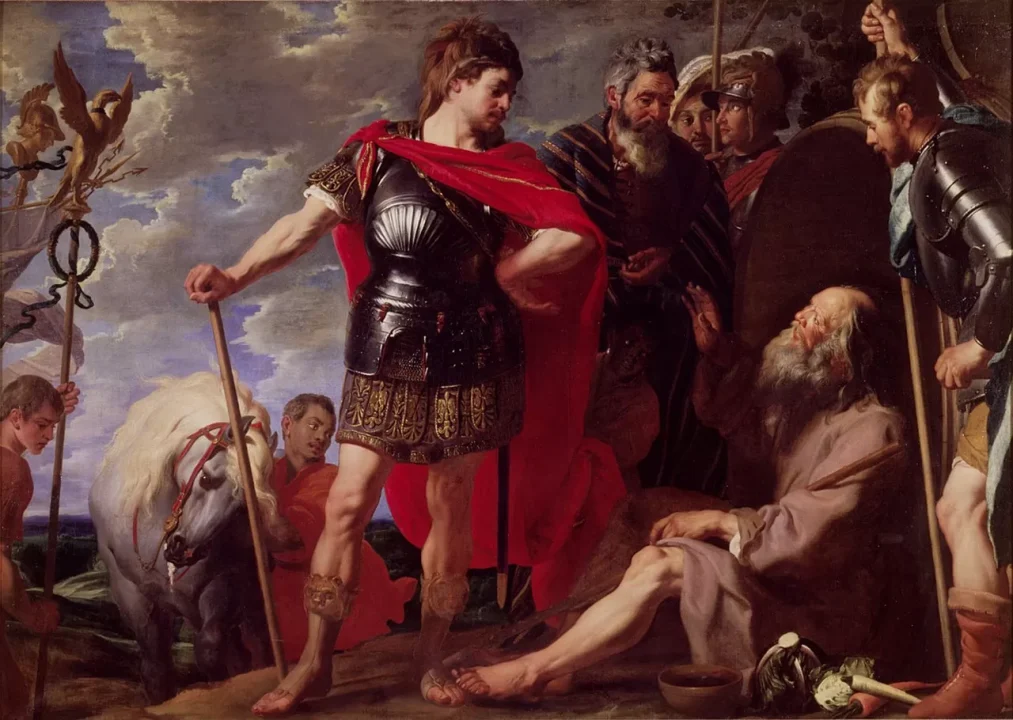
Alexander, hearing of Diogenes’ reputation as a philosopher who scorned wealth, power, and social norms, decided to visit him in Corinth.
At the time, Diogenes was living as simply as ever, in a barrel at the marketplace, owning almost nothing.
When Alexander arrived with his regal entourage, he found Diogenes basking in the sun, completely unbothered by the commotion. The young conqueror, amused and perhaps a little curious about Diogenes’ audacity, asked him:
“I am Alexander the Great. I have heard of your wisdom. Ask me for anything you desire, and I shall grant it.”
Without even looking up, Diogenes replied casually,
“Yes, there is something you can do for me. Step aside—you’re blocking my sunlight.”
Stunned by the philosopher’s boldness, Alexander stood silently for a moment. Then, instead of taking offense, he laughed and turned to his followers, declaring,
“If I were not Alexander, I would wish to be Diogenes.”
This legendary interaction evokes everything Diogenes stood for: his complete indifference to power, wealth, and status, and his commitment to living a life free of material desires or societal expectations.
Heartwarmingly, it also highlights Alexander’s admiration for the philosopher’s uncompromising freedom, even though they came from opposite extremes of society.
The story remains a timeless reminder that true life satisfaction doesn’t come from conquering others, but from mastering oneself.
And that sometimes, the humblest figure can leave even the mightiest ruler humbled.
When Diogenes Rejected Traditional Final Rites
Diogenes had an unusual request for what should be done with his body after his life came to an end.
As he grew older, his followers sometimes asked what arrangements he preferred once he was no longer alive. They expected practical instructions.
In his signature style, Diogenes answered:
“When my life ends, toss my body beyond the city walls. Let the creatures out there deal with it.”
His followers were horrified.
“How can you suggest such a thing? It’s disrespectful! What if the wild animals tear you apart?”
Diogenes, amused, replied:
“If that troubles me, give me a stick so I can keep them away.”
His friends, confused, said,
“But you won’t be alive. You won’t be able to feel anything or use a stick.”
Diogenes laughed and said:
“Exactly! If I won’t feel anything, why should I care what happens to my body?”
His point was simple. The body is only a vessel, and once life has left it, it serves no purpose. So why do we fear the end of life or obsess over rituals surrounding it?
Diogenes wanted to show the futility of elaborate customs for something as natural and inevitable as the closing chapter of a human life.
Was Diogenes A Stoic?
Diogenes was a Cynic, not a Stoic.
He was a student of Antisthenes, the founder of the Cynic school of thought, and held his teacher’s asceticism. The Cynics, unlike the Stoics, rejected societal conventions and material possessions.
But Diogenes did play a vital role in the birth of Stoicism, an enduring school of Greek philosophy. Diogenes taught Crates of Thebes, who then mentored Zeno of Citium, the founder of Stoicism.
Final Words
Diogenes spent his life challenging social norms and pushing people to confront their own hypocrisies. His stories are a key reason he remains widely discussed today.
He never hesitated to expose the absurdities of social customs through his “dog-like” behavior, reminding people to return to simplicity, honesty, and a more natural way of living.
Diogenes is still searching for an honest man!
√ Also Read: Life & Philosophy of Marcus Aurelius: Philosopher King
√ Please share this with someone.
» You deserve happiness! Choosing therapy could be your best decision.
...
• Disclosure: Buying via our links earns us a small commission.