
Today's Saturday • 8 mins read
Some people seem to be magnets for narcissists. They will look for another narcissist to get close to after breaking up with one.
They think they can easily handle the typical narcissistic traits: the demand for constant praise, needing to feel superior to others, and making every social situation about themselves.
Interestingly, despite living with and being drawn to narcissistic people, they are not narcissists.
Psychologists call this behavior pattern co-narcissism.
Co-narcissism, a term coined by Dr. Alan Rappoport, describes people who have adapted to living with or being raised by a pathological narcissist by becoming hyper-attuned to the narcissist’s needs.
Co-narcissists are victims. They have been conditioned to recognize and cater to the needs of their narcissist, and this familiarity draws them to other narcissists.
Let’s find out more on it.
Origins of Co-Narcissism
Co-narcissistic individuals often come from families with narcissistic parents.
“Every narcissistic and co-narcissistic person that I have encountered has had narcissistic parents, and the parents of their parents are reported to have been even more highly narcissistic.” – Alan Rappoport
Children of narcissistic parents learn early that their emotional survival depends on reading their parents’ moods and needs correctly.
Sadly, this is a child working toward self-preservation. They are adapting to avoid punishment and abuse by pre-reading and meeting their narcissistic parent’s needs.
The Co-Narcissist Child
The co-narcissist child becomes an expert at detecting their parent’s mood shifts, anticipating needs, and fine-tuning their behavior to keep the peace. They learn conflict avoidance at the cost of self-sacrifice.
The child also learns that their own feelings are secondary or irrelevant. They see the parent constantly redirecting focus back to themselves, dismissing the child’s emotions, or reacting with rage to normal childhood needs. So, the child adapts.
They no longer expect validation, praise, or to have their needs met. They stop voicing their demands and complaints.
These children often stop trusting their own natural reactions. They become and behave as the parent needs them to be.
This pattern solidifies into adulthood, shaping how they approach all relationships.

The Co-Narcissist Adult
Co-narcissistic individuals often have “a strong sense of responsibility for the well-being of others while minimizing their own needs” (Rappoport, 2005).
They are often characterized by low self-esteem, extreme caretaking behavior, a tendency to blame themselves for problems, feeling responsible for other people’s emotions, and difficulty identifying their own feelings or needs.
How Co-Narcissists Function in Relationships
Co-narcissism is a survival strategy that later becomes a faulty relationship blueprint. Their survival skills build them into adults who are exceptionally good at managing narcissists but terrible at recognizing their own needs.
Co-narcissists enter adult relationships with a specific skill set: they’re exceptional listeners, highly attuned to others’ emotions, and quick to adjust their behavior based on feedback.
These qualities sound positive, and in healthy relationships, they can be. But co-narcissists don’t typically find themselves in healthy relationships.
They gravitate toward narcissistic partners because that’s the dynamic they know. The typical narcissist’s demands feel familiar. The emotional labor feels normal.
The one-sided nature of the relationship doesn’t seem like a red flag as it mirrors (and even validates) what they experienced growing up.
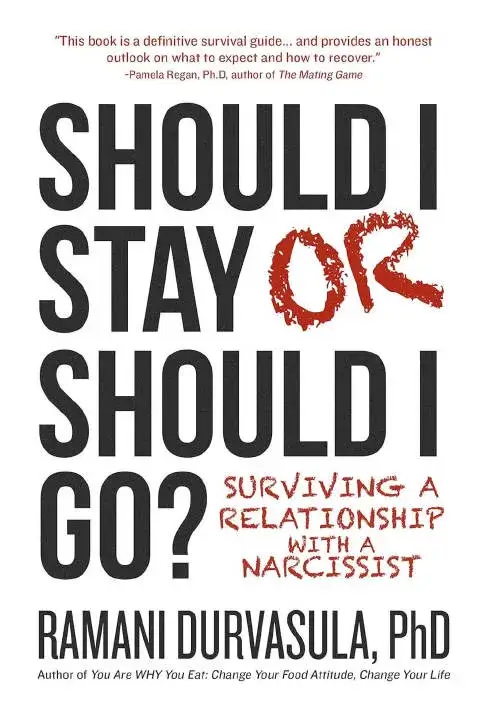
Dr. Ramani Durvasula, a clinical psychologist specializing in narcissistic relationships, notes that “the co-narcissist has been so conditioned to meet the needs of others that they often don’t even know what their own needs are.”
What she says isn’t hyperbole. Many co-narcissists genuinely struggle to answer basic questions about their preferences, desires, or boundaries.
The co-narcissist manages the narcissist’s emotions, takes responsibility for relationship problems, and works constantly to prevent conflict.
They become the narcissist’s “emotional bodyguard,” social support system, public relations manager, and scapegoat all at once.
Breaking The Co-Narcissistic Pattern
1. Recognize You’re a Victim
Co-narcissists must realize that they are a victim of the narcissist. This recognition is the first step, though not enough.
The pattern didn’t develop because you were weak or foolish. It developed because a parent treated you as an extension of themselves rather than a separate person with legitimate needs.
2. Rebuild Your Relationship With Yourself
Once they realize their condition, co-narcissists need to rebuild their relationship with themselves. They need to practice identifying their own feelings.
This might mean literally asking themselves throughout the day, “What am I feeling right now?” and sitting with whatever comes up.
They need to practice making small decisions without seeking opinions or validation from others. Start with low-stakes choices: what to eat for lunch, which route to take home, and what to watch on television.
The discomfort that you feel when you put your own needs first is a symptom of your condition, not proof that you’re being selfish.
3. Get Professional Support
Therapy helps, particularly with therapists experienced in dealing with narcissistic abuse.
Therapists help co-narcissists see that their hypervigilance, people-pleasing, and boundary struggles are adaptive responses to an abnormal childhood environment.
These patterns made sense given the circumstances. They just don’t serve you anymore.
4. Learning to Set Boundaries
Setting boundaries becomes critical. This doesn’t mean cutting off all narcissists or refusing to help others.
It means learning to distinguish between healthy reciprocity and one-sided emotional labor. It means recognizing when you’re managing someone else’s emotions at the expense of your own.
5. Understand What Recovery Actually Means
Recovery means learning that relationships can be different, that your needs matter as much as anyone else’s, and that you don’t have to earn the right to take up space.
It means unlearning the idea that your value comes from how well you serve others and recognizing that you’re worthwhile simply because you exist.
This shift takes time. Co-narcissists often feel guilty when they start prioritizing themselves, worried that they’re becoming the narcissists they grew up with. They’re not.
They’re finally learning what healthy relationships look like, and that knowledge changes everything.
Psychology of Co-Narcissism
Co-narcissism has several interconnected patterns.
- First, there’s external validation seeking. Co-narcissists learned that their value comes from how well they serve others, so they constantly look outside themselves for confirmation that they’re doing enough, being enough, and trying hard enough.
- Second, there’s decision-making paralysis. When you’ve spent years deferring to someone else’s preferences, you lose practice making choices for yourself. Co-narcissists often freeze when faced with decisions, worried about making the “wrong” choice and facing criticism or rejection.
- Third, there’s emotional suppression. Co-narcissists become so focused on managing the narcissist’s feelings that they disconnect from their own. They might feel constant vague anxiety or mild depression, and struggle to identify specific emotions or their sources.
- Fourth, there’s unrealistic loyalty. The loyalty component is particularly strong. Co-narcissists stay in harmful relationships far longer than outside observers think reasonable. They’ve been trained to believe that leaving equals failure, that their job is to fix things, and that they should be able to handle more.
Co-Narcissist vs. Narcissistic Enabler
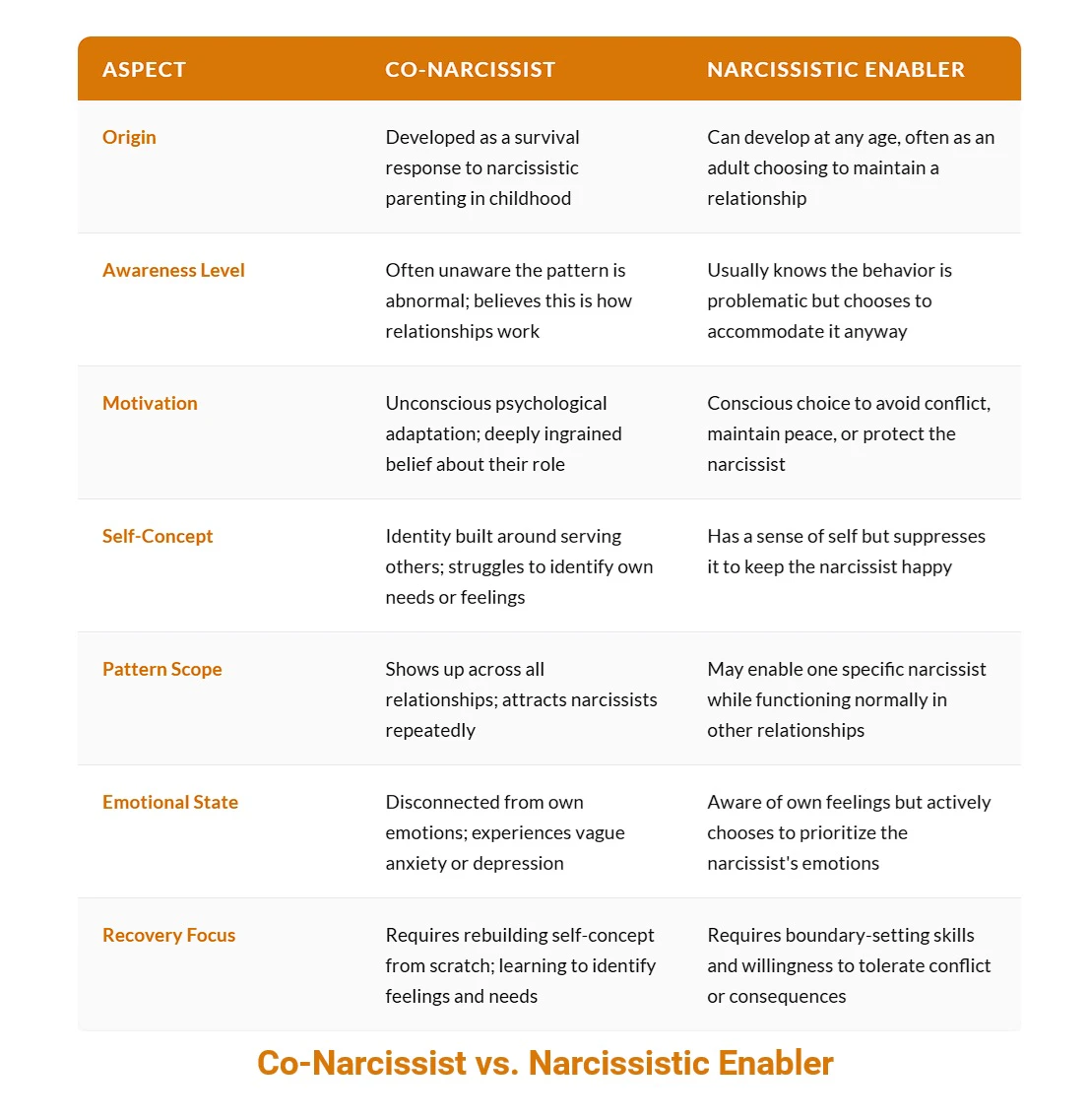
Co-narcissism overlaps with narcissistic enabling, but they’re not identical.
- Co-narcissism focuses on the psychological adaptation. It involves internalized patterns that make someone susceptible to narcissists in the first place.
- Enabling focuses on the behavior. It’s about making excuses for the narcissist, protecting them from consequences, and facilitating their dysfunction.
Hidden Strengths In Co-Narcissists
Co-narcissists are often exceptionally good-natured and competent people.
They’re the ones who hold teams together, who notice when someone’s struggling, and who can read a room and adjust accordingly. These skills matter in leadership, caregiving, teaching, and countless other places.
Qualities that make a co-narcissist easily drawn to narcissists aren’t naturally negative.
Loyalty, resilience, flexibility, empathy, and emotional attunement are valuable traits. But it’s a problem when they are using those exclusively in the service of others.
So, if you’re a co-narcissist, you don’t need to eliminate these traits.
Instead, teach yourself to extend the same care and attention to yourself that you give others. That would allow you to continue to help others while also having the self-awareness to nourish your own needs, set boundaries, and prevent others from exploiting you.
Some co-narcissists worry that becoming less accommodating means becoming narcissistic themselves. This fear itself reveals the distorted thinking that co-narcissism creates.
- Having needs doesn’t make you narcissistic.
- Expressing preferences doesn’t make you selfish.
- Expecting reciprocity in relationships doesn’t make you demanding.
Final Words
Co-narcissism is genuine victimhood. The child learned to cope with emotional invalidation and abuse by adapting to an unavoidable situation.
Children who develop these patterns did what they needed to survive in a narcissistic home. As adults, the challenge is to reassure themselves that they are safe now. And that they no longer need to use those survival strategies to live their lives.
» You deserve happiness! Choosing therapy could be your best decision.
...
• Disclosure: Buying via our links earns us a small commission.