
Today's Saturday • 14 mins read
Healthy dating is an opportunity to build a connection where each person feels valued, can be honest, keeps their boundaries, and chooses freely whether to explore a future together.
A key quality in healthy dating is finding compatibility and safety in a relaxed and pressure-free setting.
A good date can check all the boxes that get you excited, but healthy dating goes beyond chemistry. It involves respect, curiosity, authenticity, boundaries, and a willingness to accept another person without losing yourself in the process.
Here are 10 principles that can help you approach dating in a healthier way.
1. Accept the person as a separate person.
Don’t date to find a copy of you in another body, or if you can remake this person, or if they will change themselves for you.
Date to figure out whether your personalities, values, needs, and goals are compatible.
Expect them to have different preferences, habits, opinions, strengths, and vulnerabilities. Some of those may not matter (like they use a different toothpaste), while others could be deal breakers (like they want you to wake up at 5 AM every day, when you are a night owl who goes to sleep at 2 PM).
Acceptance means recognizing the other person as a separate person. It does not mean approving of everything they say or do, ignoring serious concerns, or giving up your own needs and boundaries.
Next, ask yourself: “Can I respect this person as they are, and can we build a relationship that works for both of us?”
If the answer is no, be honest and move on. If the answer is yes, find out whether they feel similarly and whether both of you want to continue getting to know each other.
A healthy relationship starts with mutual acceptance and respect. Then moves further with genuine interest and compatibility.
Do not go on a first date to find parts of you in them, someone who thinks, feels, or behaves exactly as you do. Instead, try to accept their differences.

2. Stay open to learning something new.
Curiosity is the human tendency to ask and learn about things. Dating allows us to fulfill our curiosity needs, as we meet people whose experiences are often very different from ours.
Someone may have grown up in a different family, culture, city, or social environment. They may have different interests or ways of solving problems.
You do not have to adopt their preferences. You can simply remain curious about them.
A useful attitude is, “What can I learn about this person?” rather than, “How quickly can I decide what kind of person they are?”
A first date gives limited information about a person. When you’re curious, you ask questions and explore their world instead of values, stands, and goals.
Healthy dating is about being curious about each other.
3. Stop yourself from becoming judgmental.
Dating conversations involve questions, but not those kinds of questions that seem like an interrogation or an interview.
Ask about the person’s interests, values, work, friendships, family, goals, and experiences. Then listen to the answers.
Try to understand why something matters to them rather than immediately deciding whether you agree.
Research on partner responsiveness suggests that people tend to feel closer and more satisfied when they perceive that their partner understands, values, and cares about them.
In other words, being interested in your partner is more useful than simply trying to impress them.
Healthy dating involves asking open questions and listening witjhout prejudice.
4. Build mutual respect and healthy boundaries.
A healthy relationship gives both people room to have their own boundaries. Both should be able to understand and respect each other’s comfort levels.
A boundary defines what you are comfortable with and what you will or will not accept in a relationship. It also clarifies how you will respond if someone crosses that limit.
You should be able to say, “I’m not comfortable with that,” without being mocked, pressured, threatened, or punished. The same principle applies in reverse: your partner is entitled to their boundaries too.
Healthy boundaries can include limits on physical closeness, intimacy, money, time, friendships, privacy, communication, social media, and personal space.
Healthy dating is about mutual interest, clear communication, emotional security, shared effort, and respect for each person’s boundaries and independence.
5. Invest time and attention in the relationship.
Relationships need time and attention.
It means giving the relationship enough time and attention to discover whether you genuinely enjoy being together and whether your values and goals are compatible. Not spending every possible hour together.
This can involve regular conversations, shared activities, checking in after difficult days, remembering important details, and making plans together.
Healthy dating is a two-person activity, and investment should also be mutual.
If one person is continually initiating conversations, arranging dates, solving problems, and maintaining the relationship while the other contributes very little, resentment can develop.
Healthy relationships will have disagreements, and couples do not need to agree about everything. What they need is to find how to discuss differences without turning them into loud conflicts or name-calling.
6. Learn to communicate during disagreement.
Two people can be made for each other and still have differences regarding money, family, intimacy, work, friendships, time, household responsibilities, or future plans.
Healthy relationships will have disagreements; it is a feature in the system, not a bug in the system. The goal is not to eliminate conflict. It is to learn how to handle it without turning disagreement into contempt, intimidation, or smear campaigns.
Perhaps the most common mistake in listening is waiting for your turn to speak. No. A good listener pays attention to what the other person is saying without interrupting. This is one prime reason active listening is a key skill in healthy dating.
Relationship research does not point to a single communication style that works equally well for every conflict. Direct discussion can be useful when an important problem needs to change, while validation and cooperation can be more helpful in other situations. Talk to a relationship or dating counselor.
A useful starting point is to discuss the problem, staying focused on the issue. Instead of “You never listen to me,” try “I don’t feel heard when this happens. Can we talk about it?”
You can also learn how to respond when a relationship needs negotiation.
7. Listen to what is being said (and what is not).
Communication involves more than words, especially the unspoken words.
Pay attention to tone, pauses, changes in behavior, and whether your partner seems comfortable discussing something.
But be careful not to assume that you know what another person is thinking.
If something seems unclear, ask.
- “Are you upset about this?”
- “Did I understand you correctly?”
- “Do you want advice, or would you rather I just listen?”
Good communication is a process of checking your understanding rather than assuming it. These simple questions can prevent you from building an entire interpretation around a guess.
And when you’re not sure if they understand what you left unsaid, just ask them instead of assuming.
“Stop assuming people know how you feel; tell them instead. Tell them when you’re proud. Tell them when you missed them. Tell them when you’re angry or stressed. Just tell them.” – Mark Manson
8. Respect each other’s values and beliefs.
Healthy dating means showing who you really are. You don’t need to act to be a better version of yourself to fit their desired version. And don’t need to check if you can change them into who you think they should be.
You do not need identical values to have a healthy relationship. Couples can have different opinions about politics, religion, food, hobbies, money, careers, or social life.
Some differences are easy to accommodate. Others are fundamental. The thing is whether you can disagree without trying to control, humiliate, or change each other.
Some differences may also reveal genuine incompatibility. For example, if one person wants children and the other definitely does not, acceptance alone cannot solve the difference.
Healthy dating includes discovering these differences before making major commitments.
Healthy dating is about choosing one another freely, without pressure, manipulation, dishonesty, coercion, or threats to either person’s safety.

9. Pause before reacting when something triggers you.
Dating can bring out strong emotions. A comment can remind you of an earlier relationship. A delayed message can make you feel rejected. A disagreement can trigger anger or fear.
You do not have to act on the first emotion that appears. Practice pausing before responding.
Ask yourself:
- “What am I feeling?”
- “What am I assuming?”
- “What exactly happened?”
- “What do I want to communicate?”
You’re just giving yourself enough time to respond deliberately rather than reacting automatically or suppressing your difficult emotions.
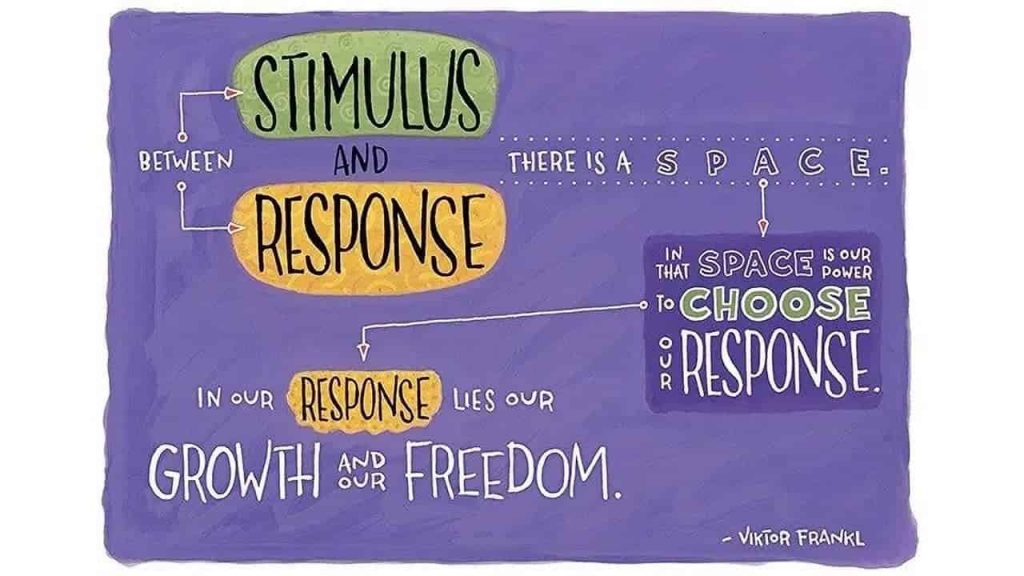
Take a moment to breathe between what someone says and how you respond. That brief pause can turn an impulsive argument into a meaningful dialog.
“Between stimulus and response there is a space. In that space is our power to choose our response. In our response lies our growth and our freedom.” – Viktor E. Frankl
10. Take responsibility for your mistakes.
Healthy dating requires two people who can admit when they have made mistakes.
You will occasionally say the wrong thing, forget something important, become defensive, or misunderstand your partner.
Taking responsibility does not mean accepting blame for everything.
It means being able to say:
- “I shouldn’t have spoken to you that way.”
- “I misunderstood what you meant.”
- “I was wrong.”
- “I’m sorry.”
A genuine apology also involves changing the behavior that caused the problem.
Research on close relationships suggests that relationship quality depends partly on how partners respond to each other over time. Responsiveness, care, and constructive responses to problems can contribute to healthier relationship processes.
You can also learn more about how to apologize and ask for forgiveness.
Healthy dating involves expressing your needs openly, handling differences safely and maturely, and making sure the relationship feels reciprocal.
What does relationship research tell us about healthy dating?
Relationship science reveals several patterns that contribute to relationship success or failure.
1. Perceived partner responsiveness
Perceived partner responsiveness is the sense of how much you feel your partner understands, values, and cares about your needs and goals.
People with more perceived partner responsiveness report better relationship quality. They feel closer, more satisfied, and more committed to their relationships. They say their partners can understand their point of view, validate their experience, and care about issues that matters to them.
Research strongly links perceived partner responsiveness with high relationship quality, intimacy, and commitment, and, through those, with long-term happiness and well-being (Canevello & Crocker, 2011).
2. Avoiding destructive conflict patterns
Gottman’s “Four Horsemen” of relationship destruction are four persistent communication patterns involving criticism, contempt, defensiveness, and/or stonewalling.
- Criticism: Trashing your partner’s character, personality, or intentions instead of addressing a specific behavior or problem. For example, “You’re so selfish” is criticism, while “I felt ignored when you interrupted me” focuses on the behavior.
- Contempt: Gottman described contempt as the most destructive of the four conflict patterns, as it communicates disgust, ridicule, mockery, or moral superiority. Examples include eye-rolling, sarcasm, insults, sneering, and statements such as “You’re pathetic,” all of which can make a partner feel belittled and disrespected.
- Defensiveness: Responding to a concern with excuses, counterstrikes, denial, or claims of victimhood rather than acknowledging your part in the problem. For example, “It’s not my fault. You’re always criticizing me” shifts responsibility instead of addressing the concern.
- Stonewalling: Withdrawing from the interaction by shutting down, refusing to respond, leaving without explanation, or acting as though the conversation does not matter. Taking a mutually agreed break to calm down is different from stonewalling, especially when the person returns to the discussion later.
When both partners see these toxic patterns and work to change them, the relationship may sustain. So the rule may be this: fight but don’t involve criticism, contempt, defensiveness, or stonewalling.
3. How to resolve conflicts
All couples experience conflict and disagreement. This is normal in close relationships. The factor that contributes most to relationship stability is how couples handle conflict.
- Start difficult conversations softly. The first three minutes of a conflict conversation predict the entire outcome. Use an I-statement structure: specific behavior + specific feeling + specific request. For example, “I feel overwhelmed when the dishes pile up. Could we figure out a system?”
- Accept Influence. It means allowing your partner’s perspective to genuinely change your mind when valid. Men who accept influence from their partners show significantly higher relationship satisfaction.
- Make and accept repair attempts. Repair attempts are moments during conflict when one partner tries to de-escalate through humor, affection, or acknowledgment. Successful couples make and accept these bids; struggling couples miss them.
- Compromise fairly. Each partner identifies core needs (which are non-negotiable) and flexible areas (which they can yield). Genuine compromise respects both people’s core needs.
4. Matching communication to the problem
Every conflict can or should be resolved in exactly the same way. Communication needs to fit both the problem and the people involved.
Some issues may require practical problem-solving, while others may call for empathy, reassurance, accountability, compromise, or simply an opportunity for each person to feel heard.
5. Commitment, appreciation, and satisfaction
Large-scale longitudinal research has found that perceived partner commitment, appreciation, intimacy-related satisfaction, partner satisfaction, and conflict are among the relationship-specific factors most strongly associated with relationship quality.
6. Emotional safety and relationship health
Findings suggest that a healthy relationship is one in which both people repeatedly experience respect, responsiveness, appreciation, commitment, and enough emotional safety to discuss differences honestly.
FAQs
1. Does healthy dating mean perfect dating?
No, healthy dating does not mean avoiding every problem or trying to have a perfect date. There can be awkward conversations or silences, misunderstandings, disappointments, and disagreements. There can be some insensitive points and some defensiveness. These moments do not mean that the date has gone unhealthy.
What matters is what happens next:
- Can both people listen?
- Can you repair the damage?
- Can you discuss the problem?
- Can you acknowledge your own part?
- Can you disagree without intimidation or contempt?
Healthy dating is more about developing ways to handle problems as reasonable adults without hurting each other.
2. Does healthy dating also mean keeping your own life?
A romantic relationship should not require you to abandon who you are beside the relationship. Both should be able to continue seeing friends, maintain their interests, take care of their health, and pursue their work and personal goals.
You can become deeply committed to someone while still remaining an individual. A healthy relationship involves both connection and autonomy. You should be able to experience closeness without feeling that you have surrendered your freedom or your entire identity.
3. What if you discover that you are incompatible?
Not every relationship should be saved. Sometimes you discover that your values, goals, personalities, or expectations are too different. A date gone unsuccessful does not necessarily mean either person is bad. A person can be kind, respectful, and emotionally healthy and still be the wrong partner for you.
For example, you may want marriage while the other person wants to remain single. One person may want children while the other does not. One may want to live abroad while the other wants to remain close to family.
These differences may not have a compromise that works for both people. So the idea is to recognize the unsolvable points of incompatibility rather than trying to force every relationship to succeed.
Final Words
Finally, healthy dating is not about finding or being a flawless partner. The main point is whether the two of you can build a relationship in which both people feel understood, respected, valued, and free to be themselves.
- Be curious. Listen carefully. Respect boundaries. Communicate openly.
- Give each other room to remain individuals. Learn to handle disagreements without mudsliging on each other’s characters.
- Take joy in discovering the diversities in each other’s lives, values, personalities, and goals. And when you make a mistake, take responsibility for it.
You’d do fine to remember that dating is a process of discovery. You are simply not going on a date to convince someone to choose you.
√ Also Read: 13 Signs of a Bad Date: Red Flags to Watch For
√ Please share this with someone.
» You deserve happiness! Choosing therapy could be your best decision.
...
• Disclosure: Buying via our links earns us a small commission.