
Today's Monday • 13 mins read
If you’ve ever left a narcissistic relationship and found yourself grieving something you can’t quite name, then this is for you. The grief is real, but the object of mourning is not the same as in a normal breakup.
Grief after separation from a normal person includes a lot of missing. You miss the person, their many little habits, and how they were woven into your routine. You even miss the sounds and smells.
That kind of grief, as painful as it is, makes sense. Your sorrow is for something real: the person and the life you once had together.
But grief after a narcissistic relationship works differently. You find yourself mourning moments that felt beautiful but empty.
Read on to find out why.
“Narcissistic grief” is the grief felt by a survivor after leaving a narcissistic relationship. The grief explored here is what narcissistic abuse victims experience, not how narcissists grieve.
Grieving A Past That Never Was
When you separate from narcissists, you miss a version of someone who may have never fully existed. You try to replay the good times with clarity, but you realize they were mostly unreal, built on a performance.
Psychologists sometimes call this “grieving a past that never was.” There is a clinical term for the broader category it falls into: ambiguous loss.
Psychologist Pauline Boss coined and developed the term into a full theory, defining ambiguous loss as a loss that remains unclear and unresolved, with no real possibility of closure (Boss, 1999).
She observed this grief among dementia caregivers: the person they care for is physically present but psychologically gone. The relationship they thought they had, the person they believed them to be, and the future they expected still occupy mental space.
So they are grieving something they cannot fully name, and that ambiguity is exactly what makes it so hard to move through.
The concept maps onto narcissistic relationships. It is one of the most disorienting parts of narcissistic abuse recovery, and it deserves an examination.
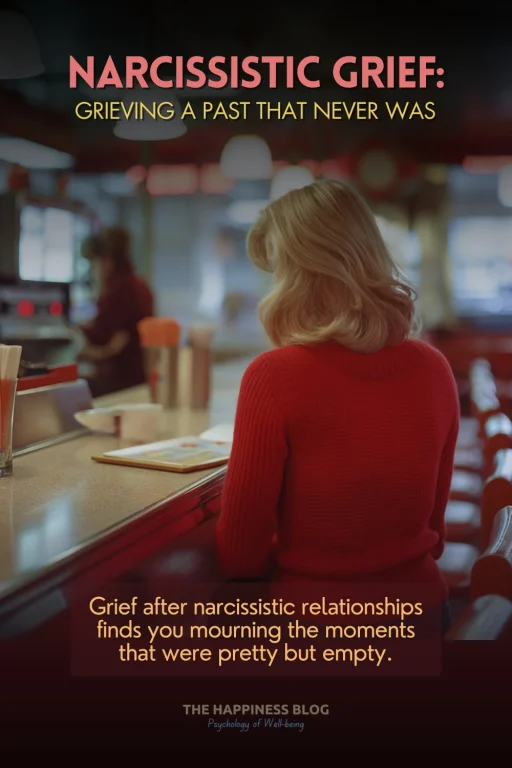
“You are not grieving the relationship as it was. You are grieving the relationship as it felt in its best moments.”
Narcissistic Relationships Start With A Flood of Good Feelings
To understand narcissistic grief, let’s go back to how these relationships begin. Narcissists typically open a relationship with an intense phase of attention, affection, and validation.
This is called love-bombing. They drench you with a steady stream of compliments, declarations of deep connection, grand gestures, and gifts. You get the sense that you have finally found someone who truly sees you (“soulmate”).
That experience is neurologically powerful. When you receive intense, consistent affection from someone, your brain releases dopamine, serotonin, and oxytocin.
- Dopamine is linked to pleasure, reward, and motivation
- Serotonin helps regulate mood, sleep, and cognition
- Oxytocin promotes social bonding and trust
Your brain begins to associate this person with safety and reward at a very deep level, often before you have had time to verify whether the connection is genuine.
Love-bombing also speeds up emotional bonding past the normal pace of trust-building. The relationship feels unusually intense and significant early on. That sense of intensity gets encoded as meaning.
Later, when the relationship deteriorates or ends, the brain actually mourns the intensity of those early months, which is still stored as something precious, not the recent version of the narcissist.
Then The Pattern Shifted, But You Stayed Hooked
The love bombing phase does not last. For narcissistic relationships, it tends to transition into something else: devaluation, inconsistency, emotional withdrawal, and intermittent moments of warmth.
The warmth, when it came, felt like getting back to the beginning. It gave you hope that the good version of the person was still in there.
This is where intermittent reinforcement gets important. Intermittent reinforcement is a conditioning pattern where rewards are given on an unpredictable schedule rather than a consistent one.
Research on dopamine has shown that the brain actually releases more dopamine in response to unpredictable rewards than to predictable ones (Carnell, 2012). The random nature of the kindness made it more neurologically potent, not less.
Put plainly, the occasional good day became more powerful than consistent good treatment would have been. Your brain learned to chase those moments. And when the relationship ended, it kept chasing them in memory.
Narcissistic people can create powerful trauma bonds. There’s an association between narcissistic partner traits and post-traumatic stress disorder (PTSD) symptoms specifically related to the relationship (Arabi, 2023). Both grandiose and vulnerable narcissistic traits were predictors of PTSD, with grandiose narcissism being the strongest. In other words, if you’re in a relationship with someone with narcissistic traits, there;s a high likelihood that you may develop PTSD. And that PTSD may be keeping you bonded to your narcissist.
The Science Behind Why You Could Not Just Leave
Understanding the grief also means understanding why the relationship was so hard to exit in the first place.
Dutton and Painter (1993) proposed that intermittent abuse produces a specific type of attachment they called traumatic bonding. Their research identified three components that make leaving feel psychologically impossible, even when the harm is clear.
- The first is what they called Core: the tendency to justify the abuser through cognitive distortions. The mind works hard to make sense of contradictory behavior. When someone alternates between warmth and cruelty, the brain searches for a frame that holds both. That frame usually involves minimizing the harm and amplifying the love.
- The second component is Damage: the ongoing psychological effects of the abuse itself, including eroded self-worth, chronic self-doubt, and difficulty trusting your own perceptions.
- The third is Love: specifically, the belief, often unconscious, that your emotional survival depends on maintaining the abuser’s affection. That belief is not irrational. It is a conditioned response to a relationship where affection was the primary source of relief from pain.
These three components work together to create an attachment that persists long after the relationship ends. The grief you feel is partly the dissolution of that attachment, which the nervous system experiences as a genuine threat to safety.
There is also a clinical dimension worth knowing about. The DSM-5-TR includes “Identity Disturbance due to Prolonged and Intense Coercive Persuasion” under its Other Specified Dissociative Disorder (OSDD) category.
A 2023 paper made the case that this OSDD specification should extend to coercive intimate partner relationships, arguing that trauma bonding in abusive relationships produces the same identity disturbances the DSM is describing (Doychak & Raghavan, 2023).
That argument has not yet become a settled clinical standard, but it points to something survivors often report: after a narcissistic relationship, you may find yourself questioning who you actually are, what you actually value, and whether your perceptions of the relationship were ever accurate.
That is a documented consequence of sustained psychological coercion often seen in extreme situations like cult indoctrination and political imprisonment.
Why The “Good Times” Feel So Real in Memory
One of the most confusing parts of narcissistic grief is how vivid the positive memories are.
You remember the trip you took together. That night, everything felt perfect. The way they looked at you in the early weeks. Those memories feel solid and real, and they are at the center of the grief.
Memory does not work like a recording, though. It is reconstructive, meaning the brain rebuilds memories each time they are accessed, and it tends to do so in ways that reduce internal conflict (Loftus, 1997).
Under emotional stress, people usually tend to recall the positive, especially when the pain of loss is high.
- The difficult moments get edited out or minimized.
- The good times get amplified.
For survivors of narcissistic relationships, this process is further complicated by the fact that some of those good moments may have been real in a limited sense.
The affection during love bombing triggered genuine neurochemical responses. The laughter was real laughter. The trips happened.
But those moments existed within a relationship structured around manipulation and control. The good feelings were real. The relationship they appeared to represent was not.
Dutton and Painter’s research on traumatic bonding showed that intermittent abuse and power imbalance strongly predict how strongly someone stays emotionally attached after leaving an abusive relationship. Even after six months, many still felt attached (Dutton & Painter, 1993).
Dutton & Painter’s (1993) test of traumatic bonding theory found that intermittent abuse and power imbalance were the strongest predictors of post-separation attachment, with relationship variables accounting for 55% of the variance in attachment six months after leaving. That is the core mechanism behind why the grief after separation is so persistent.
Narcissistic grief is a predictable outcome of how the relationship was structured.
What You Are Actually Grieving
When you dig into it, narcissistic grief tends to have several layers, and most of them have little to do with the person as they actually were.
- The first layer is grieving the person you thought they were.
During love bombing, you were presented with a version of someone attentive, special, and deeply connected to you. That person felt real. Losing them feels like a real loss, even if that version of them was largely a projection or performance.
- The second layer is grieving the relationship you thought you had.
You believed you were in something mutual. Something meaningful. Realizing the dynamic was structured around their needs, not shared ones, is a loss of the story you were telling yourself about your own life.
- The third layer is grieving the future you imagined.
Many people in narcissistic relationships hold on for a long time because they are waiting for the early version of the person to return. When the relationship ends, you lose not just the present but the future you were still hoping for.
However small, these losses are all real grief. What makes them confusing is that the object of the grief, the person, the relationship, and the future, was partly or largely a fake structure.
You are grieving the relationship as it felt in its best moments, not the whole relationship.
Grief after a narcissistic relationship often takes longer than grief after a healthy one. This is not a sign of weakness or excessive attachment. It reflects how deeply the trauma bond formed and how much neurological re-patterning recovery requires. Giving yourself more time is appropriate, not indulgent.
The Confusion of Mourning a Mirage
Survivors of narcissistic relationships commonly report symptoms consistent with post-traumatic stress, including intrusive thoughts, emotional flashbacks, and difficulty trusting their own perceptions (Arabi, 2023).
The grief exists alongside those symptoms, which makes it harder to process than ordinary relationship grief.
People outside the relationship often struggle to understand this grief. From the outside, it can look like you are pining for someone who treated you badly.
Friends may point out the harm. They may remind you of specific incidents. They mean well, but they are talking about the actual person, while you are grieving the imagined one.
Those are two different conversations. This disconnection can lead to significant shame.
You may feel you should be relieved it is over. You may wonder what is wrong with you for missing someone who caused you pain. The honest answer is that nothing is wrong with you.
The neurological and psychological mechanisms that create this kind of grief are well documented and not a matter of personal weakness. They are a predictable response to a specific type of relational conditioning.
How to Actually Move Through It
The most important shift in processing narcissistic grief is learning to separate the feelings from the facts. The feelings are valid data about your experience. But they are not reliable data about the person or the relationship.
You can grieve the loss of what it felt like while still holding an accurate picture of what it actually was.
A few things that genuinely help:
- Name what you are specifically grieving. The person? The early version of them? The future you planned? The version of yourself you were in the relationship? Getting specific interrupts the vague, amorphous pull of the grief and gives you something concrete to work with.
- Reconnect with the pattern, not just the peak moments. The brain in grief naturally goes toward the best memories. A journal, a conversation with a trusted friend, or even a simple list of what the relationship actually looked like over time can counterbalance that pull. This is not about building resentment. It is about accuracy.
- Understand the neurochemistry without using it as shame. Knowing that your attachment was partly driven by dopamine and intermittent reinforcement does not make your feelings less real. It does mean you can stop interpreting the grief as evidence that the relationship was worth returning to. The intensity of the grief reflects the intensity of the conditioning, not the quality of the relationship.
- Give the grief its time. Narcissistic grief tends to take longer than people expect, and trying to rush it usually makes it worse. Research found that even six months after leaving, attachment levels in trauma-bonded relationships remained noticeable (Dutton & Painter, 1993). That is normal. Working with a trauma-informed therapist during this period can make a meaningful difference.
If the grief is interfering with daily functioning, sleep, or your sense of self for an extended period, a therapist with experience in narcissistic abuse and trauma bonding is worth finding. This kind of grief often benefits from specific modalities, including EMDR and CBT, rather than general talk therapy alone.
Final Words
Grieving the loss of a narcissistic relationship is one of the strangest and harshest experiences one can go through.
It does not fit the normal template of loss, so it often goes unvalidated by the people around you, and sometimes even by yourself.
But the grief is legitimate. So, process your grief, even when you know what you are actually mourning is something that never was real.
√ Also Read: Co-Narcissism: When You Grow Up Under A Narcissistic Parent
√ Please share this with someone.
» You deserve happiness! Choosing therapy could be your best decision.
...
• Disclosure: Buying via our links earns us a small commission.