
Today's Saturday • 11 mins read
Cutting contact with a narcissistic person is a lot like going through a grief cycle. You lost someone you deeply invested in and cared about.
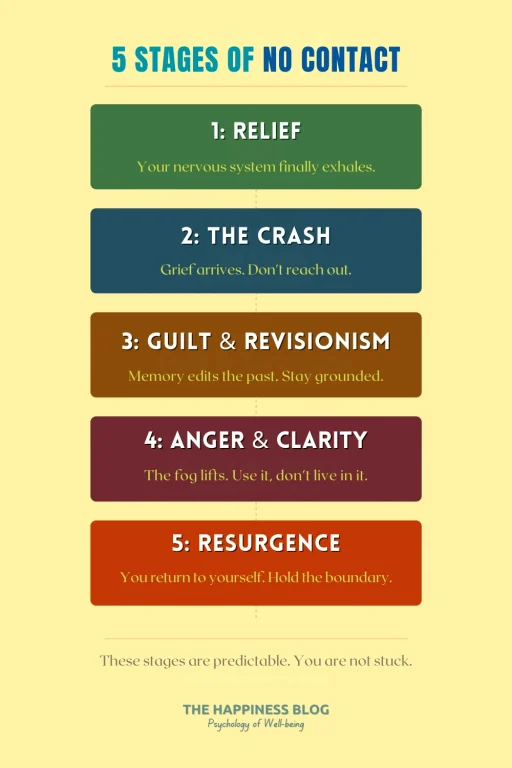
The aftermath mostly follows five predictable emotional stages. Knowing those stages can help make the experience more survivable, stay strong, and move on from the past.
No contact means you intentionally stop all communication with someone. No calls, no texts, no DMs. You block them on social media and may even step back from shared social circles.
No contact is one of the hardest decisions you can make. You’ve removed someone from your daily life. This someone probably shaped your routines, your habits, your sense of what a normal week is like.
What many don’t realize is that no contact unfolds in stages, and those stages are fairly predictable.
Yes, the stages won’t arrive on a neat schedule, and they won’t always move in a straight line. But they follow a recognizable pattern.
Knowing that pattern in advance means you’re less likely to mistake a hard phase for a sign you made the wrong choice.
5 Stages of No Contact With A Narcissist
They were woven into your Mondays and Saturdays. And now you are supposed to just leave it all alone.
Here’s what those five stages actually look like and what to do when you’re in each one.
1: Relief
This one surprises a lot of people, especially if the relationship ended badly.
In the first hours or days after cutting contact, many people feel something close to calm. The constant checking of phones stops. The bracing for the next argument or cold silence stops. Your nervous system finally gets a break that it probably didn’t know it needed.
Relief is real, and it is valid. It means you were under chronic stress, and that stress has lifted, at least for now. Your system no longer has to brace for the challenges in the relationship.
For people cutting contact specifically with a narcissist, this relief can be especially strong.
Narcissistic relationships tend to run on unpredictability and intermittent reinforcement. That keeps the other person in a state of low-grade hypervigilance that becomes normalized over time.
The calm you feel after leaving is your baseline self-regulation returning.
Let yourself feel it without treating it as a final verdict. Relief now does not mean you won’t grieve later. Use this window to sleep, eat properly, and stabilize your routines. The harder stages are coming, and a solid foundation now will matter.
2: The Crash
The relief does not last. At some point, usually within the first two weeks, the reality of absence sets in.
This is when grief arrives, and for a lot of people, it arrives hard. You might reach for your phone to share something funny, then remember. You might dream about them. You might feel a physical ache that is genuinely hard to tell apart from illness.
This is neurologically consistent with what happens during any significant loss. Attachment bonds activate the same brain systems involved in physical pain.
A widely cited fMRI study found that social rejection can feel a lot like physical pain; both affected the same areas of the brain (Eisenberger & Lieberman, 2003).
The loss is real, and the brain processes it accordingly.
The instinct at this stage is to reach out. To just check in. To send one message. Resisting that impulse is the entire job of stage two.
This is worth naming clearly for anyone going no contact with a narcissist. The crash is often mistaken for proof that the relationship was worth keeping. It is not.
The intensity of the grief usually reflects how much emotional energy the relationship consumed, not how healthy it was.
Name what you are feeling without dramatizing it. Write it down if that helps. Talk to someone who will stay grounded with you, not someone who will romanticize the relationship or nudge you toward breaking no contact.
“The instinct is to reach out. Resisting that impulse is the entire task of stage two coping.
3: Guilt and Revisionism
Stage three is where no contact most commonly fails. The acute grief of stage two softens slightly, and guilt moves into that quieter space.
You start revisiting the relationship, but your memory begins selectively editing out the difficult parts. You remember the good times with unusual clarity. You start wondering whether you overreacted, whether you were too harsh, whether they’ve changed.
This is a known cognitive pattern, not a personal weakness.
Human memory is reconstructive, and under emotional stress, we tend to bias toward recall that reduces internal conflict (Memory for a Past That Never Was, Elizabeth Loftus, 1997).
Idealizing the past is your brain’s attempt to resolve the pain of loss. It feels like insight. It is usually a distortion.
Guilt also gets misdirected here. You might feel guilty for hurting them, for moving on, or even for the relief you felt in stage one.
Some guilt is legitimate if you genuinely acted badly toward someone. Most of the guilt in stage three is a feeling, not a verdict.
This is especially true when the person you cut contact with is a narcissist.
Narcissistic people excel at inducing guilt as a control mechanism, and that conditioning does not simply disappear the moment you go no contact. The guilt you feel in stage three may be a learned response, not a reliable moral signal.
Go back to whatever record you kept of why you made this decision. A journal entry, a note to yourself, a conversation with a friend who was present. The goal is not to build a case against the other person. It is to stay anchored in reality when memory becomes unreliable.
4: Anger and Clarity
For some people, this stage comes before guilt. For others, it arrives after. Either way, it usually makes its presence felt sometime after no contact.
Anger gets a bad reputation in the context of breakups and estrangements, but within no contact, it often serves a real purpose. It is often the first time you see the relationship clearly, without significant distortion in either direction.
The anger can be clarifying in a way that the earlier stages are not. You are no longer romanticizing. You are out of the acute grief.
The fog lifts somewhat, making it easier to see what actually transpired. This stage also provides enough courage and resilience to keep an emotional distance.
You start redirecting energy back into your own life.
▪ Anger is widely recognized in psychology as a “secondary” emotion, meaning it often works as a protective, outward mask for more vulnerable, underlying, or “primary” emotions like fear, sadness, hurt, or shame.
▪ In those with insecure attachment styles, it acts as a defensive mechanism to help cope with feelings of abandonment, worthlessness, or helplessness.
There’s a risk of getting stuck in this stage. Sustained anger functions as a secondary attachment.
You are still organizing your emotional life around the other person, just with a different charge.
If you find yourself replaying issues on repeat, or building arguments in your head for conversations that will never happen, you’re stuck. That is rumination (overthinking), a cyclical loop of negative thinking.
Let the anger inform you without letting it become a permanent home. Redirect the energy it generates toward something concrete: a project, a habit, a goal you had deprioritized. The anger will tell you what you value and what you will not accept. Take that information and put it to use.

5: Resurgence
This final stage is less dramatic than the others, which is partly why people underestimate it. Resurgence is the period when you start to feel like yourself again.
Your attention is more forward-facing than backward. The absence stops being the loudest thing in the room. The loss does not disappear. It just finds a proportionate place.
Resurgence is also when no contact gets quietly challenged. An anniversary. A mutual friend’s event. Seeing their name pop up somewhere unexpectedly.
The progress you made in stages two through four can feel suddenly fragile when the person re-enters your peripheral vision. That is normal. It is not a sign that you haven’t healed.
For people who went no contact with a narcissist, this re-entry often takes a specific form: hoovering.
Hoovering is when the narcissist tries to pull former partners or family members back into contact. They typically send messages that invoke nostalgia, create urgency, or manufacture a crisis.
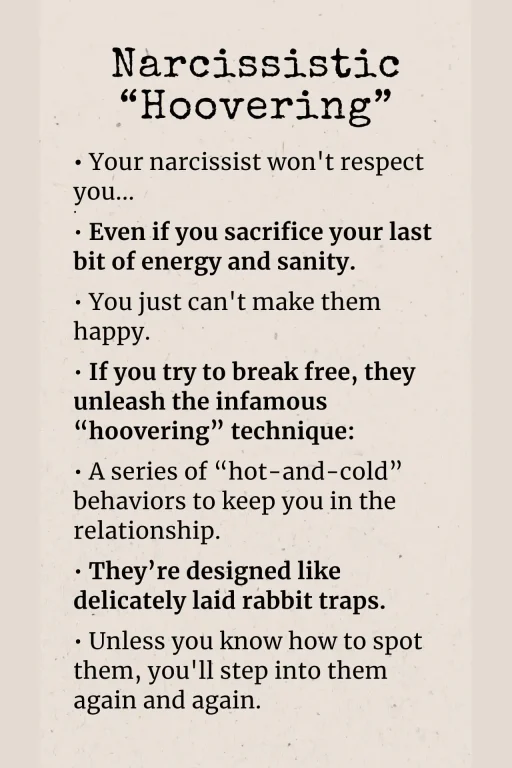
Your narcissist’s return to showering you with attention and love does not mean they will truly change who they are. It is a set pattern in narcissistic relationship cycles.
Nostalgia for what was good in the relationship is different from a signal to re-engage. People who genuinely thrive in stage five can hold both truths at once:
- that the relationship had real value, and
- that maintaining distance is still the right call.
Do not mistake the absence of acute pain for the absence of need for continued boundaries. Resurgence requires active maintenance, not passive coasting. Keep the structures you built in earlier stages. The emotional work that got you here does not need to be repeated daily, but abandoning it entirely is what sends people back to stage one.
Final Words
Even when it is the right call, leaving a relationship is genuinely stressful and depressing.
A study in PLOS ONE found that people who had a recent romantic breakup showed higher depression scores compared to people still in relationships, with over 26% reporting mild-to-severe symptoms (Verhallen & Renken, 2019).
No contact is not the easiest path. It’s just sometimes the only one that works.
One thing to remember: No Contact is a tool, and whether it’s appropriate depends on the situation:
- For relationships involving abuse or serious harm, the case for maintaining it is strong.
- For others, it may be a temporary reset.
When you’re stepping back from a narcissist, a toxic relationship, or someone who consistently causes harm, knowing the stages of No Contact helps you move through them with less self-doubt and more self-trust.
When you know what’s coming, you stop treating each hard phase as evidence of a mistake. That’s worth something.
√ Also Read: Co-Narcissism: When You Grow Up Under A Narcissistic Parent
√ Please share this with someone.
» You deserve happiness! Choosing therapy could be your best decision.
...
• Disclosure: Buying via our links earns us a small commission.