
Today's Tuesday • 8 mins read
The Last Meeting Theory says that when people have done this one thing, they vanish from your life. You don’t meet them again. So what are the real reasons?
You might see someone every day for months. Then one day, you don’t. You never do again.
The Last Meeting Theory claims this happens because relationships have expiration dates.
Each person you meet teaches you something. Once you learn that lesson, the universe stops arranging encounters between you.
You could live in the same city or even on the same street. You might shop at the same grocery store. But you won’t run into each other.
The theory suggests life operates like a classroom. People enter to teach specific lessons. They leave when those lessons end.
The Last Meeting Theory
The “last meeting theory” suggests that once two people have fulfilled their purpose in each other’s lives, the universe ensures they will never cross paths again, even if they share the same city, friends, or hangouts. Because the chapter is complete, and holding on would only keep you from your next beginning.
- It suggests that every relationship has a purpose (to teach, heal, or challenge), and once that goal is met, the connection naturally ends.
- The final meeting is often ordinary and unceremonious. It happens without a dramatic goodbye, any closure talk, or even a realization that it is the last time.
- Instead of a relationship failure, this separation should be seen as a necessary step for each person’s evolution and moving forward.
- There are no further encounters. The universe acts as a “gatekeeper,” preventing future meetings, often making it impossible to see that person again, even by chance.
- In a way, the last meeting theory is about finding your peace. When you’re dealing with the abrupt end of a relationship, this theory helps you accept that the “last meeting” was the final lesson.
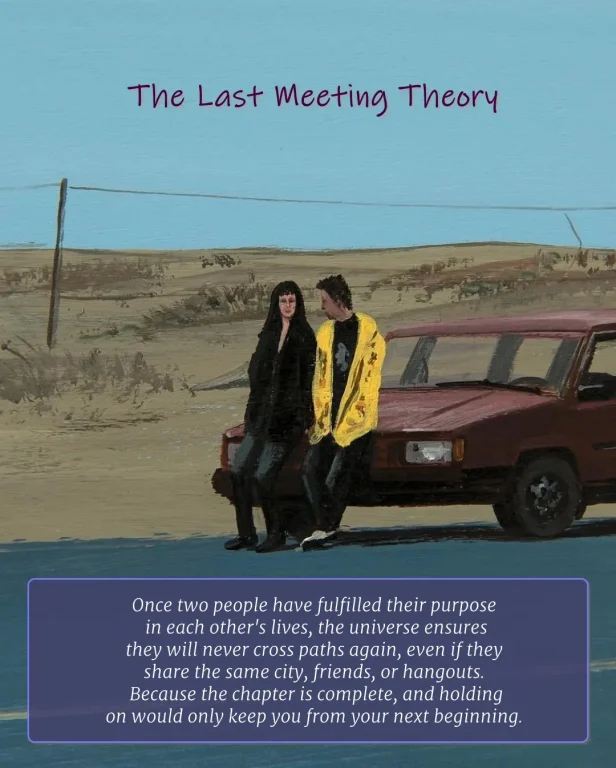
People share their stories of friendship or romance that suddenly faded without explanation after a last meeting. And they never met them or ran into them again, despite living in the same town.
The “theory” may seem psychological, but it is not found in any textbook. Still, the idea is so popular on social media (TikTok, Instagram) as a “psychological” way to find peace with abrupt relationship endings.
Actually, the last meeting theory helps turn a painful loss into a meaningful chapter.
How The Last Meeting Theory Works
The theory makes three claims.
- First, every person you meet serves a purpose. A classmate might show you how to stand up for yourself. A coach might teach you discipline. A friend might help you understand loyalty. The relationship exists to deliver that specific lesson.
- Second, once you learn what you need from someone, they exit your life. The timing feels deliberate. You stop getting their texts. They change lunch tables. They move away. You cross paths less often, then not at all.
- Third, this separation happens automatically. No one decides to end things. The universe handles it. You might want to stay connected. You might miss them. But circumstances keep you apart.

Real-Life Examples of The Last Meeting Theory
Think about elementary school friends. You spent years together. You knew their favorite snacks and their biggest fears. Then middle school started. Different classes. Different interests. You meant to hang out. You never did.
Or consider a mentor who helped you through a tough time. They gave great advice. They listened when you needed it. Then they changed jobs, or you moved on. The connection faded.
The theory says these weren’t accidents. You learned what you needed. The relationship completed its mission.
Appeal of The Last Meeting Theory
People like this theory because it makes sense of loss. Friendships end. Romantic relationships fall apart. Family members drift away. These experiences hurt.
The Last Meeting Theory transforms pain into purpose. This is almost poetic!
Your ex-best friend didn’t abandon you. You finished learning from each other. That person who ghosted you wasn’t cruel. The cosmic schedule moved you both forward.
This framework offers closure without confrontation. You don’t need an awkward conversation. You don’t need to understand what went wrong. The universe handled it.

5 Reasons The Last Meeting Theory Fails
The theory sounds neat. It has issues.
- First, it removes personal responsibility.
People make choices. Someone who stops texting you back made that decision. They weren’t puppets of cosmic forces. Blaming the universe lets people off the hook for their behavior.
- Second, it assumes all relationships have hidden purposes.
Sometimes people connect because they live near each other. Or they share a hobby. Or they sit next to each other in math class. Not every interaction carries deep meaning.
- Third, the theory can’t be tested.
How do you prove the universe orchestrates meetings? How do you measure when someone has learned their lesson? You can’t. This makes it a belief system, not a fact.
- Fourth, it ignores effort.
Relationships take work. Friends stay close because they call each other. They make plans. They show up. The theory suggests maintenance doesn’t matter. Connections either last or they don’t, regardless of what you do.
- Fifth, it can justify giving up.
Why try to repair a friendship if the universe decides when it ends? Why reach out to someone you miss if cosmic timing says you’re done?

What Actually Happens In Life
Research shows that proximity drives relationships [Festinger et al., 1950].
You become friends with people you see often. When circumstances change, relationships often fade. You graduate. You switch jobs. You move. Shared spaces disappear. So do easy opportunities to connect.
Life stages matter too. A friend who fits perfectly at age 13 might not fit at 16. Your interests shift. Your values change. This explains why some relationships end even when both people live nearby.
People also have limited capacity for relationships. You can’t maintain close connections with everyone you’ve ever met [Dunbar, 1992]. You prioritize. You invest time in some relationships and let others drift.
Sometimes people grow apart because they want different things. One person changes. The other stays the same. Neither is wrong. They’re just incompatible now.
The Middle Ground
You can appreciate what the theory gets right without accepting it completely.
Relationships do teach you things. A friend who betrayed you might have shown you what loyalty looks like by its absence. Someone who supported you during hard times taught you the value of showing up. These lessons are real.
Some connections do have natural endpoints. You learned what you needed. You gave what you could. Moving on makes sense.
But you control more than the theory suggests. You can reach out. You can make plans. You can decide which relationships matter enough to maintain. The universe doesn’t write the script. You do.
When Relationships End
Most relationships fade out. You text less often. Weeks pass between hangouts. The friendship doesn’t cut off sharply. It fades.
Some end suddenly, sure. The triggers could be an argument, a betrayal, or a big change. These hurt more because they lack the gradual buffer.
The Last Meeting Theory tries to soften both types of endings. It says every goodbye has meaning. That part feels true. People shape you. They leave marks.
But the theory goes too far when it removes human agency. You choose whether to fight for a relationship. You decide if someone deserves another chance. You control whether you reach out or stay silent.
What You Can Do
Pay attention to patterns. If someone consistently doesn’t respond, they’re showing you something. If you feel drained after spending time with them, that’s information. The universe isn’t sending messages. People are showing you who they are.
Decide which relationships deserve effort. Not every connection needs to last forever. Some people fit specific chapters of your life. That’s okay.
Don’t use cosmic explanations to avoid hard conversations. If a friendship matters, talk about what’s wrong. If you miss someone, tell them.
Accept that some relationships end even when you don’t want them to. This hurts. It’s normal. You don’t need a grand theory to explain it. People change. Circumstances shift. Life moves forward.
Final Words
The Last Meeting Theory offers a comforting story about why people leave. It makes randomness feel purposeful. It turns loss into a cosmic plan.
But real life is messier. People come and go for many reasons. Some relationships teach you crucial lessons. Others are just pleasant company. Some endings feel meaningful. Others feel pointless.
You don’t need the universe to arrange your connections. You meet people through proximity, shared interests, and chance. You keep them through effort, compatibility, and care.
When someone exits your life, you can look for lessons. You can honor what they taught you. You can recognize when a relationship has run its course.
Just don’t wait for cosmic intervention to fix what’s broken or to reunite you with someone you miss. If a relationship matters, you have to show up. You have to try. You have to choose it.
The universe might bring people into your life. But you decide whether they stay.
√ Also Read: 5 Types of People Who Can Ruin Your Life
√ Please share this with someone.
» You deserve happiness! Choosing therapy could be your best decision.
...
• Disclosure: Buying via our links earns us a small commission.