Today's Thursday • 8 mins read
— By Aditya Shukla & Dr. Sandip Roy
Positive emotions often seem irrelevant when you’re dealing with stress, dispute, or loneliness. Yet Barbara Fredrickson’s research shows they act as psychological nutrients.
They help you notice options that stress usually hides, and they gradually build strengths that keep you steady when life becomes unpredictable.
Positive emotions do not erase problems. They change how much room your mind has to handle them.
Fredrickson doesn’t promote toxic positivity. Instead, she encourages simple daily habits like focusing on what you can control, limiting negativity, and nurturing positive connections.
These shifts create an “upward spiral” of well-being.
As these moments add up, you start seeing more possibilities and feel more capable of taking action using your emotional, cognitive, and social resources.
“Cultivating positive emotions opens our minds and builds lasting resources.” —Barbara Fredrickson
Broaden And Build In Your Daily Life
The Broaden-and-Build Theory of Positive Emotions has four stages: positive emotions, broadening, building, and well-being.
A simple sequence:
A small positive emotion shifts your state ↠ It broadens your attention ↠ The broadened attention motivates you to build skills, insights, or connections ↠ These resources improve your long-term well-being.
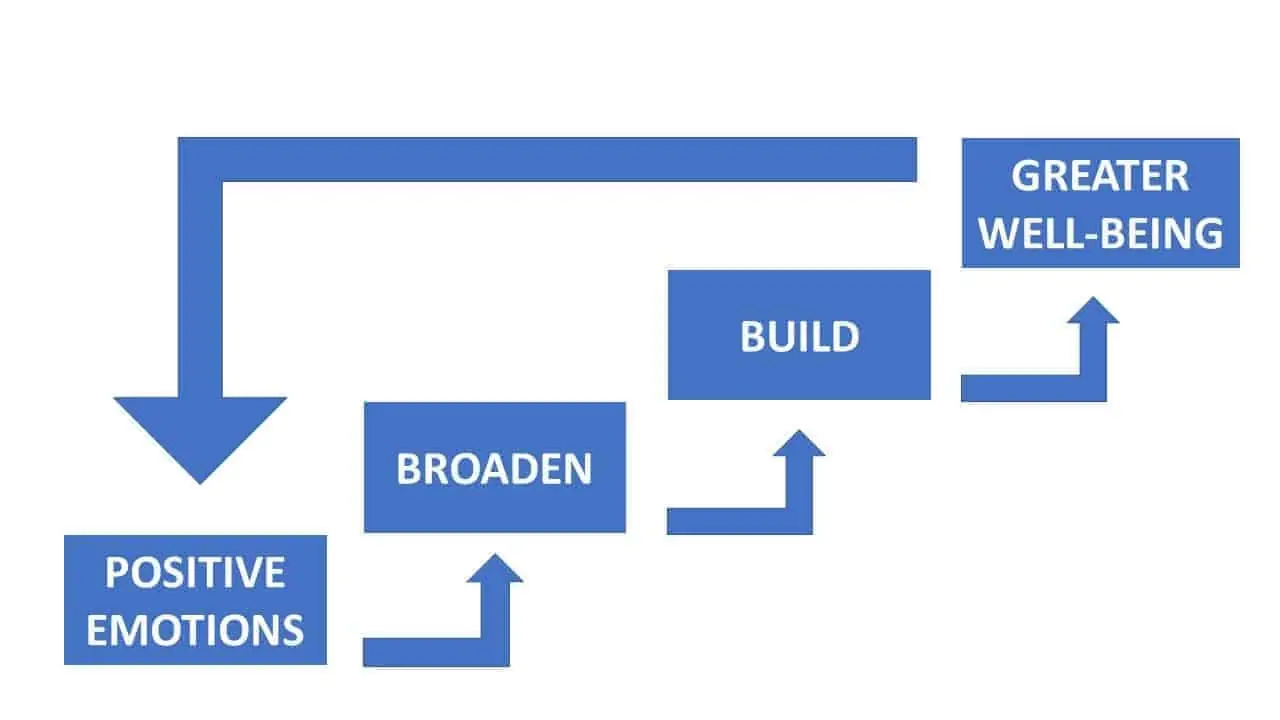
Fredrickson found that positive emotions of joy, interest, pride, contentment, and love broaden a person’s thought-action options and expand the range of responses that come to mind.
- Joy encourages play and creativity.
- Interest brings the urge to explore and take in new information.
- Pride motivates you to share your achievements and imagine greater goals.
- Contentment leads you to savor your current experience and integrate it into your sense of self.
- Love, in safe relationships, creates repeated urges to connect, explore, and enjoy shared experiences.
10 Ways To Reduce Everyday Stress Using Broaden And Build
Small shifts in your routine can interrupt the threat-focused tunnel vision created by chronic stress. Once your attention leaves threat mode, you notice more possibilities and choices.
Try these small habits to reduce your stress and restore your mental space.
1. Limit Crisis News
Protect your mental environment from avoidable stress. News and social media drain emotional resources quickly.
- Most news is negative because negativity sells. Keep your news intake to 5–10 minutes a day.
- Long, mindless scrolls expose you to social comparison and unsolvable uncertainty. Treat time limits as emotional hygiene.
2. Focus On The Controllable
Not everyone will behave as you would. Don’t spend mental space on that.
Shift your energy toward parts of your day you can influence.
This stops rumination from taking over. And turns worry into positive action and stabilizes your mood.
3. Embrace Balanced Productivity
You don’t need to stay busy every hour. Give yourself room to pause.
Boredom is not a failure of motivation. It signals your mind wants variation. Learn to tolerate boredom in small steps.
Stop constantly trying to perform at your best. Perfectionism keeps your system in threat mode. Learn to leave projects at good enough levels; you’ll be in better health.
4. Release Guilt of Not Knowing All
Drop the expectation to know everything. The pace of modern information is too much to keep up with.
Let go of the pressure to constantly acquire new skills. Simply managing daily life with steadiness is already a meaningful achievement.
When self-judgment drops, emotional space increases.
5. Tackle Your Loneliness
Many miss the hidden signs of loneliness. You can feel lonely even when surrounded by friends.
Loneliness heightens stress sensitivity, weakens resilience, and narrows attention. A single genuine interaction can reset your system.
Try a brief chat with a colleague, a check-in call, or shared laughter over coffee. Self-soothing rituals like a warm bath or a familiar playlist work too.
6. Move Your Body
Body movement fuels the upward spiral.
Any activity that raises your heart rate or loosens tight muscles releases brain chemicals that lift attention and mood.
Walks, stretching, and yoga help clear mental clutter and create a buffer against stress buildup.
7. Maintain The Basics
Protect the basics: 7–8 hours of sleep, healthy meals, hydration, light exercise, and a clean living space.
They stabilize your baseline well-being. When your baseline is solid, stress doesn’t overwhelm as easily.
8. Manage Conflict With Patience
Simple debates can quickly escalate under stress. Patience becomes easier when your mind has space, and broadened thinking helps keep conversations grounded.
When you’re not in threat mode, you can pause, listen, and respond without fueling dispute. You realize you don’t need to stress out to prove your point.
9. Reward Your Resilience
People often ignore their own endurance story. Celebrate your wins, however small.
They reinforce your belief that you can handle future challenges. This builds self-efficacy, one of the most reliable psychological resources within Broaden and Build.
10. Seek Help for Abuse and Toxicity
If your environment is chronically abusive, toxic, or unsafe, reach out for support. Broaden and Build helps with coping, but no one should stay in an emotionally dangerous situation without help.
A Simple Framework To Start Your Upward Spiral
You can apply Broaden-and-Build with a four-step sequence.
- First, identify one action that sparks a positive state. It could be sunlight on your balcony, a short walk, music, a warm drink, or a brief conversation. The spark does not need to be dramatic. It only needs to be genuine.
- Next, allow that small emotional shift to widen your thinking. You may feel ready to try a new recipe, adjust a routine, look for a helpful resource, or reach out to someone you trust.
- Then use that expanded mindset to build something small but stable. A little skill. A slightly healthier habit. A piece of knowledge. A supportive interaction. Each addition strengthens your resilience.
- Finally, pause for a moment of fulfillment. Recognize that you created this shift through deliberate action. This reinforces the spiral, making it easier to repeat.
How To Manage Your Anger With Broaden-and-Build
Anger narrows attention even faster than stress. When your body surges with adrenaline, your thinking becomes sharp but rigid. Broaden and Build helps by creating emotional pauses.
- A brief time-out interrupts the physical escalation. Freshening up with water, a change of clothes, or a stretch resets your physiology.
- 4–7–8 Breathing. Inhale for 4 seconds, hold for 7, exhale for 8. If that’s hard, reduce each by one second. Regulated breathing slows your heart rate enough to restore cognitive flexibility.
- 5–4–3–2–1 Grounding Technique. Notice 5 things you see, 4 you hear, 3 you touch, 2 you smell, 1 you taste. Sensory grounding pulls your mind back to the present, not the trigger.
- Music affects rhythm and mood regulation. Letting a song shift your body’s tempo often eases anger faster than effortful control.
- Avoid venting. Studies show venting anger makes us angrier (Bushman, 2002). Plus, there is a higher risk of cardiovascular events shortly after outbursts of anger (Mostofsky & Penner, 2014).
- Doing nothing at all is more effective than venting anger. Waiting out when feeling anger reduces its intensity and lets you see the real issue more accurately. Speaking 20–30 minutes later, with a calmer mind, leads to healthier outcomes.
- Movement, like dancing or brisk walking, releases muscle tension and helps the brain exit fight mode.
- Explore the emotions beneath the anger. Anger can hide underlying fear, shame, letdown, or rejection sensitivity. Naming the actual emotion reduces the urge to lash out.
- Reconnect with your values to decide how you want to show up in important relationships. This prevents downward spirals.
How Stress Shrinks Your Mental Space
Stress alters your cognitive style. It pushes your brain into tunnel vision.
You start missing information that could help you cope. You take things personally more often. You react faster than you intend.
All of that makes your world feel smaller and more threatening than it really is. This is why people report feeling stuck. The stuckness is psychological, not a character flaw.
You cannot think broadly while your body believes you are in danger. When the system calms down even slightly, your attention widens again.
That widening is the heart of Broaden and Build. It lets you see steps that felt unavailable before.
The theory also matches what many clinicians observe.
When someone lives under constant pressure or dispute, attention tightens. They slip into hypervigilance and keep scanning for danger. They lose flexibility and start interpreting small hurdles as major threats.
Broaden and Build interrupts this pattern by giving the mind brief moments of spaciousness. Over time, these moments strengthen personal resources that make future stress easier to manage.
Final Thoughts
Broaden and Build remains one of the most practical psychological frameworks for stress relief. It works because it focuses on small, repeatable moments that change how you think and respond.
When you create these moments regularly, you build a reservoir of emotional resources. That reservoir protects you from the psychological wear and tear of modern life.
You do not need dramatic breakthroughs. You need small experiences that expand your mind a little each day. With time, those experiences become resilience.
• • •
Author Bio: Aditya Shukla is an applied psychologist and the creator of Cognition Today, a website that explores the inner workings of the mind.
√ Also Read: How To Stop Being Narcissistic: 7 Behavior Changes
√ Please share this with someone.
» You deserve happiness! Choosing therapy could be your best decision.
...
• Disclosure: Buying via our links earns us a small commission.