Today's Saturday • 9 mins read
Emotional neglect is when you feel unloved in a relationship. You may not yet know it’s happening.
Psychologists define emotional neglect as the absence of acknowledgment or validation of your feelings. The consistent lack of emotional attunement, response, and support creates slow relationship damage.
What makes it destructive is its invisibility. It’s not always obvious until you learn to see the signs.
- Neglect is the conversation that never happened, the question that was never asked.
- Sometimes, it was when they said your feelings were overreactions.
- Or when they fulfilled your needs as if doing unavoidable duties.
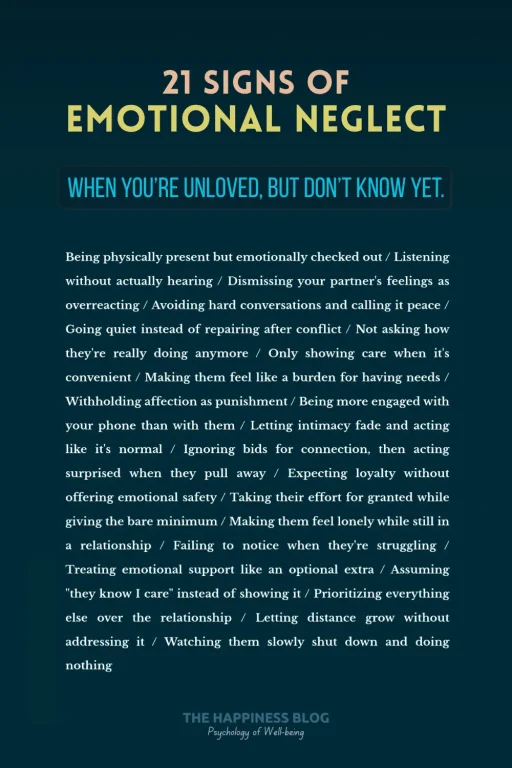
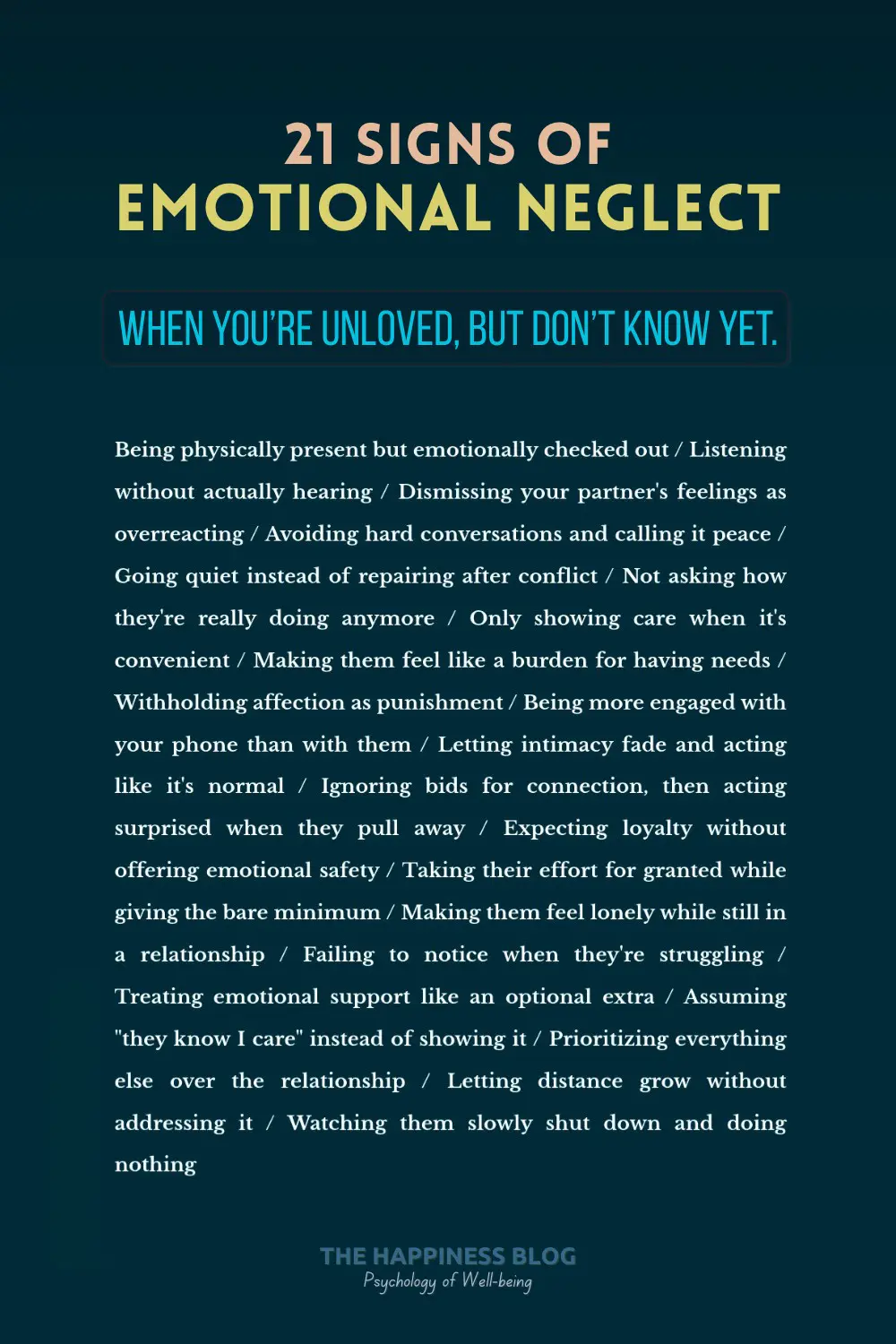
Here are 21 signs of emotional neglect in relationships:
1. Being physically present but emotionally checked out
This is the hallmark of emotional neglect. The body is there, but their mind, attention, and emotional self are unavailable.
You sit next to them, but it feels a thousand miles away. Their eyes glaze over when you speak.
You feel this distance when they don’t look up from their phone, even nod at the right moments, but absorb nothing.
It signals that your presence is not worthy of engagement. And creates profound loneliness.
2. Listening without actually hearing
Listening without hearing is passive listening, a form of emotional bypassing.
It makes you feel unheard and, consequently, unimportant. You share something meaningful and get silence or a distracted “uh-huh” in return.
Your words land nowhere. No questions follow. No curiosity surfaces about what you just shared.
Listening with hearing is active listening. “Hearing” means processing, validating, and responding to what a speaker is saying.
3. Dismissing your partner’s feelings as overreacting
You are sending a message to your partner that you don’t value their feelings, thoughts, or opinions if you constantly dismiss their feelings as overreactions.
It teaches the partner that their emotional compass is broken and that seeking comfort is unsafe. It’s a primary driver of emotional shutdown.
“You’re too sensitive” becomes a refrain. The dismissed partner learns to question their own perceptions. They begin apologizing for having feelings at all.
4. Avoiding hard conversations and calling it peace
This prioritizes superficial calm over genuine resolution and intimacy.
The “peace” is false and built on the suppressed needs and feelings of the partner, which will eventually breed resentment. Real issues get buried under forced pleasantness.
One person’s discomfort with conflict becomes the other’s mandate for silence. Problems, when pushed under, don’t disappear. They fester beneath the surface.
5. Going quiet instead of repairing after a dispute
The “repair attempt” is a critical predictor of relationship health.
After a fight, one partner reaches out. The other withdraws completely. Hours or days pass in cold silence.
Withholding repair is an act of emotional abandonment. Gray-rocking, silent treatment, and stonewalling are weapons that destroy closeness.
The message is, you’ve displeased me, so now you suffer. Learn to see it as neglect, not a quirk of their defensive nature.
6. Not asking how they’re really doing anymore
This shows a loss of curiosity and care. The baseline of check-ins has dropped, indicating the partner’s internal world is no longer a priority.
It’s a subtle signal of disengagement. The questions that once came naturally stop appearing.
“How are you really doing?” vanishes from conversations. Weeks pass without meaningful inquiry into their emotional state or daily struggles.
7. Only showing care when it’s convenient
Conditional care is unreliable care. It teaches the partner that their needs are an inconvenience, making them hesitant to express needs in the future.
Support appears only when it costs nothing. The partner learns to time their vulnerability around the other person’s mood and schedule.
They stop asking for help because the risk of rejection is too high.
8. Making them feel like a burden for having needs
This behavior is deeply damaging. Core attachment needs (for comfort, support, companionship) are framed as a character flaw.
The partner learns to hyper-independently suppress needs to maintain the relationship. Sighs and eye rolls greet your requests for connection.
“Do we have to talk about this now?” becomes standard. The partner shrinks their emotional world to fit the space allowed.
9. Withholding affection as punishment
This is neglect as well as abuse. Affection is turned from a gift of connection into a tool for control.
This directly weaponizes love and security, creating a foundation of fear and instability. Hugs, touch, and warmth disappear when behavior doesn’t meet standards.
The partner never knows when access to basic affection will be withdrawn next. They walk on eggshells to maintain a connection.
10. Being more engaged with your phone than with them
In the modern context, this is a ubiquitous form of micro-neglect. It consistently chooses a distraction over the human in front of you, devaluing them in real-time.
Eyes stay glued to screens during conversations. Notifications get immediate responses while the partner waits.
The message repeats constantly: this device matters more than you do.
11. Letting intimacy fade and acting like it’s normal
Intimacy requires maintenance. Passive acceptance of its decay signals a lack of investment and a failure to protect the relational bond.
Normalizing it gaslights the partner who feels the loss.
Physical closeness disappears. Emotional vulnerability stops happening. Shared experiences become rare. Then comes the claim: “This is just what happens in long-term relationships.”
But decay is often a choice, not a destined consequence.
12. Ignoring bids for connection, then acting surprised when they pull away
Based on Dr. John Gottman’s research, “bids” (a touch, a shared joke, a story) are fundamental units of emotional connection in relationships.
- What are bids? A bid is any attempt to connect, express a need, or get a response from a partner.
- Examples: Asking for help with a task, a nonverbal touch, sharing a thought, or even a sigh.
Responding to these bids with a “turning toward” (acknowledging and engaging) builds intimacy.
In contrast, consistently “turning away” (ignoring or brushing off the bid) or “turning against” (criticizing the bid) are among the best predictors of relationship failure.
Start noticing how your small attempts at connection get ignored scores of times. It may soften the shock when your partner stops trying completely.
13. Expecting loyalty without offering emotional safety
This is a contract violation. Loyalty is built on safety.
Expecting loyalty without providing emotional or psychological safety is like a feudal lord demanding obedience without offering any protection.
They expect you to always remain committed while giving no security in return. It’s exploitative.
Trust cannot form when the ground of emotional safety is constantly shifting.
14. Taking their effort for granted while giving the bare minimum
This behavior creates a deep-reaching power imbalance.
It communicates, “Your labor to maintain this relationship is expected and unremarkable, while mine is a generous favor.”
One person plans everything, initiates conversations, manages conflicts, and remembers important details. The other just shows up. The imbalance becomes the norm.
Over time, it builds resentment.
15. Making them feel lonely while still in a relationship
This is another core neglect. This is perhaps the most succinct definition of the outcome of chronic emotional neglect: relational loneliness.
It is more painful than being alone because it highlights the unmet promise of connection. You’re technically with someone but functionally isolated.
The person next to you can’t see your struggle or share your joy. You signed up for a partnership and got abandonment instead.
16. Failing to notice when they’re struggling
Emotional attunement is the ability to read a partner’s nonverbal cues. It is noticeably absent.
You feel invisible to your partner in your pain.
You’re drowning right there in front of someone who promised to care. Your face, efforts, and acts show distress. Your behavior changes. But nothing gets noticed.
The invisibility cuts deeper than the original problem. It is more isolating than the struggle itself.
17. Treating emotional support like an optional extra
This frames support as a bonus feature, not a core function of a relationship.
In normal, healthy relationships, emotional support is part of the default operating system, not an app that is optionally deletable.
Connection only exists as long as it’s easy. When real difficulty arrives, you face it alone.
In emotionally neglectful relationships, support is something offered when convenient.
The relationship reveals itself as transactional.
18. Assuming “they know I care” instead of showing it
Love is a verb. This assumption is the laziness of love.
It privileges the neglectful partner’s intention (“I feel it inside”) over the other partner’s lived experience (“I never see or feel it”).
Internal feelings stay internal. Actions never follow. The partner is asked to survive on promises while starving in reality. What matters is impact, not intention.
19. Prioritizing everything else over the relationship
The emotional needs are consistently placed at the bottom of the physics of the relationship.
Work, hobbies, friends, errands, and screens all come first. The relationship receives whatever energy remains.
This status of the least important priority destroys the relationship’s sense of primacy and security.
Time and attention are the currencies of care. Where they’re spent reveals what matters.
20. Letting distance grow without addressing it
Distance doesn’t “just happen”; it grows through inaction.
Failing to address it is a choice for disconnection over repair. It’s a passive relationship dissolution.
Two people don’t accidentally drift apart. They stop doing the work to stay close.
The gap widens week by week. Neither person names it happening, or fights against it. The end arrives slowly through a thousand moments of not trying.
21. Watching them slowly shut down and doing nothing
This is the Ultimate Neglect. This is witnessing the catastrophic result of all the points above.
This “zombie walking” phase of a relationship is where the partner’s spirit has given up, and they choose complicity through inaction.
It is profound abandonment. You see the light dim in their eyes. All connection attempts stop. Both go quiet and numb.
You watch it happen. You do nothing. This is the final betrayal.
Final Thoughts
Emotional neglect is a failure to meet a core human need for connection. It’s often chronic and always invisible.
Each sign above represents a failure to provide necessary emotional nutrients. The damage is insidious: nothing to point to, no clear transgression. Just a slow accumulation of absence where presence should exist.
Recognition matters. You can’t address what you can’t name. Understanding these patterns is the first step toward emotional health, whether through repair or departure.
√ Also Read: 10 Toxic Behavior Patterns In A Narcissistic Family
√ Please share this with someone.
» You deserve happiness! Choosing therapy could be your best decision.
...
• Disclosure: Buying via our links earns us a small commission.