
Today's Sunday • 8 mins read
— By Dr. Sandip Roy.
The gray-rock method is a quietly powerful way to maintain your calm when you’re with a manipulative partner, especially if they have more power, like a narcissistic husband.
It also works in any relationship where you don’t have as much power, like a controlling spouse, partner, friend, coworker, or professional contact. Done right, it protects your psychological safety.
The phrase “gray rock” was first used by a writer named Skylar in a 2012 post called “The Gray Rock Method of Dealing With Psychopaths.” Skylar said that “psychopaths are addicted to drama and can’t stand to be bored,” and they would lose interest if a victim became “as unresponsive as a rock.”
Gray-rocking is not a formally studied therapy technique, but many abuse survivors and some therapists say it is an effective coping strategy to deal with people who are manipulative and abusive.
So what is gray-rocking, and how do you make it work the best?
What is the gray rock method?
Gray rocking means acting like a gray-colored stone that doesn’t react to anything said or done to it.
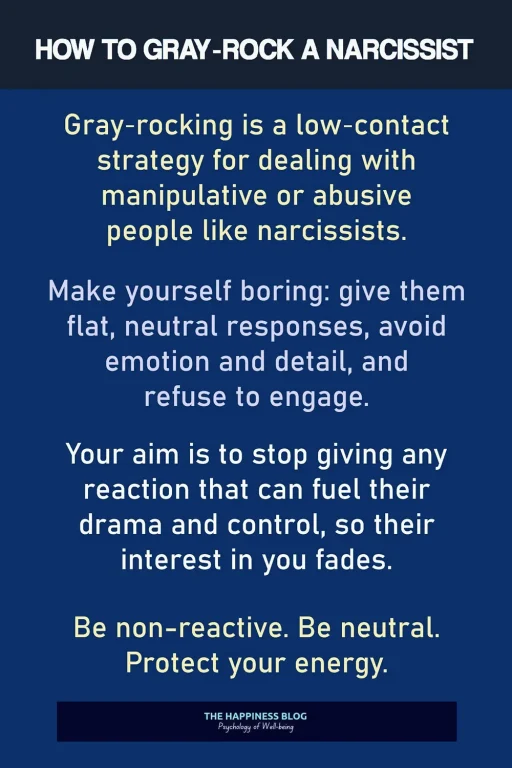
- It is a low‑contact strategy for dealing with manipulative or abusive people like narcissists.
- Make yourself boring: give flat, neutral responses, avoid emotion and detail, and refuse to engage.
- You aim to stop giving reactions that fuel their drama and control so that their interest in you fades.
Gray‑rocking removes the drama. You simply refuse to give them the reaction they’re looking for.
The gray‑rock method mainly discourages toxic people from engaging. You avoid eye contact, keep a neutral “flat” face, and reply with the shortest, bland answers until they lose interest.
Gray‑rocking is also a subtle defensive signal. You show you’re unaffected by their behavior without arguing or apologizing, which helps protect your boundaries.
How To Gray Rock Your Narcissist Husband (And Other Manipulative People)
You may use the gray rock technique on drama-seeking narcissists, such as your spouse, parent, or other family member.
Here is how to gray rock anyone:
1. Show no emotions.
First rule: Project an emotionless face; no anger, surprise, or distress. Simply a stoic expression.
Let the narcissist think, “I was expecting her to scream and shout, but she’s simply sitting there, stone-faced.”
Avoid interacting with them unless you have to.
And when you have to interact with them, keep your interactions matter-of-fact and emotion-free. Stay impersonal and don’t let your voice or face reveal your feelings.
Keep your responses purely transactional and steer clear of stray talks.
Give one-word replies, like “Yes,” “No,” or “Okay.”
Even when they talk excitedly or yell at you, refrain from showing any emotional reaction.
Observe in the mirror how you appear when you feel anxious, fearful, depressed, or frustrated, and then try putting on a deadpan expression.
Practice how to switch from expressive to emotionless in a matter of seconds.

2. Close your posture.
Never project to the narcissist a low level of power through your body language.
Studies show that low-power persons act in more inhibited and indirect ways, and report more self-conscious and anxiety-related emotions.
Research found anxiety reduces your perceived ability to act and induces withdrawal behaviors. So, when you are anxious, you lose some of your ability to act and tend to retreat.
A tense body posture may trigger negative feelings in you, such as anxiety and fear.
So, don’t stand scared stiff before the narcissist, as it can actually make you less capable and less willing to act.
Rather, exude authority and gravity in your stance.
Don’t fidget or make any sudden gestures of wincing or turning away. Maintain a steady closed stance, arms across your torso, and listen to them uninterested.

3. Don’t look them in the eyes.
Looking into an angry narcissist’s eyes can evoke instant fear, even before you realize it.
Fox & Lester’s research showed that our brains can rapidly and efficiently detect angry facial expressions.
This study found that looking into the eyes of others strongly activates the amygdala, the brain part linked to emotion, punishment, reward, and attention.
Once your narcissist sees the fright in your eyes and senses you are losing your nerves, they will intensify their yelling and gesturing to subdue you, and then make you obey them.
Moreover, narcissists are charming with their eyes and facial mannerisms. They can entice you in seconds, especially if they know what expression of theirs gets you floored.
So, look away from them, away to a side wall, or down toward the floor.
- Interesting fact: Peering into the eyes of children with Autism Spectrum Disorder (ASD) triggers a strong fear response. If a child has a higher amygdala volume at age 3, it predicts poorer social adjustment at age 6 (Lieberman, 2013).
4. Detach your mind.
Gray rocking is not suppressing your emotions.
It is detaching yourself so much from the situation that their words stop making sense and are therefore incapable of drawing any reaction.
Pull up interesting memories, let your mind wander to interesting places, or imagine funny things like they are donkeys who are braying incoherently.
This is where the stage of psychological detachment begins.
5. Tell them you have a task.
Calmly ask them a few times if they are finished so that you can go on to “another important task.”
Be careful to have thought out a specific task because they will most likely ask you about it.
Asking them if they have finished so that you can attend to a pressing matter might be helpful. It may be safe to say, “If you’re done, I can use the restroom urgently.”
6. Leave at the first chance.
Your entire arsenal of apathy and aloofness bores them. It makes them think or utter, “It’s no use wasting my breath on her. She just does not understand what I am saying.”
That is your moment of escape and victory. Be four steps away before finishing your “Okay, I am leaving now.”
Narcissists are experts at turning the argument and making you feel like you are the wrong one. You must know how to correctly argue with a narcissist.
7. Use it only temporarily.
Gray rocking is a short-term tactic. You cannot do it all the time.
Ideally, its ultimate goal is to give you a few breaks so that you find a more permanent solution.
Repeated gray rocking may cause your narcissist husband’s rage to rise to vicious levels.
Remember, they do not have the empathy to realize that your gray rock method is to get them to change their behavior. They are unlikely to change without professional counseling.
The best and most permanent method to deal with a narcissist is to go “No Contact.”
How Narcissists React When You Gray‑Rock Them
The idea behind gray‑rocking a narcissist is to give them the attention and control they crave, but at such flat, meaningless levels that it becomes unrewarding.
Common reactions you may see:
- Anger: They get furious that you won’t respond to their attempts to engage.
- Provocation: They may fling verbal insults or try petty provocations to draw you out.
- Escalation to drama: If provocation fails, they might intensify dramatics or attempts to shame you.
- Silent treatment/ghosting: They may go silent or disappear from your life to punish or unsettle you.
- Withdrawal: Eventually, most narcissists lose interest and stop trying to engage you further, or they move on to find someone else.
Actually, what narcissists are using on you is reactive abuse.
When To “Not” Use The Gray Rock Strategy?
Avoid gray‑rocking when the person is physically stronger, openly aggressive, or consistently hostile toward others.
If they hold significant power over you, whether physical, social, financial, or political, gray‑rocking can be dangerous: a frustrated narcissist may escalate to threats, verbal insults, or physical force in retaliation.
Some covert narcissists may flip the tactic, using quiet withdrawal to unsettle a codependent partner, so never rely on gray‑rocking alone. Pair it with clear boundaries, a safety plan, and outside support.
Gray‑rocking may discourage some abusers, but it doesn’t work for everyone. If you feel at risk, prioritize immediate safety: remove yourself from the situation, get to a safe place, or seek help from authorities or trusted people rather than attempting to gray‑rock.
Final Words
The core aim of gray‑rocking is to remove the reaction they feed on. You want to disengage the narcissist without triggering their anger or stepping into a conflict.
Is it the right thing to do? Yes, because pushing away someone who keeps you constantly under the fear of their wrath is ultimately an act of self-love.
The best advice is to spot the narcissist from a distance, avoid getting too close to them, and leave them, even when you have no money.
Get professional help to rebuild your courage and decisiveness. Use the gray rock method to stay safe until you can leave them.
• • •
√ Also Read: What Is Trauma Bonding With A Narcissist (How To Break It)?
√ Please share it with someone if you found this helpful.
» You deserve happiness! Choosing therapy could be your best decision.
...
• Disclosure: Buying via our links earns us a small commission.