
Today's Thursday • 10 mins read
Forgiving your narcissistic mother seems impossible. It would release her from any responsibility for the scars she has left on you.
More so, because it wasn’t your fault. You didn’t ask to be raised by a narcissistic mother. You didn’t want to be taught that you’d be loved for what you do for her, not just because you exist.
It wasn’t your choice to grow up feeling that other people’s needs mattered more than your own. Nor did you choose the childhood criticism to later become a self-critical inner voice.
After carrying the weight of her judgment for so many years, you often question if you’ll ever be able to forgive her.
But forgiveness isn’t about excusing or forgetting what she did. It’s about you. It’s about quieting her critical voice, finding peace, and reclaiming your power and priorities.
So, what your narcissistic mother might have done to you that forgiving her seems so difficult?
How A Narcissistic Mother May Have Hurt You
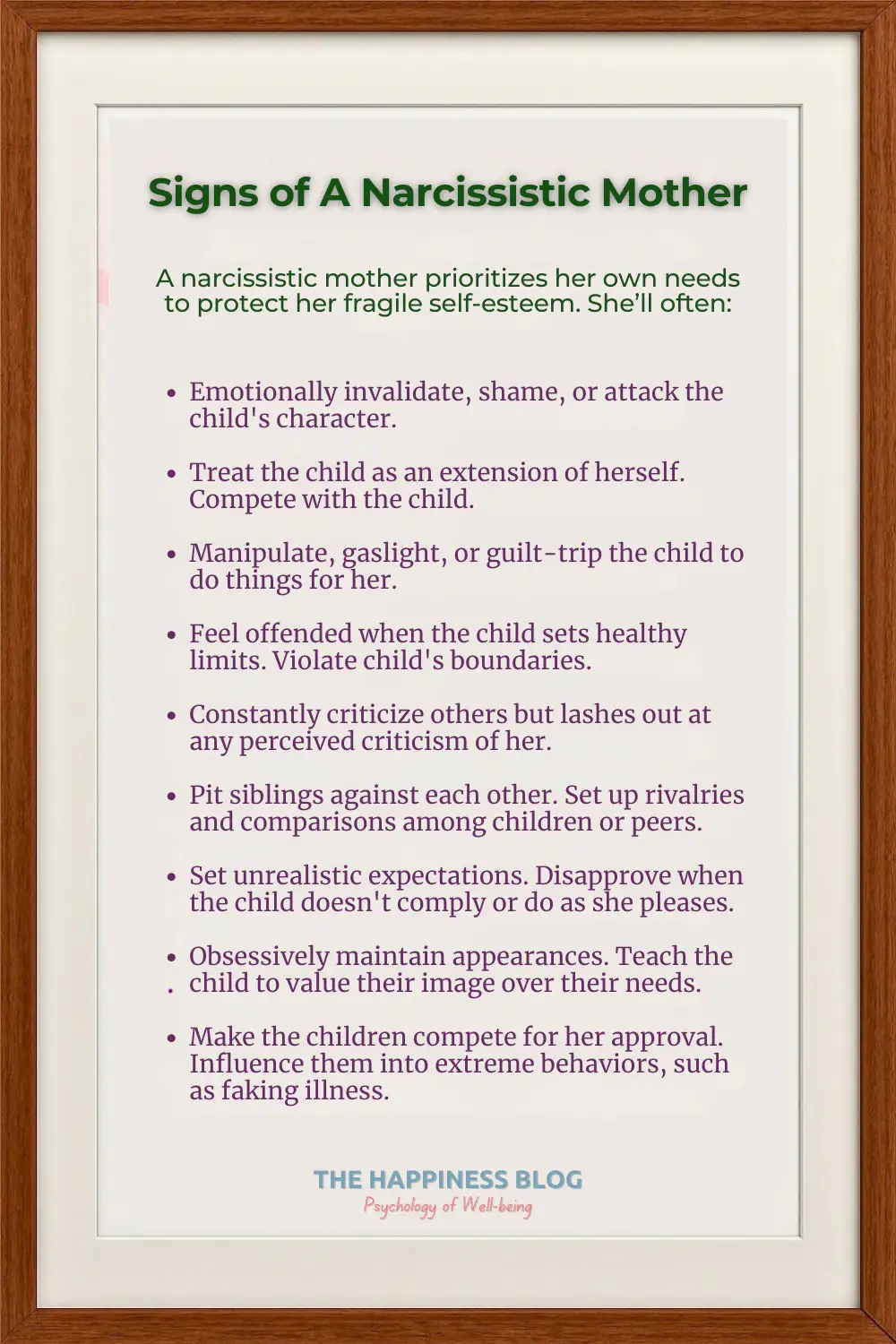
A narcissistic mother raises you in a world where your needs and emotions come second. She trains you to read and predict her moods to avoid getting punished.
The hurts keep hurting even when you move out or grow up, or she passes away. You struggle to break free from your dysfunctional patterns, whether at work, in your friendships, in romantic relationships, or, most painfully, in your relationship with yourself.
- Your sense of self-care gets twisted. When a mother consistently prioritizes her ego over your emotional needs, you learn that your feelings don’t matter. You become an extension of her. You learn that you exist to validate and please her first, often sacrificing your own needs.
- Your relationships suffer. The blueprint for relationships you learned at home wasn’t healthy. Since you had no time to grow into your own person, you struggle with boundaries and react in opposite ways. You let anyone barge into your personal space, or block out even the most supportive ones. You constantly seek approval from others, or push them away before they can hurt you.
- Your inner voice turns cruel. That voice in your head that says you’re not good enough is often her voice, internalized. Years of criticism, invalidation, and conditional acceptance create a harsh inner critic that doesn’t quit when she’s not around.
- Guilt became your default emotion. Narcissistic mothers are experts at making their children feel responsible for their happiness. This is called parentification, where the child assumes the role of a parent of their actual parent. You learned to feel guilty for loving yourself, having needs, setting boundaries, and simply existing as a separate person.
The damage runs deep, so how can you forgive her?
How To Forgive Your Narcissistic Mother
Start by accepting that what happened to you wasn’t normal, and it wasn’t your fault.
1. Process The Hurts Your Narcissistic Mother Gave You
Face your fears. You can’t forgive what you are trying to avoid or escape. Look directly at your struggles and experiences.
Try these ways: writing, mindfulness, and supportive people.
• Write It Out.
Journaling creates a safe space to explore emotions you might have suppressed for years.
Write letters about your experiences that you send to no one, or burn after writing. List every instance of hurt you remember. Describe the feelings you weren’t allowed to have as a child.
Don’t edit yourself. Don’t try to make it pretty. Let the anger, sadness, and confusion pour onto the page.
Trauma journaling and expressive writing have proven positive effects. They let you untangle and address your thoughts about the issue and release pressure that’s been building for decades.
• Practice Mindfulness
Mindfulness lets you be a nonjudgmental observer of your thoughts and feelings.
It anchors you in the present, away from past hurts or future anxieties. A mindful mind observes the emotions when memories surface or old triggers activate, without being consumed by them.
Simple mindful practices: deep breathing when anxiety spikes, body scan meditation to release tension, vagus nerve stimulation to quiet the critical inner voice.
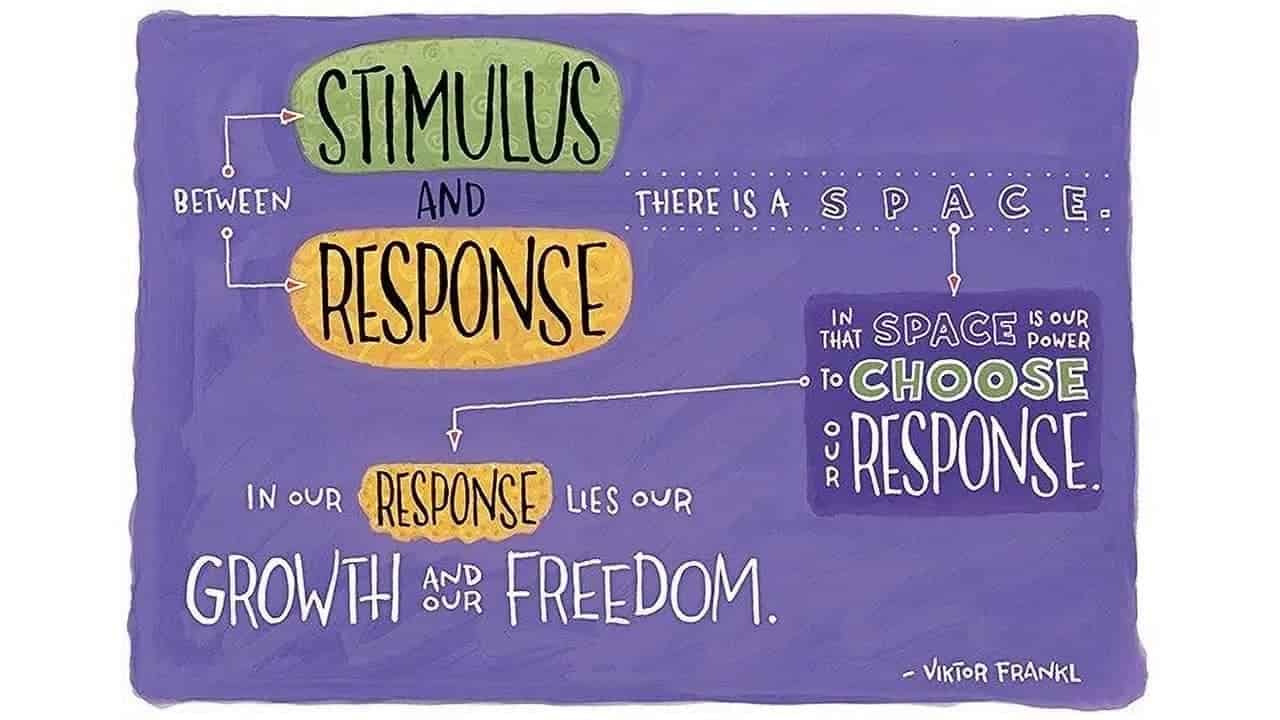
Mindfulness, as the Holocaust survivor psychiatrist Viktor Frankl said, lets you create a space between stimulus and response.
• Get Outside Support
Join a narcissist survivor group. They can suggest lived ways to get past your hurt. They can lead you to the therapists who have treated those coming from narcissistic family systems.
A therapist who understands narcissistic abuse can help you process trauma in ways you can’t do alone. They share with you the tools for rewiring the patterns and perspectives you learned in childhood.
Cognitive-behavioral therapy (CBT) helps challenge the distorted thoughts narcissistic parenting instills. Trauma-focused therapy addresses the deeper wounds.
2. Preparing Yourself To Forgive Her
Forgiveness isn’t a light switch you flip. It’s a process that requires preparation.
• Understand The Why Behind Her Behavior
Your mother’s narcissism may have been generational. She might have developed them from her own deep wounds, insecurities, and possible mental health issues.
Understanding the root causes of her behavior does not excuse it. Rather, it lets you make a firm decision: the generational transfer of narcissism ends with you.
She treated you the way she did because of her limitations, not because of your inadequacies. Her incapacity for empathy reflects her brokenness, not your unworthiness.
This knowledge shifts the narrative from “What’s wrong with me?” to “What’s wrong with her capacity to parent?”

• Set Firm Boundaries With Her
You cannot forgive someone who continues to hurt you. Set the seven relationship boundaries with your narcissistic mother.
Decide what contact feels safe for you:
- Limited contact with strict rules about acceptable behavior
- Low contact with only necessary communication
- No contact if the relationship remains toxic
Communicate your boundaries clearly. Expect pushback. Narcissists don’t respect boundaries because boundaries limit their control. Enforce consequences when boundaries are violated.
• Rebuild Your Relationship with Yourself
Years of narcissistic parenting damage your self-concept. Rebuilding starts with small acts of self-care and self-love.
Challenge the critical voice. When it says, “You’re not good enough,” ask yourself, “Is that true, or is that her voice?”
Replace criticism with compassion. Celebrate small wins. Practice positive affirmations even when they feel fake at first.
Treat yourself the way you wish a normal mother would have treated you. Nurture the parts of you that she neglected. Give yourself permission to have needs, feelings, and boundaries.
Your relationship with yourself is the foundation for everything else.
3. The Forgiveness Process
Forgiveness doesn’t require reconciliation. You can forgive from a distance, even from no contact.
When you’re ready, forgiveness unfolds in stages.
• Acknowledge the Full Impact
List everything her narcissism cost you: the childhood you didn’t have, the confidence you lost, the relationships that suffered, the years spent trying to earn love that was never freely given.
See it clearly. Feel it fully. Don’t minimize or rationalize.
• Grieve What You Didn’t Receive
You deserved a mother who saw you, celebrated you, and loved you unconditionally. You didn’t get that. That loss deserves grief.
Mourn the mother you needed but never had. Mourn the childhood that could have been. Grieve the relationship you’ll never have with her, even if she’s still alive.
Grief isn’t weakness. It’s recognition that something valuable was missing.
• Choose to Release
After acknowledging and grieving, you reach a choice point: continue carrying this, or set it down.
Forgiveness is choosing to set it down.
Say it out loud or write it: “I forgive you, not because you deserve it, but because I deserve peace. I release my anger because holding it hurts me. I accept that you are who you are, and I choose to be free.”
This moment isn’t dramatic. It might not feel like much at first. Forgiveness often arrives quietly, like a weight you didn’t realize you were carrying until it’s gone.
• Expect Waves, Not Finality
Forgiveness isn’t permanent the first time you reach it. Anger and hurt will resurface, especially when triggered by interactions with her or situations that echo childhood dynamics.
Each time, you choose again. Forgiveness is a practice, not a destination.
Be patient with yourself. Healing isn’t linear. Some days you’ll feel free. Other days you’ll feel stuck. Both are part of the process.
4. Building Your Life After Forgiveness
Forgiveness opens space for something new.
• Cultivate Healthier Relationships
Now that you understand narcissistic patterns, you can spot them in others. Choose relationships based on mutual respect, emotional safety, and genuine reciprocity.
Watch for red flags: people who violate boundaries, demand constant attention, lack empathy, or make everything about them. You don’t have to accept these dynamics anymore.
Surround yourself with people who see your worth, celebrate your growth, and support your healing.
• Rewrite Your Story
You’re not defined by what your mother did or failed to do. You’re the author of your life moving forward.
Define yourself by your values, your choices, your strengths. Build the life you want, not the life she told you you deserved.
The narrative shifts from “damaged daughter of a narcissist” to “survivor who chose healing” to simply “person living their life.”
• Accept Imperfect Progress
Some days you’ll feel ready to take on the world. On other days, you’ll notice the old patterns of self-criticism creeping back in. That’s okay.
Healing isn’t about achieving perfection, nor does it happen linearly. All that matters is that you’re making progress.
Forgive yourself for the setbacks. Celebrate the victories. Keep moving forward, even when the steps are small.
Your Peace Doesn’t Require Her Approval
The hardest truth: your mother may never acknowledge what she did. She may never apologize, change, or even recognize that there’s a problem.
Forgiveness means accepting that reality without letting it stop your healing.
Your peace exists independent of her awareness or validation. You don’t need her to admit the truth for it to be true. You don’t need her blessing to forgive her.
This is your journey, your healing, your freedom. She doesn’t get a vote on it anymore.
Final Words: Why Forgiveness Matters For Healing
Forgiving a narcissistic mother is extremely hard.
You can’t forgive her, as you think it will erase the harm she did, redeem her from her sins, and allow her back into your life. But forgiveness is not that.
Forgiveness is choosing your peace over your anger, releasing your resentment, and accepting that you cannot change the past by carrying it with you.
Forgiveness is an internal shift. It’s when you decide to no longer hold onto your anger and bitterness. You choose a peaceful future over a painful past.
You forgive her for yourself, not for her. She doesn’t even need to know about it. She doesn’t need to earn it. She doesn’t need to apologize first.
The anger is valid. The hurt is real. But carrying it indefinitely means she’s still controlling your life. Forgiving means you’re not letting the hurtful person occupy rent-free space in your mind anymore.
√ Also Read: Narcissistic Triangulation: 10 Examples To Understand It
√ Please share this with someone.
» You deserve happiness! Choosing therapy could be your best decision.
...
• Disclosure: Buying via our links earns us a small commission.
