Today's Tuesday • 7 mins read
The Serenity Prayer is a famous prayer many people use to find peace and inner strength. For those who don’t practice any religion, traditional faith, or belief system, there is an atheist version.
This version of the Serenity Prayer, with no reference to God or a higher power, can be used by:
- atheists (people who don’t believe in God)
- agnostics (those who do not believe in religion or deities)
- secularists (people who don’t follow any religious traditions)
- pantheists (people who see the divine as the sum of all matter, energy, and natural laws)
- indigenous belief systems (ancient spiritual traditions deeply tied to specific geographies, communities, and localized ecology)
By definition, a prayer is a hope or belief that something can or will happen. So even when you’re not into religion or faith, practicing this powerful prayer can help you feel more peaceful and confident when going through tough or confusing situations.
Many therapists recommend it to people dealing with stress and having trouble taking action.
Serenity Prayer For Atheists, Non-Religious, And Seculars
“May I have the serenity to accept the things I cannot change,
the courage to change the things I can,
and the wisdom to know the difference.”
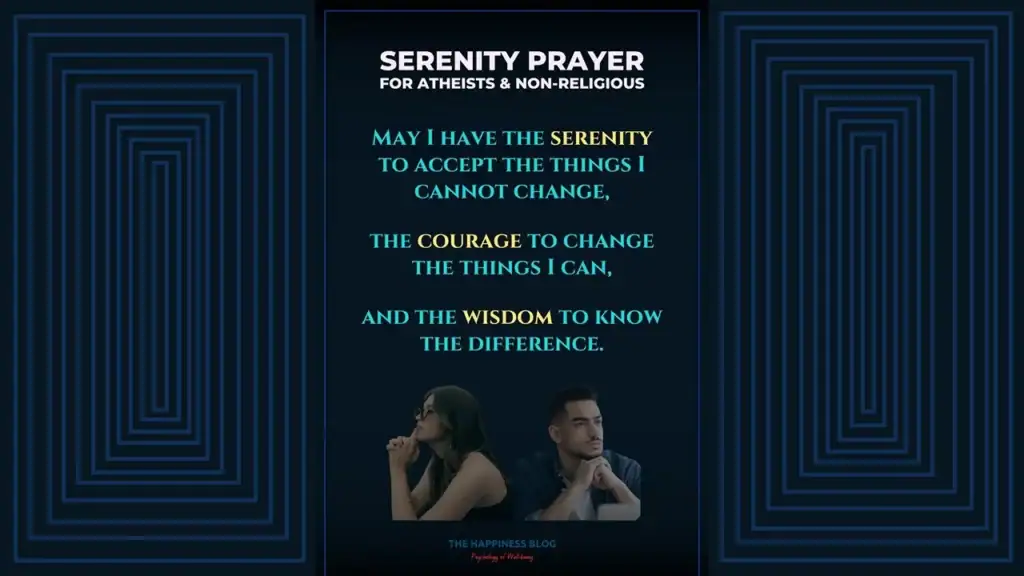
The message of the Serenity Prayer:
Accept the unchangeables. Act on the actionables. Decide wisely where to put your energies.
The root purpose of this prayer is to encourage you to use your own abilities and strengths instead of asking for help or direction from a higher power.
You may even personalize it into an affirmation by removing “May”:
“I have the serenity to accept the things I cannot change,
the courage to change the things I can,
and the wisdom to know the difference.”

The Serenity Reflection
This reflective version of the Serenity Prayer is from a Reddit post:
May I have the calm to accept what is beyond my control, the courage to act where my actions matter, and the clarity to tell the difference.
Living one day at a time, meeting one moment at a time.
Seeing hardship not as punishment, but as practice; not as proof that the world is against me, but as part of the world as it is.
May I face reality without flinching, not as I wish it to be, but as it stands before me.
May I keep my integrity when pressured, questioned, or afraid.
May I choose my response when I cannot choose my circumstances.
And may I find enough peace in this life by acting with courage, acceptance, and reason.
Extended Version of The Non-Religious Serenity Prayer
An extended version of the non-religious serenity prayer:
I am responsible for my own peace.
So, I accept my past.I’ll be brave enough to change my current conditions,
Ignore other people’s opinions of me,
And only compare myself to who I was yesterday.I’ll make the most of every moment
While being kind and true to myself
And find my happiness.
A few more non-religious versions of The Serenity Prayer:
“Let me have the serenity to accept the things I cannot change,
the courage to change the things I can,
and the wisdom to know the difference.”
“Let me have the strength to face my fears,
the determination to overcome my challenges,
and the resilience to bounce back from setbacks.”
“Let me find peace within myself,
and to live a life that is meaningful and fulfilling.”
Stoicism & Serenity Prayer: Did The Stoics Give It To Us?
At the heart of the Serenity Prayer lies Stoicism.
Ancient Stoics were not atheists in the modern sense. They believed in a divine principle called Logos, a rational, organizing force that governed the universe. You could say this was close to modern pantheism, as opposed to the God of Christianity or other theistic religions.
For Stoics, the divine was more like the rational order of nature itself.
Marcus Aurelius writes about “the gods” but treats them as part of the natural cosmic order, not as beings you pray to for favors. He saw humans as having a spark of this divine reason within them, which is why he said we should align ourselves with the natural order of things.
So while Stoics weren’t asking Zeus to help them accept what they couldn’t change, they were also not materialist atheists. They occupied this middle ground. This was a belief in a rational, divine cosmos while rejecting the idea of gods who intervene based on human prayers or desires.
In ancient Greek, “serenity” was “apatheia,” which meant freedom from intense emotional storms. The Stoics understood that when our passions, like anger, grief, or even joy, get out of control, they can ruin us.
The most famous Stoic passage that mirrors the Serenity Prayer comes from Epictetus, and it’s the opening of his Enchiridion (Handbook):
“What, then, is to be done? To make the best of what is in our power, and take the rest as it naturally happens.” – Epictetus
Epictetus also said:
“Some things are within our power, while others are not. Within our power are our opinion, motivation, desire, aversion, and, in a word, whatever is of our own doing; not within our power are our body, our property, reputation, position, and, in a word, whatever is not of our own doing.” – Epictetus
“Don’t demand or expect that events happen as you would wish them to. Accept events as they actually happen. That way peace is possible.” – Epictetus
“There is only one way to happiness and that is to cease worrying about things which are beyond the power of our will.” – Epictetus

And the Philosopher King Marcus Aurelius echoed this in his Meditations:
“You have power over your mind—not outside events. Realize this, and you will find strength.”
And this:
Well then, would it not be better to make use of what lies within your power as suits a free man rather than to strain for what lies beyond it in a slavish and abject fashion?
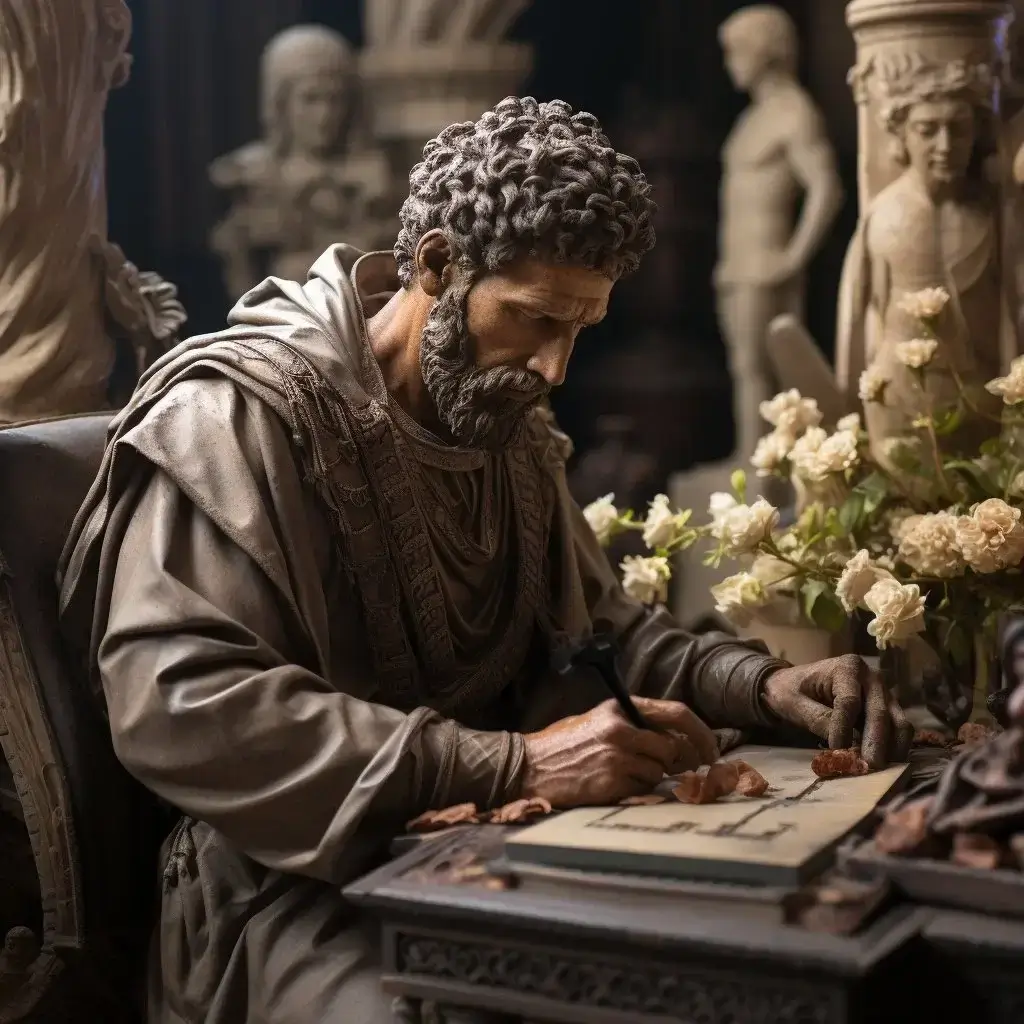
The Serenity Prayer just packages this 2,000-year-old wisdom in more accessible, modern language:
Accept things as they naturally unfold and turn your focus on what’s in your control (your thoughts, choices, and responses).
Final Words
Finally, a psychology-based serenity prayer:
“I will observe my thoughts and feelings without judgment, accept what lies outside my control, and direct my energy toward actions that align with my values.
I will practice psychological flexibility, respond rather than react, and build resilience through mindful awareness of what I can influence and what I must let be.”
This version draws from key psychological findings:
- Cognitive Behavioral Therapy (CBT): Shows that learning how our thoughts, feelings, and behaviors interact helps us view challenging situations more clearly and respond to them more effectively.
- Acceptance and Commitment Therapy (ACT): Acceptance and mindfulness, combined with commitment and behavior change processes, help produce psychological flexibility.
- Resilience Research: A positive cognitive triad (positive view of the self, the world, and the future) strengthens resilience, the ability to cope with stressful events.
You can even create your own version that speaks to your experience and values.
√ Also Read: Stoicism For Inner Peace: How To Be Calm When Life Is Hard
√ Please share this with someone.
» You deserve happiness! Choosing therapy could be your best decision.
...
• Disclosure: Buying via our links earns us a small commission.