
Today's Tuesday • 9 mins read
Gaslighters have narcissistic traits. And narcissists have gaslighting traits. The two are so intertwined that it is hard to find one without the other.
The term “gaslighting” comes from a 1944 film in which a husband systematically manipulates his wife into doubting her own perception of reality. Since then, this dynamic has become one of the most well-documented forms of psychological abuse.
Gaslighting is manipulating someone psychologically to make them doubt their own sanity, particularly by leading them to question their own experiences or perceptions. The person doing it is the gaslighter. The target is the gaslightee.
At its core, gaslighting is a narcissistic strategy. It serves the same function as most narcissistic behavior: protecting a fragile self-concept by controlling the reality of everyone nearby.
Gaslighters can make you doubt things you have known your entire life. Your memory. Your emotional responses. Your basic read on events. That erosion is the point.
Gaslighting is abuse, by any definition. Though the American Psychological Association does not yet formally recognize it as a clinical term, the psychological literature on coercive control and narcissistic abuse documents the behavior extensively.
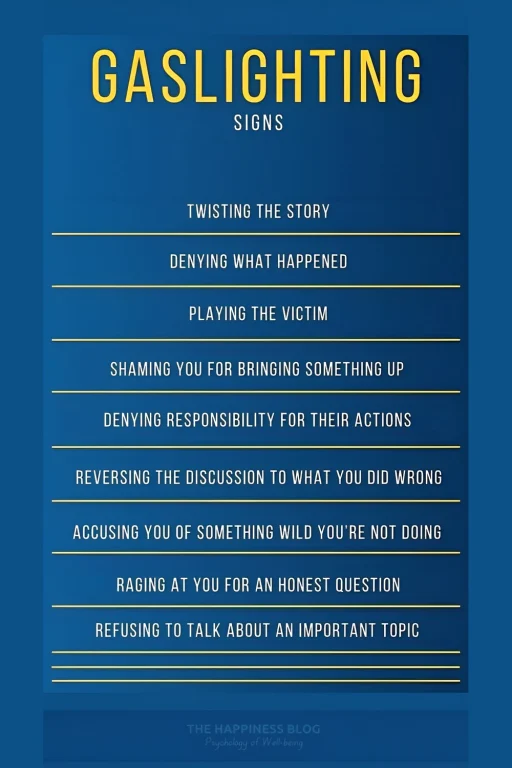
Here are 10 signs that you are being gaslighted without you even realizing.
10 Subtle Signs of A Narcissist Gaslighting You
1. They Are Intolerant of Criticism and Disagreement
Narcissistic personality structure depends on an idealized self-image that cannot tolerate challenge. When a gaslighter receives feedback that conflicts with how they see themselves, they rarely try to resolve the conflict.
Their default response is deflection, anger, or targeting the messenger back. Never any reflection on what might be wrong with their behavior.
You could say that pointing out their mistakes is a sure way to get them triggered. What follows often looks like narcissistic rage.
This rage is different from normal anger; it’s an aggressive reaction much bigger than the trigger. Its goal is to make it too expensive to raise objections or give feedback again.
Over time, you stop offering feedback altogether. That is exactly the outcome they need.
2. They Are Bullying and Domineering
Gaslighters use volume, persistence, and hostility to wear down resistance. They will hammer a position until the other person yields, not because the argument is sound but because the pressure becomes unbearable.
This is coercion dressed as conviction.
In narcissistic relationships, this domineering quality serves a specific function: it establishes who controls the shared version of reality. The more dominant partner sets the terms of what is true, what happened, and how it should be interpreted.
Many online trolls operate by the same mechanism, overwhelming opposition with hostility rather than engaging with it honestly. The goal is submission, not understanding.
3. They Systematically Undermine Your Memory and Perception
This is gaslighting in its most direct form.
They question whether you correctly remember events, whether you accurately perceived what happened, and whether your emotional response matches what actually occurred.
And they do this repeatedly, across small things and large ones, until you begin to do their work for them and question yourself before they even prompt you.
The narcissistic dimension here is notable. This behavior is strategic, not random cruelty.
A person whose self-concept depends on being right, dominant, and beyond reproach needs those around them to be uncertain. Your self-doubt is their stability and their control.
4. They Stage and Manage Events To Win Your Trust
This is one of the more calculated signs. They predict an event and then quietly arrange circumstances to make that prediction come true.
Say you win a prize at a party they told you about in advance. A plan they suggested works out exactly as they said it would.
Gradually, you start to believe they have an unusual grasp on reality, that their version of how things work is more reliable than your own.
What they have built is a controlled environment in which their credibility rises as yours falls. This is gaslighting as a long-term architecture, not just a single manipulative moment.
5. They Isolate You From People Who Might Confirm Your Reality
Isolation is a core feature of coercive control, and it has a specific psychological purpose in gaslighting: it removes the external reference points that might validate your perception.
They work gradually, convincing you that the people around you are hiding things, misrepresenting things, or simply cannot be trusted the way they can.
By the time the isolation is complete, they are your primary source of reality. That is when the gaslighting becomes most effective and most damaging.
This process is well-documented in narcissistic relationships under the clinical term coercive control.

6. They Reject Any Evidence That Contradicts Their Version of Events
Narcissists have a low tolerance for information that threatens the self-concept. In a gaslighting dynamic, this shows up as a blanket refusal to accept contradiction, even when the evidence is direct and undeniable.
You were there. You heard it. You have the message. None of those matters to them.
“It is all in your head” is the default response.
Then they withdraw temporarily, not because they have reconsidered, but because the interaction no longer serves them.
The refusal is not about the specific fact being disputed. It is about maintaining control over what counts as real.
7. The Gaslighting Never Stops
Either they are actively gaslighting you, or they are preparing the next move. They are always waiting for the moment you express your first doubt, because that moment is the opening they have been working toward.
Once you say, “Maybe I’m remembering it wrong” or “Maybe I overreacted,” they move quickly: “I told you so. You’ve been forgetting things lately.”
From that point, they double down, pushing you further inside what amounts to a manufactured reality.
When they sense you are close to the breaking point, the effort intensifies. The goal is to become the authority on what is real for you, not just win a few arguments.
8. They Show No Genuine Empathy
Empathy is the capacity to understand another person’s experience. Compassion is the desire to reduce their suffering.
Gaslighters, operating from a narcissistic base, are structurally limited in affective empathy: the felt sense of what another person is going through (Baskin-Sommers et al., 2014).
They may understand, cognitively, that you are distressed. They are unlikely to feel moved by it.
If they ever perform empathy or compassion, it serves a function: to deepen your dependence on them, or to buy time.
Their consistent indifference to your mental state, over time, becomes its own form of erosion. And when that erosion produces visible distress, they will use it as evidence that you are unstable.
9. They Begin With Microhostile Behaviors
Gaslighting rarely arrives fully formed. It begins as small, deniable hostilities: a dismissive tone, a look that undercuts what you just said, a minor reframing of an event that seems almost reasonable.
These microhostile behaviors are easy to second-guess in the moment. Was that a slight? Did they mean it that way?
Over time, the frequency increases and the pattern becomes harder to dismiss. What started as an occasional friction becomes a regular feature of the relationship.
By the time it is clearly recognizable as abuse, the groundwork has been laid for months or years, and you have already absorbed significant damage.
10. They Use Psychological Projection
Projection is when someone assigns their own traits, feelings, or behaviors to another person.
Narcissistic projection is a well-documented narcissistic defense mechanism, a way of protecting the idealized self-image by externalizing its flaws (Kernberg, 1975).
In a gaslighting context, projection does double work. It deflects scrutiny from the gaslighter while simultaneously putting the target on the defensive.
They accuse you of lying when they are the ones distorting facts. They call you controlling when control is their primary mode.
They tell you that you are unstable when destabilizing you is the whole project. As you work to defend yourself against the projection, your attention moves away from what they are actually doing.
What Prolonged Gaslighting Does To You
Sustained gaslighting erodes self-esteem, distorts self-image, and produces chronic self-doubt.
Anxiety and depression are common outcomes. Research on narcissistic abuse documents more severe consequences, including symptoms consistent with PTSD and learned helplessness (Herman, 1992).
The most disorienting part is that most targets cannot identify the cause. By the time the damage is visible, the gaslighter has already established the narrative: you were always fragile, always forgetful, always unstable.
The abuse and its explanation arrive together.

References:
- Baskin-Sommers, A., Krusemark, E., & Ronningstam, E. (2014). Empathy in narcissistic personality disorder. Personality Disorders: Theory, Research, and Treatment.
- Kernberg, O. F. (1975). Borderline Conditions and Pathological Narcissism. Jason Aronson.
- Herman, J. L. (1992). Trauma and Recovery. Basic Books.
Final Words
Gaslighting works because it is incremental and deniable. Each move is small enough to explain away your reality. The pattern is what reveals it, and patterns take time to see clearly.
The most effective thing you can do is start trusting your own perception again. Write things down. Note what was said, what happened, and how you felt before the reframing began.
Gaslighting depends on your uncertainty. The moment you can name it with any confidence, its power over you begins to reduce.
That is not a small thing. For many people in these relationships, being able to say, “This is gaslighting,” is the first clear thought they have had in years.
√ Also Read: How To Stop Gaslighting In Relationships And Take Back Power
√ Please share this with someone.
» You deserve happiness! Choosing therapy could be your best decision.
...
• Disclosure: Buying via our links earns us a small commission.