
Today's Tuesday • 8 mins read
— By Dr. Sandip Roy.
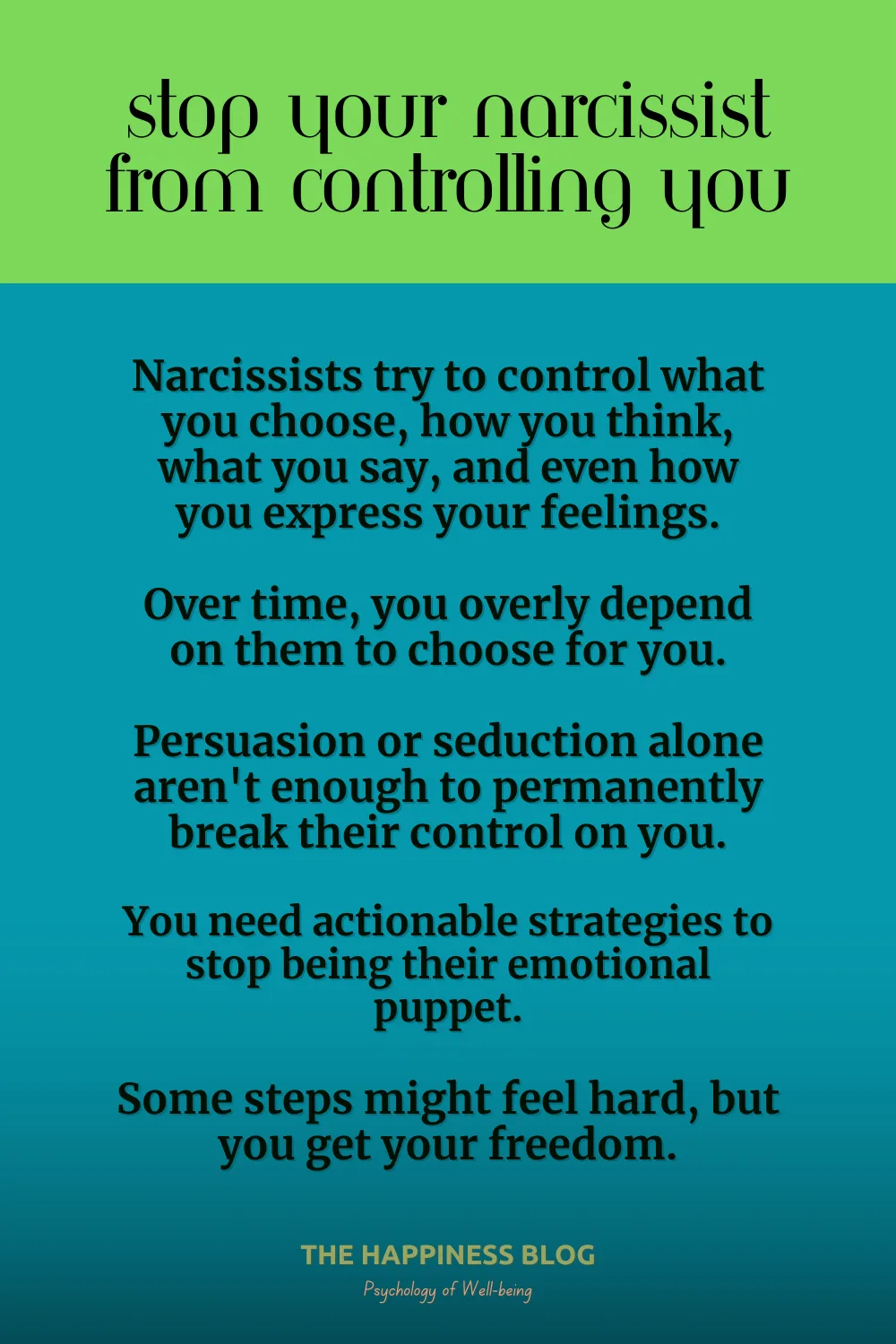
Narcissists are good at using you as a cost-free validator, controlling your narrative, and making you dependent on them.
Breaking free from their control requires more than seductive persuasion. It demands actionable strategies.
These strategies will give you back your power when you’re ready to stop being their emotional puppet. Some steps might feel hard, especially if they act cruelly or when you want revenge.
Your freedom starts here: Stop your narcissist from controlling you and reclaim your agency.
11 Strategies To Stop A Narcissist From Controlling You
1. Set Firm Boundaries & Make Them Stick
Boundaries are limits on what behaviors you will accept from others. Every relationship needs them.
Write down your boundaries first. Then, when you declare them to your narcissist, send them a copy over email, text, or message.
Note that boundaries are about what you would do, not what the other person should do.
Some examples of good boundaries are:
- “I need to take a break from our conversations.”
- “I cannot give you my time or my attention at all hours.”
- “I will not tolerate being blamed for your feelings or actions.”
- “I won’t engage in discussions that involve name-calling or insults.”
- “I am not okay with you making decisions for me; I will make my own choices.”
Two things. One, don’t apologize for setting boundaries. Two, expect pushback when you tell them, as narcissists hate losing control.
When they push your boundaries, stand firm and respond consistently to enforce them. Don’t negotiate or over-explain yourself. Don’t lose your cool.
Good boundaries sustain on consistency, not intensity.
2. Neutralize Drama With The Gray Rock Method
Narcissists thrive on drama. It gives them satisfaction that they got you to react, so they are in control.
Deny them the emotional drama they feed their egos on. Become boring to the narcissist, as if you’re a piece of gray rock.
You have your vibrancy, but it’s not for them. You can share a laugh or an emotional talk with others, but the narcissist is not getting any of that.
Rehearse how to be emotionally bland when they try to trigger you. How to gray rock:
- Keep your conversations brief and neutral.
- Give minimal responses to their inflammatory statements.
- Avoid sharing feelings or opinions that they can use against you.
- Cut their power to create drama or get emotional reactions from you.
Constant gray rocking blunts the narcissist’s urge to control you.
One thing: Gray rock is not forever.
Life is too short to live like a gray rock in a relationship.
3. Build Your Emotional Support Team
Narcissists gradually cut you off from others, making you more dependent on them and increasing their control over you.
To counter this, set up a safety net of people to fall back on.
- Maintain relationships with people who know your situation and can support you if things get worse. They can also offer perspectives when you are unsure about your future or yourself.
- Join an online or offline narcissist survivor and support group. Read what others share. Share your feelings and specific behaviors of your narcissist.
- Connect with friends and family who can validate your feelings without judgment. If they don’t meet your needs, consult a therapist.
Shared wisdom can help you escape the isolated gaslit swamp the narcissist traps you in.
4. Keep Evidence of Abuse To Prove Yourself
Documenting their abuse in a daily journal can help you see patterns in their behavior, fact-check when the narcissist dishes you “word salad”, and serve as evidence in legal matters.
- Keep a record of all unpleasant interactions.
- Save texts, emails, and voicemails.
- Note dates and details of incidents.
Create a simple system that works for you, a dedicated folder or journal, online or offline. Review it weekly to spot manipulation tactics you might have missed.
Trust your memory less than you think you should.
5. Protect And Upgrade Your Reputation
Narcissists can use smear campaigns to paint you in a bad light and cause people to distance themselves from you. It gives the narcissist more control over you.
To counter this, invite others to see your good side.
- Practice staying calm and composed if your narcissist tells others you are always angry.
- Don’t talk ill of others, or let anyone talk negatively about others with you. It will make people realize you don’t gossip and can be trusted with their secrets.
- Appreciate people for the things that others take for granted. Make it a habit to offer help. Thank people for doing good things for you, believing in you, and helping you. It will dispel the negative ideas of you being selfish.
Win people’s hearts. Project strength and calm confidence. It will keep others from being swayed by the narcissist, as your actions speak louder than their words.
When you protect your reputation, the narcissist loses control over you.

6. Find A Passion That Anchors You
Rediscover activities you were once passionate about.
- Add a new hobby or healthy habit to your current life.
- Start a gentle exercise routine, like daily walking, to boost your happiness.
- Take breaks from familiar surroundings. Travel somewhere new. Explore your city like a tourist.
Changes create space for healing and personal growth. And help you bounce back to normalcy faster.
7. Share Less About Your Inner Life
Don’t reveal too much about your personal life. Share less and hide more of your thoughts, emotions, plans, and activities.
- Practice neutral responses that reveal nothing meaningful.
- Develop a mental filter: “If I share this, how might they use it later?”
- Create spaces, incomes, and savings in your life that they know nothing about.
The less they know about your private thoughts and plans, the less vulnerable you are to them. The more “unknown” you are, the less power the narcissist has over you.
Find safe people with whom you can be fully open.
8. Go Low-Contact Before Fading Out
Sometimes, distance is the healthiest option to break the cycle of control. Create physical and emotional distance from your narcissist.
- Reduce interactions. Go low-contact or no-contact.
- Separate gradually if full separation feels overwhelming or undoable.
- Take mental health breaks. Notice how your stress levels change when you’re away from them.
Distance helps you reconnect with parts of yourself that were lost during the relationship. You get to see a life without their chains of influence.
9. Release & Forgive Them for Self-Liberation
After you break up with your narcissist, forgive them. Unforgiveness keeps them in your mind; forgive to remove them from your mental space.
Trying to get back at the narcissist will only keep you tied to their toxicity.
- Don’t let their toxicity get to you. Rise above the idea of revenge.
- Don’t let them live rent-free in your head. Release them. Ignore them into oblivion.
- Move forward in your life without dragging the past. Focus on your happiness and progress.
When you forgive, you free up mental space for positive thoughts.
Just move on, cutting any remaining ties with the narcissist.
The best revenge is living a happy life.
10. Stand Alone Strong, Embracing Yourself
Some of your common friends and loved ones may leave you after you leave the narcissist. Don’t feel guilty or ashamed.
- Embrace your independence. Embrace your solo life for a while.
- Gradually build new connections, but don’t go in expecting them to heal you.
- Those who left you were never meant to be in your life; accept the end of the relationship.
Tough love: You will lose some relationships in life. Stay prepared.
11. Heal Out Loud & Boldly Process Your Emotions
Emotions need processing, not hiding or revolting against them.
Processing emotions means naming what you feel, sitting with the sensation without judgment, tracing its origin, and allowing it to move through you rather than acting on it impulsively.
- Reflect on the thoughts that feed the emotion, and then safely express it through talking, journaling, or therapy.
- Choose constructive responses that align with your values; allow yourself to cry and be vulnerable.
- Over time, this deliberate work reduces reactivity, clarifies needs, and converts raw emotion into information that guides healthier choices.
- Tell trusted people how hurt you are, and give yourself permission to grieve the loss of a relationship that took so much from you.
Narcissists will often try to block your healing.
They may set you off on a downward emotional spiral with their sarcastic comments or fake apologies.
Avoid getting triggered. Gray rock them. Learn how to respond to narcissistic apologies.
Don’t give them the drama they come looking for.
If the painful emotions get too hard to process, seek help from a mental health professional.
Final Words
The best way to take away their control over you is to leave them and purge them from your thoughts.
These lines from a famous song by the Nobel laureate Tagore will inspire you:
If they turn away, and desert you when crossing the wilderness,
O you unlucky one,
trample the thorns under your tread,
and along the blood-lined track travel alone.
If they do not hold up the light when the night is troubled with storm,
O you unlucky one,
with the thunder of pain ignite your heart
and let it burn alone.
√ Also Read: 8 Ways To Set Boundaries With Your Narcissistic Mother
√ Please share this with someone.
» You deserve happiness! Choosing therapy could be your best decision.
...
• Disclosure: Buying via our links earns us a small commission.
