
Today's Saturday • 9 mins read
Every relationship has rough patches. People disappoint each other. Couples fight. Friends go through cold spells. That’s two imperfect people simply trying to make something work.
But then, there’s a category of relationship that operates differently. In this, the hurts are a consistent pattern that keeps you small, confused, and off-balance. This could be a narcissistic person you are dealing with.
Knowing which situation you’re actually in matters. So, how do you tell them apart?
1. Difficult Relationships Have Problems. Narcissistic Ones Have Patterns.
This is the first and most important distinction.
In a genuinely difficult relationship, problems are varied. Sometimes you’re the issue. Sometimes they are. Sometimes circumstances are. The texture is uneven and somewhat random.
Both of you work to resolve the arguments. You feel bad, apologize to each other, and move forward.
In a relationship with a narcissist, the problems form a circular pattern. They repeat recognizably.
It comes in a cycle of idealization, devaluation, and discard that researchers have documented extensively in clinical literature (Kernberg, 1975; Ronningstam, 2005).
You may not see the full cycle at first, but over time, the pattern gets undeniable:
First, they put you on a pedestal, then they take you down, and then they throw you away.
You go through the same emotions on repeat: attraction, confusion, and then being abandoned.
Difficult relationships feel hard to different degrees. Narcissistic ones feel circular. The same feelings resurface. The same conversations go nowhere.

2. Narcissistic Relationships Let You Engage Only On Their Terms.
In a healthy relationship, even an imperfect one, both people have some say in how it functions.
Both people have a say in when difficult talks will happen, what tone will be acceptable, and what a fair resolution will look like. You negotiate these things, sometimes clumsily, but you negotiate them together.
In a relationship with a narcissistic person, those rules belong to them. Discussions happen when they’re ready. The topics on the table are the ones they can control.
If you push for a conversation at the wrong moment, you get labeled aggressive or irrational. If you bring up something that reflects poorly on them, it gets buried or turned back on you.
Research on narcissistic personality consistently points to a deep need to regulate the interpersonal environment to protect a fragile self-concept (Campbell & Foster, 2002).
In easy words, narcissists strongly want to control their social environment to protect their fragile sense of self. The terms of a relationship with a narcissist will only be to serve that purpose.
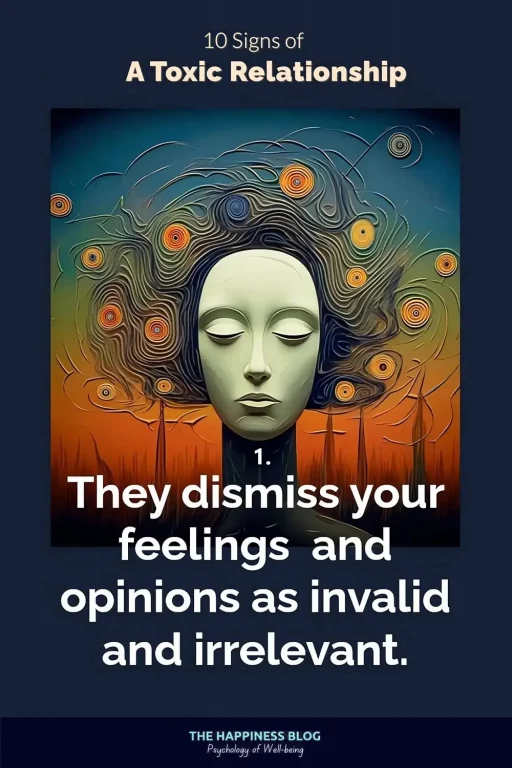
A sign you’re in a narcissistic relationship is: You’ve stopped initiating conversations about anything that actually matters to you. The reason you learned to do so is that they constantly devalue or invalidate your emotions, opinions, and ideas.
3. Narcissistic Relationships Make You Carry The Emotional Weight For Two People.
Emotional labor, the ongoing work of managing feelings, tracking relational tension, and keeping the peace, gets distributed unevenly in most relationships at some point. In a narcissistic relationship, the imbalance is permanent and one-directional.
You track their mood and adjust your behavior accordingly. You (literally) soften your words to avoid harsh consequences.
You stay alert to shifts in their moods and spirits because those shifts determine what kind of day you’re going to have.
Meanwhile, they rarely perform this labor on your behalf. They can say to you what they want to, without bothering about your mood or mental state.
Your emotional state matters to them only when it affects them: when you’re visibly upset in a way that inconveniences or embarrasses them, or when managing you serves a purpose.
This is less of a character flaw and more of a structural feature. Narcissistic people show measurably reduced empathic response, particularly affective empathy, even when cognitive empathy remains intact (Baskin-Sommers et al., 2014).
They may understand, intellectually, that you’re hurting. They are unlikely to feel moved to do much about it.
- Do you know why narcissists admire powerful narcissists?
4. Every Conflict With A Narcissist Ends With You As The Problem.
Normal conflict involves genuine accountability on both sides. After a fight in a functional relationship, both people can usually articulate what they could have done differently, and that reflection is part of how the relationship repairs itself.
In a narcissistic relationship, the conflict resolution process has a prefixed destination: you. Even when the incident began with something they did, the conversation routes back to your tone, your history, your sensitivity, or your unreasonable expectations.
Trauma researcher Jennifer Freyd identified this as DARVO, Deny, Attack, Reverse Victim and Offender (Freyd, 1997), a pattern in which the person confronted with their behavior flips the script and positions themselves as the one being wronged.
Over time, you absorb this dynamic and start pre-accepting blame. You apologize first. You frame your concerns as your problem before they can do it for you.
This is an adaptation to a system that has no other exit, and it says nothing about your character.
5. You Stop Feeling Safe Expressing Your Needs To The Narcissist.
In a difficult relationship, expressing a need might lead to conflict, disappointment, or a clumsy response. That’s uncomfortable, but it’s mostly workable.
With narcissists, expressing a need tends to produce something diametrically different: harsh dismissal, mockery, weaponization, or punishment.
So you learn not to express your opinions, ideas, or needs. You stop asking; you stop expecting.
Self-silencing in intimate relationships is a documented psychological mechanism with real mental health consequences, linked to depression, anxiety, and loss of self-coherence over time (Jack & Dill, 1992).
It is a response to a specific relational environment, not a personality trait.
You didn’t arrive in the relationship this way. If you regularly rehearse what you’re going to say, edit it down to almost nothing, and still decide not to say it, the relationship has trained you to do that.
6. Your Perception of Reality Is A Regular Point of Dispute With The Narcissist.
People in difficult relationships disagree. They have different memories, different interpretations, different priorities. That’s normal, and it usually gets worked through.
Being told repeatedly that your read on events is wrong is a red flag of a different order. That the thing that upset you didn’t happen the way you remember.
That your emotional response is disproportionate, fabricated, or manipulative. That you’re too sensitive, too suspicious, or too dramatic.
This is gaslighting, a term now well-established in clinical and social psychology literature (Abramson, 2014), and its effect is corrosive over time.
People in these relationships gradually stop trusting their own perception. They check their reactions constantly against the other person’s version of events and become genuinely uncertain about what they’re experiencing.
In a narcissistic relationship, reality gets challenged strategically whenever it threatens the other person’s narrative. The goal is always to control the story in their favor.
7. The Relationship & The Narcissist Never Actually Change.
Every relationship worth staying in has some capacity for growth, not perfection, but genuine movement.
There are many moments where a scraggy pattern shifts after feedback lands, because both people decided to change it. That capacity is what distinguishes a difficult relationship from a dead-end one.
In a narcissistic relationship, change is promised frequently and delivered rarely. The cycle runs: incident, conflict, remorse (sometimes), promises, a brief improvement, then reversion to the same behavior.
Therapists who work with narcissistic personality structure note that meaningful change requires a level of self-reflection and accountability that runs directly counter to narcissistic defense mechanisms (Malkin, 2015).
The promises aren’t always conscious deception, but the outcome is the same: you’re perpetually waiting for a version of the relationship that doesn’t arrive.
If you’ve had the same core conflict, in essentially the same form, more times than you can count, and nothing has structurally changed, that pattern is telling you something worth listening to.
Table: Difficult Relationship vs. Narcissistic Relationship
| Aspect | Difficult Relationship | Narcissistic Relationship |
|---|---|---|
| 1. Problems | Varied, unpredictable, context-dependent | Repetitive, circular, follow a recognizable pattern |
| 2. Conflict resolution | Both people take some accountability | You are always the problem, regardless of what happened |
| 3. Emotional labor | Shared unevenly at times, but both contribute | One-sided. You manage their feelings; they don’t manage yours |
| 4. Your needs | Can be expressed, even if imperfectly received | Dismissed, punished, or used against you |
| 5. Reality | Occasionally disputed | Systematically questioned to protect their narrative |
| 6. Change | Possible. Patterns shift when both people work at it | Promised often, delivered rarely |
| 7. How you feel | Frustrated or hurt at times, but basically yourself | Confused, self-doubting, walking on eggshells |
References:
- Malkin, C. (2015). Rethinking Narcissism.
- Kernberg, O. F. (1975). Borderline Conditions and Pathological Narcissism.
- Ronningstam, E. (2005). Identifying and Understanding the Narcissistic Personality.
- Abramson, K. (2014). Turning up the lights on gaslighting. Philosophical Perspectives.
- Jack, D. C., & Dill, D. (1992). The Silencing the Self Scale. Psychology of Women Quarterly.
- Freyd, J. J. (1997). Violations of power, adaptive blindness, and betrayal trauma theory. Feminism & Psychology.
- Campbell, W. K., & Foster, C. A. (2002). Narcissism and commitment in romantic relationships. Personality and Social Psychology Bulletin.
- Baskin-Sommers, A., Krusemark, E., & Ronningstam, E. (2014). Empathy in narcissistic personality disorder. Personality Disorders: Theory, Research, and Treatment.
Final Words
Narcissism might be a defense mechanism that develops in childhood. That adult arrogance, entitlement, and need for praise may be keeping the narcissist’s fragile sense of self safe.
The most under-discussed fact about narcissistic abuse is this: it doesn’t require a diagnosable narcissist to cause damage.
What causes harm is the dynamic: the consistent suppression of one person’s reality to protect another’s. That pattern can exist on a spectrum, in relationships with people who would never meet the clinical criteria for NPD.
Trust your own experience. If you feel more discomfort than peace with this person, that’s worth taking seriously. It may be time to take a break and rethink the relationship.
√ Also Read: Unbelonging: The Pain of Being Everywhere and Nowhere
√ Please share this with someone.
» You deserve happiness! Choosing therapy could be your best decision.
...
• Disclosure: Buying via our links earns us a small commission.