
Today's Friday • 9 mins read
What is DARVO? How do narcissists use it to trigger you into emotional dramas? Learn the common DARVO phrases.
The term “DARVO” was coined by psychologist Jennifer Freyd in 1997. As of 2026, DARVO was added to the Merriam-Webster dictionary.
Freyd identified it in her research on how perpetrators of intimate violence pass on accountability to the victim.
Today, it has been found to occur in many power-imbalanced relationships. Narcissists often use it as a psychological defense to avoid responsibility and shift blame.
DARVO may seem like a heated argument or emotional overreaction. But underneath is a series of moves designed to confuse the victim, shift blame, and protect the offender’s ‘holier-than-thou’ image.
Narcissists who use DARVO often leave the confronting person confused, hurt, and feeling like the actual offender.
What is DARVO?
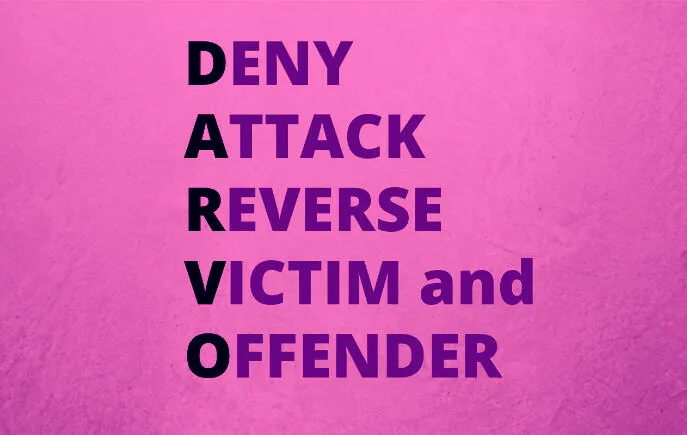
DARVO stands for Deny, Attack, Reverse Victim and Offender. DARVO describes a response pattern in which the perpetrator or offender may Deny the behavior, Attack the individual raising the concern, and Reverse the roles of Victim and Offender such that the perpetrator assumes the victim role and turns the true victim into an alleged offender.
DARVO is common with, but not exclusive to, people with narcissistic traits. A single defensive statement does not prove that someone is using the DARVO pattern. It is more useful to notice a repeated sequence of avoiding accountability and shifting blame.

This is how DARVO unfolds:
1. Deny
Picture this. You confront a narcissistic partner about their cutting remarks, and they insist it never occurred. The flat denial comes as a shock, clashing with your sense of reality.
This step is their first line of defense.
They do this by using phrases like “You’re imagining things” or “That never happened.” Or the more common, “You misconstrued,” or “I was just joking; why so serious?”
Denial forces you to second-guess your memory. You are taken aback, wondering, “Was I mistaken?”
Their aim is clear. To erode your confidence in what you saw happen. Over time, you start doubting your perception of right and wrong.
2. Attack
Once denial isn’t enough, they shift into attack mode. Attack is the pivot to shift the focus away from them.
They can use subtle jabs, sharp criticism, or bring up past faults of yours. You hear things like “You always overreact,” “You always twist everything,” or “The real issue is you.”
These barbs distract you from their actions. The deeper idea is to make you feel small and guilty.
Suddenly, you are on the defensive. You’re shouting things like, “No, I’m not overreacting,” or “No, I’m not twisting things,” or “No, the real issue is you, not me.”
Their attack has moved the original issue of their accountability into the background. Now, as “you are losing your mind,” they resume control of the confrontation.
3. Reverse Victim and Offender
The final move flips the entire script. The narcissist positions themselves as the injured party. And paint you as the aggressor.
Statements like these pour in: “How dare you accuse me when you’ve been worse,” or “After all I’ve sacrificed, this is my thanks?”
It’s a calculated reversal. It’s designed to confuse you and silence your voice.
This stage isolates you further. Friends or family might even side with the narcissist. The emotional toll builds, reinforcing their power.
Common DARVO Phrases That Narcissists May Use
Some common DARVO phrases:
- “I’m the real victim here.”
- “You’re always creating drama.”
- “You’re the abusive one, not me.”
- “You’re attacking me for no reason.”
- “You’re too sensitive; it was only a joke.”
- “Everyone can see that you’re unstable.”
- “You owe me an apology for accusing me.”
- “You’re just trying to punish or control me.”
- “You’re the one who started this argument.”
- “That never happened. You’re making it up.”
- “You’re projecting your own behavior onto me.”
- “You’re only bringing this up to make me look bad.”
- “You’re twisting my words and making me look bad.”
- “You’re obsessed with finding fault in everything I do.”
- “I can’t believe you’re portraying me as the bad person.”
- “You’re remembering it wrong; that isn’t what happened.”
- “After everything I’ve done for you, this is how you treat me?”
- “You’re destroying this relationship by constantly accusing me.”
- “No one else has a problem with me. This is entirely your issue.”
- “If you hadn’t provoked me, none of this would have happened.”
These statements can be concerning when the narcissistic person consistently replaces a substantive response with denial, personal attacks, or accusations against the person who raised the issue.
That said, context matters. Someone may deny an allegation because they genuinely remember events differently, and an isolated defensive reaction is not enough to establish abuse or a personality disorder.
Research suggests that seeing/hearing DARVO responses can make people doubt a complainant’s credibility and increase victim-blaming. That’s why it’s helpful to document events and find a neutral, trusted source of support.
Why Narcissists Use DARVO
Narcissists build and cling to a flawless image of themselves. They can use many unfair ways to maintain this carefully crafted, perfect image. DARVO is one of those ways to protect this image from any dents or cracks.
Control and superiority form the core of a narcissist’s world. They fear losing those.
They fear that admitting fault will shatter the illusion of flawlessness they spent years cultivating. And once their admirers discover their flaws, they will withdraw their approval.
The narcissist’s lack of empathy also plays a role. They may not even recognize the hurts their actions cause. So, when confronted, they view it as a personal affront.
DARVO could be coming from their “ego survival” instinct. It preserves their ego, entitlement, and self-importance.
Psychological Effects of DARVO On Victims
DARVO can feel like an emotional whiplash, putting you in a confused daze.
- You went to your narcissist seeking clarity and resolution, but you left feeling like a guilty party. The reversal stings deeply.
- Over repeated encounters, self-doubt creeps in. Then guilt turns into anxiety and shame. Your grip on reality loosens.
- DARVO also heightens your vulnerability. You start to apologize before sharing even your simplest opinions or ideas.
- Long-term, it erodes trust in your own instincts. You minimize your presence, making yourself invisible and unheard to avoid being labeled as the offender again.
Persistent exposure to DARVO can raise the risk of depression, as ongoing invalidation wears down self-worth, according to insights from trauma psychology. It may also trigger PTSD-like symptoms, such as hypervigilance or flashbacks to abusive moments, mirroring patterns seen in emotional abuse research.
Recognizing DARVO in Real Life
DARVO isn’t limited to close relationships. It can show up in families, offices, courtrooms, and online spaces.
DARVO appears in defamation lawsuits against abuse survivors, prosecutions of victims for reporting, and high-profile political and celebrity cases (Trump, Kavanaugh, Harvey Weinstein, Johnny Depp/Amber Heard).
Stay aware and notice the pattern:
- You express hurt → they accuse you of hurting them.
- You try to leave → they claim you’re abandoning or abusing them.
- You bring up something they did → they accuse you of overreacting.
Take special note of the intensity or contempt in their voice or gestures. Overreactions to mild feedback stand out. Intensity often escalates quickly.
Some examples of DARVO in real life:
- A friend might deny borrowing money without repaying it, then attack your memory as unreliable, and finally claim you’re the selfish one for bringing it up.
- In the workplace, a boss could deny missing a deadline they caused, lash out by calling you incompetent, and reverse by saying your complaints are sabotaging team morale.
- Public figures often use it in scandals, like denying allegations in interviews, attacking the accuser’s credibility, and portraying themselves as victims of a smear campaign.
- Even in family settings, a parent might deny harsh criticism, counter by blaming your sensitivity, and flip to say they’re the ones suffering from ungrateful children.
Track these red flags. Journal interactions for clarity. Sharing with trusted others reveals the tactic’s hold.
How To Protect Yourself From A DARVO
Spotting DARVO mid-conversation breaks its grip. Without awareness, you may get pulled into the spin cycle of guilt, confusion, and self-blame.
These are some ways to handle DARVO:
- Stay grounded in your truth: it’s not your fault.
- Don’t apologize for the mistakes of your narcissist.
- See getting attacked for setting your boundaries as a red flag.
- You have the right to your feelings and experiences; no one can say that your experiences are wrong.
- Use the “gray rock” method by responding with minimal emotion or detail to starve them of reaction fuel.
- Leave the scene as soon as the manipulation intensifies; this is when your narcissist senses a loss of control and is likely to explode.
Build support networks to help validate your experiences. Therapy can help you see new ways to rebuild confidence. Consider apps like Day One or Journey for journaling and tracking abusive incidents, to build evidence for support.
If DARVO is a recurring pattern in your relationship, consult a therapist to find out why you keep getting drawn into such relationships.
Further Reading:
- Freyd (1997). Violations of power, adaptive blindness, and betrayal trauma theory (introduced DARVO).
- Harsey, Zurbriggen & Freyd (2017). DARVO and victim self-blame.
- Harsey & Freyd (2020). DARVO’s impact on third parties and anti-DARVO education.
- Rosenthal & Freyd (2022). College women’s contact with perpetrators after assault.
- Harsey & Freyd (2023). DARVO and insincere apologies’ influence on perceptions of assault.
- Harsey, Adams-Clark & Freyd (2024). DARVO use linked to harassment perpetration.
- Durland, Harsey & Freyd (2026). DARVO-SF measurement and trauma symptoms.
Final Words
DARVO is a toxic blend of denial, blame-shifting, and emotional gaslighting.
But DARVO is not proof of past behavior. A person innocent of an accusation might use it (though it is never a necessary response). Therefore, calling out DARVO should not be used lazily, inaccurately, or as an unfounded rhetorical weapon.
√ Also Read: How To Respond To A Narcissist’s Irrational Anger?
√ Please share this with someone.
» You deserve happiness! Choosing therapy could be your best decision.
...
• Disclosure: Buying via our links earns us a small commission.