
Today's Monday • 8 mins read
Quiet people are often stereotyped. Many see them as strange, lacking social skills, or people who hate people.
But the truth is quite different. Quiet people may be introverted, honed by life’s experiences early on, or choose peace over superficial talk.
Read on to discover how these people are much more than you may have expected.
10 Traits of The Quiet People
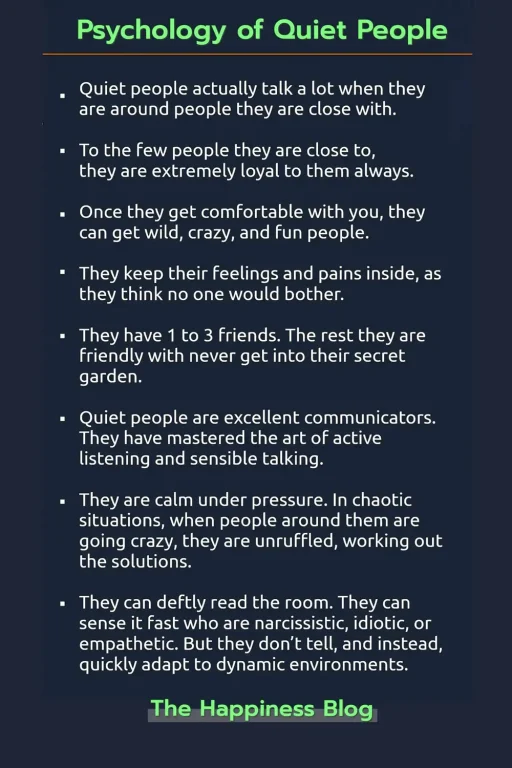
- Quiet people actually talk a lot when they’re around people they are close with.
- To the few people they are close to, they are extremely loyal to them, always.
- Once they get comfortable with you, they can get wild, crazy, and fun people.
- They keep their feelings and pains inside, as they think no one would bother.
- They have 1 to 3 friends. The rest that they are friendly with never get into their secret garden.
- Quiet people are excellent communicators. They have mastered the art of active listening and sensible talking.
- They are calm under pressure. In chaotic situations, when people around them are going crazy, they are unruffled, working out the solutions.
- They can deftly read the room. They can sense quickly who is narcissistic, idiotic, or empathetic. But they don’t tell, and instead, quickly adapt to dynamic environments.
- They are deep thinkers and creative innovators. They often surprise you with their unique and valuable insights.
- They are wise mentors, empathetic leaders, collaborative teammates, and inspiring friends.
Psychology Behind Quiet People’s Traits
A brief psychological explanation of each point above about quiet people:
1. Talking More Around Close People
Quiet people actually talk a lot when they are around people they are close with.
Introverts save energy for relationships that matter. Social situations drain them, especially with strangers or acquaintances.
Their every conversation requires mental effort to monitor body language, choose words carefully, and manage their own anxiety.
But with close friends and family, this effort disappears. They feel safe and drop their guard. They don’t need to perform or edit themselves. Without the cognitive load, they can finally relax.
Research shows introverts process social information more intensely than extroverts [Jung’s theory of psychological types]. This explains why they need fewer but deeper connections.
These secure relationships restore their energy. They feel understood and accepted. They can express themselves freely without constant self-monitoring.
Without safe, close relationships, introverts lose their verve and energy.
2. Loyalty To Their Inner Circle
To the few people they are close to, they are extremely loyal to them, always.
Quiet people choose friends carefully. They invest time and emotional energy into a small number of relationships. This selectivity makes each connection valuable.
They don’t collect friends like trading cards. They build bonds slowly, testing trust over time.
Once someone earns a place in their inner circle, they stay there.
Studies on attachment theory suggest that people who form fewer relationships often show stronger commitment to those they have [Bowlby, 1977].
So, for them, quality beats quantity. Their loyalty isn’t dramatic or loud. It’s steady, reliable, and deep. The effort invested in building these relationships creates unwavering support.
3. Wild Side In Safe Spaces
Once they get comfortable with you, they can become wild, crazy, and fun people.
Introversion doesn’t mean boring. Quiet people can be energetic, silly, and spontaneous when they feel comfortable.
The reserved behavior many people see is actually a form of social caution.
Remove the threat of judgment, and a different person emerges. They laugh louder. They take risks. They show personality.
This shift reflects context-dependent behavior [Mischel’s personality research, 1979 onwards].
The playful side was always there. Unlocking authenticity needed the right audience and psychological safety.
When introverts shed their guarded exterior, they express their true selves. This isn’t a hidden personality. It’s freedom in a secure environment.
4. Keeping Pain Hidden
They keep their feelings and pains inside, as they think no one would bother.
Many quiet people learned early that sharing feelings carries risks.
Someone dismissed their emotions. They felt like a burden. Maybe vulnerability seemed weak. These experiences create a pattern: keep it inside.
Past invalidation or dismissal of emotions leads to learned reluctance to share. This behavior functions as a defense mechanism [Freud’s defense theory]. It protects against rejection and disappointment.
But suppressing emotions has costs. Research links emotional suppression to anxiety, depression, and physical health problems [Gross and John’s emotion regulation studies].
They need safe people who listen without fixing, judging, or minimizing.
5. Small Friend Groups And Secret Gardens
They have 1 to 3 close friends, not more. The rest of those they know, they are just friendly with.
Quiet people maintain clear boundaries. They have acquaintances and friendly faces. Then they have real friends.
The difference is access to their “secret garden.” Only a select few see their internal world of thoughts, fears, dreams, and vulnerabilities.
What looks like coldness is self-protection and preference. By nature, introverts feel overwhelmed by large social networks. So they prefer investing in a few meaningful relationships [Cain’s research on introversion].
They control who gets close. They decide who enters their private space. This selectivity preserves energy and protects their emotional core. They control who they let emotionally close.
6. Excellent Communicators
Quiet people are excellent communicators. They have mastered the art of active listening and sensible talking.
Quiet people listen first. They watch the person. They notice body language, tone shifts, and pauses. They respond after processing all that information.
Active listening means giving full attention to the speaker, understanding the message, remembering what is said, and responding with care [Rogers’ person-centered therapy]. Quiet people excel at this.
They don’t interrupt. They fully process the verbal content and nonverbal cues before speaking.
Their “sensible talking” comes from the habit of choosing words carefully and avoiding unnecessary chatter.
Research shows introverts tend to engage in deeper, more reflective processing of information, focusing on internal thoughts and feelings than extroverts [Jung’s cognitive processing studies].
They avoid empty chatter. When they speak, they aim for clarity and empathy. This makes their conversations meaningful.
7. Calmness Under Pressure
They are calm under pressure and chaotic situations, working out the solutions without staying unruffled.
While people around them are in panic or going crazy, quiet people stay steady. They focus inward. They block out noise and distraction.
Their autonomic nervous system responds differently. Their lower reactivity to external stimuli helps them think clearly when situations spiral.
Studies suggest introverts show less pronounced “fight-or-flight” responses in stressful situations [Eysenck’s arousal theory]. Their internal focus and reduced response to sensory overload or emotional contagion help them keep calm.
They assess problems objectively, stay grounded, and find solutions, while others react emotionally.
8. Reading The Room
They can deftly and quickly read the room they enter.
Quiet people see what others miss. They catch micro-expressions. The tension in voices. The shift in group energy. Years of observing social dynamics sharpen this skill.
They can sense quickly who the narcissists, empaths, and fakes are. But they don’t announce their findings. They adapt instead.
They adjust their behavior to fit different environments and people. This flexibility comes from strategic thinking and careful observation.
They can swim smoothly across complex situations by watching patterns and responding accordingly. Their high emotional and social intelligence makes this possible [Goleman’s social intelligence work].
Their reluctance to judge openly reflects their preference for avoiding conflict and maintaining harmony.
9. Deep Thinkers and Innovators
They are deep thinkers and creative innovators, and often surprise with their unique and valuable insights.
Quiet people spend time inside their heads. This introspection breeds creativity.
They explore ideas thoroughly. They make connections others overlook. Their insights surprise people because they result from careful reflection, not quick reactions.
Solitude fuels original thinking. Studies link introspection to creative problem-solving and novel perspectives [Csikszentmihalyi’s creativity research].
They don’t rush to conclusions. They sit with problems. They turn them over. They examine angles. This process produces valuable, unique insights.
Focused attention in quiet contemplation allows for their deep processing. They generate original solutions that feel fresh.
10. Wise Mentors and Leaders
They are wise mentors, empathetic leaders, collaborative teammates, and inspiring friends.
Their traits converge here. Active listening makes them effective mentors. High empathy and emotional intelligence make them trusted leaders. Thoughtful communication creates inclusive environments.
They value diverse perspectives and build collaborative teams. Their loyalty inspires friends. Their calm under pressure steadies groups.
Studies show introverted leaders excel at empowering teams and fostering growth in others [Grant’s research on leadership styles].
They lead quietly but powerfully. Their strength isn’t loud or flashy. It’s steady, thoughtful, and deeply impactful. They contribute meaningfully to group dynamics.
Their capacity for building strong relationships has a profound positive impact. They change lives without demanding attention.
Final Words
My advice for introverts:
- Declare you are an introvert at the first meeting; don’t let them misjudge you as shy.
- Don’t listen to an extrovert who tells you to become like them; they don’t know what it is like to be you.
√ Also Read: How To Safely Make Someone Fall In Love With You (No Tricks)
√ Please share this with someone.
» You deserve happiness! Choosing therapy could be your best decision.
...
• Disclosure: Buying via our links earns us a small commission.