
Today's Friday • 11 mins read
Do you brace for criticism before it happens, or read rejection into a delayed text reply? You’re not imagining the intensity. But the label for what you’re experiencing matters more than most guides let on.
None of us likes being disliked or dismissed. The need to be accepted, included, and liked by others is a fundamental human motivation (Baumeister and Leary, 1995).
At the same time, rejection is a routine part of social life. Everyone gets turned down, ignored, or excluded at some point. What varies is how strongly people react to it, and how early that reaction fires.
This guide covers what’s actually established about rejection sensitivity, where the popular term “rejection sensitive dysphoria” (RSD) comes from, and where the two get confused with each other.
Rejection Sensitivity: A Real, Well-Studied Trait
Rejection sensitivity (RS) is an individual’s tendency to anxiously anticipate, readily perceive, and intensely react to the possibility of social rejection. It was formally defined by Downey and Feldman (1996) as “the predisposition to defensively expect, readily perceive, and react strongly to interpersonal rejection.” McDonald and colleagues (2010) describe it similarly, as the tendency to anxiously or angrily expect rejection.
People high in rejection sensitivity tend to:
- Have a strong desire to be liked and accepted
- Stay highly alert for any sign, however small, of being dismissed or excluded by people they care about
- React with hurt, anger, withdrawal, or tears even when the “rejection” is ambiguous or imagined
This is a genuine, decades-old area of psychological research, not a fringe concept. It is not, however, a clinical diagnosis. RS does not appear in the DSM-5-TR as a standalone disorder. It’s studied as a personality trait or disposition, the same category as, say, neuroticism or attachment anxiety.

Where “RSD” Comes From, and Why It’s Not the Same Thing
Rejection sensitive dysphoria (RSD) is a different, newer, and less formally established term. It was coined by Dr. William Dodson, a psychiatrist specializing in adult ADHD, who noticed a pattern across his ADHD patients: an extreme, often shame-laden emotional pain response to perceived criticism or rejection, well beyond what ordinary rejection sensitivity would predict.
A few things worth being precise about here:
- RSD is not a DSM diagnosis. It has never gone through formal diagnostic validation. It originated from clinical observation, not a peer-reviewed diagnostic study, and much of what circulates about it traces back to Dodson’s own writing and interviews rather than independent replication.
- RSD is not interchangeable with RS. RS is the broader, longer-studied trait. RSD, as Dodson describes it, is a much more severe, sudden, and often physically felt form of that same vulnerability, one he associates specifically with ADHD’s emotional dysregulation.
- The “exclusive to ADHD” claim is contested. Dodson originally framed RSD as essentially universal among people with ADHD and largely specific to it. Other clinicians and writers on the topic now describe RSD-like reactions in autism, social anxiety, and other conditions as well, and there’s no consensus yet on how exclusive the ADHD link actually is.
If you see “RSD” and “RS” used as if they’re the same word, or “Rejection Sensitivity Disorder” used as if it’s a diagnosis, that’s a sign the source is blending an established research trait with a newer, still-informal clinical observation. They deserve to be discussed separately, because the evidence behind them is at very different stages of maturity.
What Seems to Contribute to Rejection Sensitivity
The exact cause of rejection sensitivity isn’t fully understood, but a few contributing factors show up repeatedly in the research.
Early experience
Stressful childhood experiences, including critical or neglectful parenting, being bullied or excluded by peers, or experiencing rejection in early relationships, are consistently linked to higher rejection sensitivity later on. These experiences appear to shape how a person interprets ambiguous social cues going forward.
A learned, self-reinforcing pattern
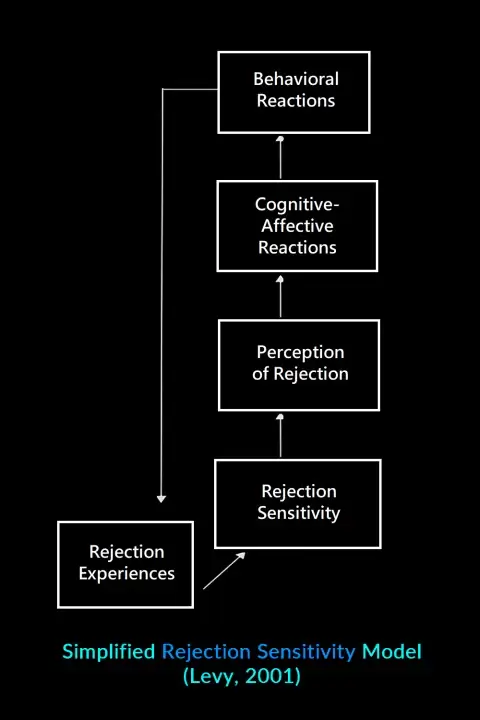
People who’ve faced repeated rejection or criticism can develop a heightened, increasingly automatic sensitivity to future instances of it. The Rejection Sensitivity Model (Levy et al., 2001; Downey & Feitas, 1998) describes this as a cycle: past rejection produces anticipatory anxiety, which causes a person to perceive rejection even where there’s little real evidence of it, which triggers a defensive or hostile reaction, which can actually provoke the rejection the person feared in the first place, reinforcing the whole cycle.
Overlap with other conditions
Rejection sensitivity shows up more often alongside ADHD, autism spectrum conditions, generalized anxiety disorder, and some depressive disorders. A 2019 study found that youth with ADHD showed heightened sensitivity to peer rejection and blunted response to peer acceptance (Babinski et al., 2019). Lord and Liverant (2022) describe rejection sensitivity as potentially “transdiagnostic,” meaning it shows up across a range of different psychiatric presentations rather than belonging to any one of them specifically.
A genetic contribution, with an important caveat
One study proposed a biological piece of the puzzle: variation in the OPRM1 gene, which affects the body’s mu-opioid receptors, and is best known for its role in physical pain regulation.
Way, Taylor, and Eisenberger (2009) found that people carrying a less common version of this gene reported higher dispositional sensitivity to rejection, and showed more brain activity in pain-related regions when rejected in a lab task. It was a genuinely interesting finding, and it got a lot of attention when it came out.
It’s also a single study with a modest sample: 122 participants overall, with only 31 completing the brain-imaging portion. And it hasn’t held up well since. A 2019 study with a far larger, preregistered sample of 490 people specifically tested whether this gene variant predicts rejection sensitivity, and found no evidence that it does, concluding that the link is considerably weaker than the original research suggested (Persson et al., 2019).
That doesn’t mean genetics play no role in rejection sensitivity. Twin and family studies generally suggest some heritable component to most personality traits, this one likely included. It does mean the specific “one gene” story is not something current research supports, and any claim that a relative’s RSD raises your own risk through this particular gene is getting ahead of the evidence.
Signs and Symptoms
Rejection sensitivity tends to show up as a triggered response, with a fear of being turned down by people the person values sitting at the center of it.
- Avoidance. Skipping social situations entirely, or only engaging when rejection feels close to impossible.
- Defensiveness or hostility. Lashing out at, or abruptly withdrawing from, someone perceived as rejecting.
- Reading catastrophe into ambiguous cues. A delayed text reply gets interpreted as anger or disinterest rather than someone being busy.
- Jumping to worst-case scenarios. Anticipated rejection spirals into anxious or depressive thinking about what it “means.”
- Functional impairment in severe cases. Difficulty forming or keeping relationships, overlapping with social anxiety symptoms.
- Dismissing more mundane explanations. Even when a more likely, non-rejecting explanation exists, it gets overridden by the assumption of rejection.
What Rejection Sensitivity Is Associated With
Peer rejection in childhood is linked to a range of downstream difficulties: anxiety, low self-esteem, and depression (Sandstrom & Zakriski, 2004), along with worse performance on social-cognitive tasks like reading peer cues and problem-solving in social situations (Dodge & Feldman, 1990; Nesdale & Lambert, 2008).
By adolescence, chronic peer rejection is associated with academic difficulty, truancy, and higher rates of delinquency and substance use (Kupersmidt, 1990; McDougall, 2001).
In adulthood, rejection and exclusion are linked to emotional distress and depression (Baumeister & Twenge, 2002; Williams & Cheung, 2000), along with self-defeating behaviors such as risk-taking and procrastination (Twenge, Catanese, & Baumeister, 2002).
These are associations, not proof that rejection sensitivity causes any specific outcome on its own. People arrive at heightened rejection sensitivity through different pathways, and it often travels alongside other conditions that independently affect these same outcomes.
How It’s Measured
The Adult Rejection Sensitivity Questionnaire (A-RSQ), developed by Berenson, Ayduk, and colleagues in 2006, is a 12-item self-report measure assessing two dimensions: rejection expectancy (the belief that rejection is likely) and rejection concern (the emotional distress that anticipated rejection produces).
Research using the A-RSQ has found that rejection expectancy is more strongly linked to reduced positive affect, while rejection concern tracks more closely with negative affect and interpersonal dysfunction. It’s used in research settings to identify people at elevated risk for related psychosocial difficulties, and to track whether an intervention is actually changing someone’s rejection sensitivity over time.
What Actually Helps
There’s no cure for rejection sensitivity, in the sense that it’s a trait rather than an illness to eliminate. But there are approaches with reasonable evidence behind them for managing its impact.
- Cognitive-behavioral therapy (CBT). Helps identify and challenge the automatic, catastrophizing interpretations that fuel the cycle, and build more flexible ways of reading ambiguous social situations.
- Mindfulness-based approaches. Can help build a longer pause between a perceived slight and the emotional reaction to it, giving room to check the interpretation before acting on it.
- Working with a mental health clinician, particularly one familiar with ADHD or autism if either is also present, since rejection sensitivity often overlaps with and complicates those presentations.
On medication: this is worth being careful about. Alpha-agonist medications (like guanfacine) are sometimes discussed anecdotally, including by Dodson himself, as helpful for RSD specifically in people with ADHD. But there are no controlled clinical trials establishing this.
If medication comes up in a conversation about rejection sensitivity or RSD, it should be a decision made with a prescriber who can weigh it against your specific history, not something to seek out based on an online claim that it treats RSD.
FAQs
- Is “RSD” the same as rejection sensitivity? No. Rejection sensitivity is the broader, well-established trait studied in psychology for decades. RSD is a term coined more recently by a clinician, describing a more extreme and specifically ADHD-associated pattern, and it has not gone through the same level of formal validation.
- Is RSD exclusive to ADHD? That was the original framing, but it’s contested. RSD-like intensity is also described in the context of autism, and some clinicians see it in other conditions. There isn’t yet a research consensus on how specific to ADHD it really is.
- What might an RSD episode look like? Sudden, intense emotional pain following perceived rejection or criticism, sometimes with physical sensations, and difficulty thinking clearly in the moment. Symptoms can resemble those of depression, social anxiety, bipolar disorder, or PTSD, which is part of why professional evaluation matters rather than self-diagnosis from a symptom list.
- Are anxiety and rejection sensitivity linked? They often coexist. People with generalized anxiety disorder may be more prone to reading social situations as threatening, which can compound an existing tendency toward rejection sensitivity.
- What are some ways to cope in the moment? Naming the physical sensation as it’s happening (tight chest, hot face) can create a small pause before reacting. From there, checking the story you’re telling yourself against the actual evidence, and considering other explanations for what happened, can interrupt the spiral before it escalates into a full defensive or withdrawal response.
Resources:
- Downey, G., & Feldman, S.I. (1996). Definition of rejection sensitivity.
- McDonald, K.L., et al. (2010). Definition of rejection sensitivity.
- Way, B.M., Taylor, S.E., & Eisenberger, N.I. (2009). OPRM1 and social rejection sensitivity. PNAS.
- Persson, E., et al. (2019). Variation in the μ-opioid receptor gene (OPRM1) does not moderate social-rejection sensitivity in humans. Psychological Science.
- Levy et al. (2001) Rejection Sensitivity Model and Downey & Feitas (1998).
- Babinski, D.E., et al. (2019). ADHD and peer rejection sensitivity.
- Berenson, K.R., Ayduk, O., et al. (2006). Adult Rejection Sensitivity Questionnaire (A-RSQ).
- William Dodson’s coining and framing of “rejection sensitive dysphoria.”
- Guanfacine/alpha-agonist use for RSD.
Final Words
Rejection sensitivity is a real, well-documented trait, not a character flaw or a sign of fragility. RSD describes something many people, especially those with ADHD, recognize instantly in themselves, even though the clinical research behind the term is still catching up to its popularity. Both deserve to be taken seriously. Neither deserves to be treated as settled science it isn’t yet, especially when it comes to genetics or medication. If rejection consistently derails your day, a clinician who knows this territory, not a self-test, is the most reliable next step.
“No one can make you feel inferior without your consent.” — Eleanor Roosevelt
√ Also Read: Are You Emotionally Damaged But Don’t Know The Signs?
√ Please share this with someone.
» You deserve happiness! Choosing therapy could be your best decision.
...
• Disclosure: Buying via our links earns us a small commission.