
Today's Friday • 7 mins read
You promised yourself this relationship would be different. Six months in, it feels oddly familiar. Same criticism, different voice. Same silence after conflict, different face across the table.
Maybe it’s the third partner in a row who pulls away right when things get close. This isn’t bad luck. It isn’t a broken picker either. It has a name: repetition compulsion.
Freud coined the term “repetition compulsion” in 1920 to describe how people unconsciously recreate painful experiences instead of avoiding them (Freud, 1920).
A century later, research on attachment and trauma has filled in the mechanism he could only describe from the outside.
What Repetition Compulsion Actually Means
Freud noticed something odd in his patients. They went into relationships that replayed their traumas from past relationships. But on the surface, these relationships were unlike the original ones.
Freud proposed that the mind repeats what it hasn’t mastered.
So it’s as if the mind keeps repeating the same situations while trying for a different outcome the second, third, or tenth time around.
The theory sounds abstract until you see it laid out in a dating history. Three partners in a row who go quiet during conflict. Two marriages that both ended with the same accusation, word for word.
The pattern could be your mind running the same experiment, hoping for new data this time.
Freudian psychotherapists consider “repetition compulsion” a painful and destructive pattern of feeling and behaving in relationships. They think it explains why you keep attracting the same type of toxic people in your life. Perhaps your subconscious mind is trying to get you to re-experience your old relationship wounds over and over again, in the hope that this time you can fix them.
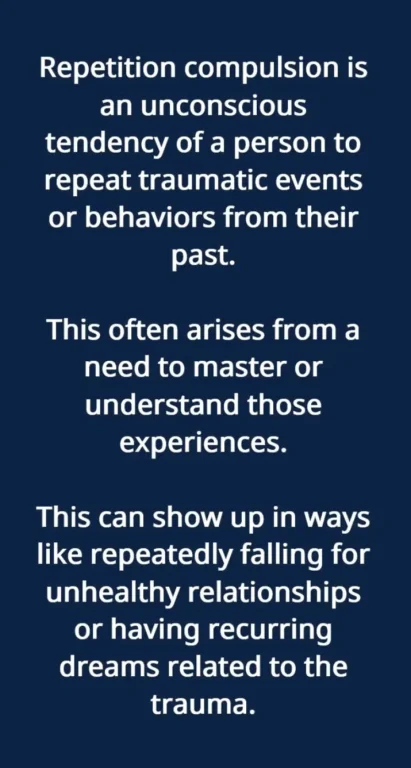
Repetition Compulsion: Why The Familiar Feels Like Home
Attachment theory explains why the pattern feels magnetic instead of obviously wrong. Developed by John Bowlby, it is a psychological framework explaining how early emotional bonds with primary caregivers shape lifelong relationship patterns.
Children build what psychologists call internal working models. These are unconscious templates for what love and closeness are supposed to feel like. They form early, based on the child’s earliest caregivers.
The majority of researchers today hold that it is rare for an adult to forget a childhood trauma completely, and that recovered memories are often inaccurate (Otgaar & Howe, 2019).
If those first bonds were inconsistent, anxious, or distant, a specific thing happens. Their nervous system begins to link love with vigilance, waiting, or the moods of the parent. They learn that love has to be earned through constant effort, not something they can receive for just being themselves.
As adults, this shows up in who they’re drawn to. A calm, consistent partner can start to feel rehearsed, predictable, or even suspicious, simply because it doesn’t match what love used to feel like.
A partner who runs hot and cold reads instead as chemistry, because the nervous system recognizes the rhythm. It isn’t chemistry; it’s recognition, and recognition is a powerful, misleading signal.
Not every insecure attachment style produces this pull with equal force. Anxious attachment tends to produce the vigilance and effort-based love just described.
Disorganized attachment, the pattern that develops when a caregiver was both a source of comfort and a source of fear, shows the strongest link to this kind of trauma reenactment (Liotti, 2004). Liotti proposed that early disorganized attachment, dissociative processes, and vulnerability to trauma are deeply interconnected concepts.
In fact, disorganized attachment adds a harder edge: an unconscious pull toward partners who are frightening in the same way the original caregiver was.
What The Nervous System Tries To Fix With Repetition
Psychiatrist Bessel van der Kolk studied trauma survivors who kept ending up in situations that echoed their original injuries.
He concluded that repetition is also a physiological response, not just psychological. The body seeks a kind of resolution it never got the first time around. It replays the old dynamic, hoping to finally come out the other side in control (van der Kolk, 1989).
That’s part of why the pull toward a familiar but painful dynamic can feel so strong, almost involuntary. It is likely an old survival system, still running its original code, in a present-day context where that code no longer serves you well.
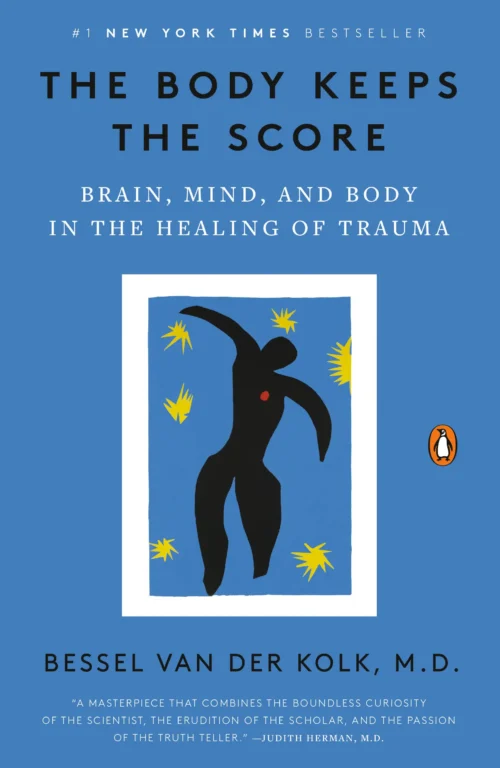
“For real change to take place, the body needs to learn that the danger has passed and to live in the reality of the present.” – Bessel van der Kolk, The Body Keeps the Score
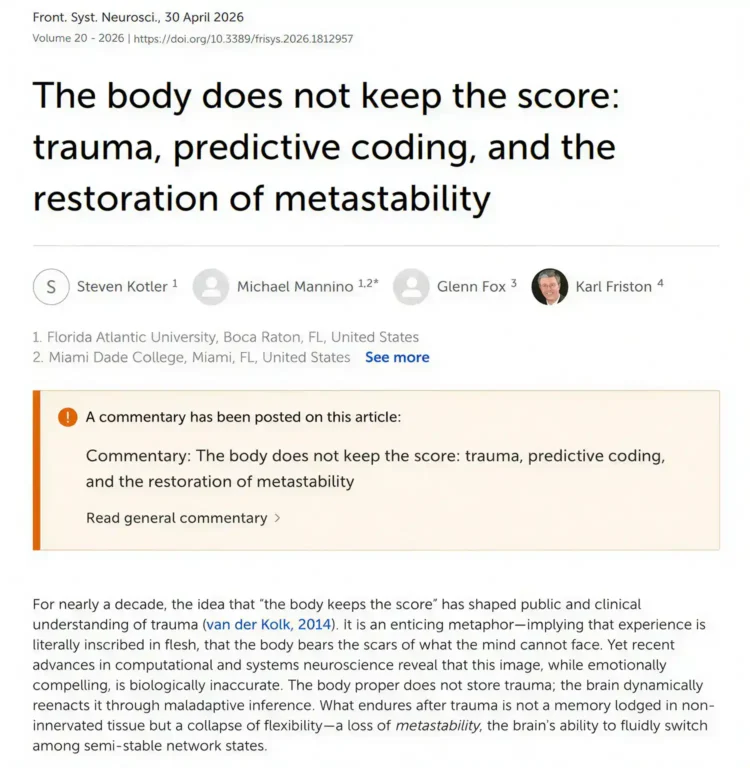
To be fair, Kolk’s “body keeps the score” idea has been proven wrong recently (Kotler & Mannino, 2026).
How Early Attachment Follows You Into Adult Relationships
A landmark longitudinal study that tracked children from infancy all the way into their twenties might just provide the right evidence.
Researchers found that attachment security at just 12 months old predicted the quality of emotional experience in romantic relationships two decades later. The effect was partly explained by the person’s social competence in childhood, and by the quality of their teenage friendships (Simpson et al., 2007).
The throughline from a one-year-old’s bond with a caregiver to a twenty-three-year-old’s fights with a partner is a real enough measure across thirty years of data.
This is also why repetition compulsion rarely announces itself clearly.
Nobody consciously picks a partner because they resemble a difficult parent. The resemblance usually hides underneath the surface traits.
A parent who criticized achievement might get echoed by a partner who criticizes appearance instead. The content changes from person to person. The emotional shape underneath stays the same. That particular flavor of not-quite-good-enough keeps showing back up.
Why Awareness Alone Doesn’t Break the Pattern
Here’s the frustrating part. Knowing all of this rarely stops it from happening again on its own.
Insight explains the pattern, but it doesn’t automatically rewire the nervous system that generates it in the first place.
Plenty of people can narrate their own repetition compulsion in perfect detail. And they can still find themselves three months into the exact same dynamic anyway.
You can’t blame these on a failure of willpower or a lack of self-knowledge. Actually, the attachment patterns that build in infancy, long before language existed, are too powerful to respond to being talked about the way most adult problems do.
They respond to new, repeated, lived experience that directly contradicts the old template over time.
How to Actually Interrupt the Cycle of Repetition Compulsion
Breaking the pattern starts with noticing it. But noticing alone can’t eliminate it instantly. A few things help:
Track the early signals: Monitor the specific feelings (e.g., stress signals in your body) when a new relationship starts to resemble an old one, not just the eventual blowup months later.
Get curious about behavior patterns. Get curious about what feels “boring” in a calm, steady partner. That boredom may actually be the old template complaining that it isn’t being fed the chaos it expects.
Watch for the opposite signal: An instant, overwhelming sense that someone is “the one” within the first few weeks. That intensity is sometimes recognition of something healthy. Just as often, it’s an old pattern lighting up in familiar, painful territory.
Seek a therapist. Work with a therapist trained in attachment-based approaches when possible. These patterns formed inside relationships, and they tend to heal fastest inside one too. Expect slow, uneven progress along the way.
A pattern laid down over years of childhood does not dissolve after a few weeks of awareness, no matter how sincere that awareness is.
Final Words
The detail worth sitting with:
Repetition compulsion is your mind trying to finish something old, using the only tools it had available at the time it first learned them. Not your mind sabotaging you on purpose.
That reframe doesn’t make the pattern less painful to live through. It does make it less shameful, and shame turning down is often the first real condition for anything to change.
The relationship you’re in right now can still be the one where the old pattern finally gets rewritten.
√ Also Read: Trauma Bond Addiction: Why Victims Return To Their Abusers
√ Please share this with someone.
» You deserve happiness! Choosing therapy could be your best decision.
...
• Disclosure: Buying via our links earns us a small commission.