Today's Monday • 14 mins read
Every November, millions of people gather around a table and take turns saying what they are grateful for.
Thanksgiving makes gratitude a public ritual. For one day, we pause to notice the people, experiences, and ordinary parts of life that we might otherwise take for granted.
But does gratitude actually make people happier?
Psychologists have studied that question for more than two decades. One of the most influential early studies came from psychologists Robert Emmons and Michael McCullough. Their 2003 research found that people assigned to keep a weekly gratitude journal reported better overall well-being and greater optimism than people who recorded daily hassles or neutral events.
In one of the study’s measures, Emmons later described the difference as a 25 percent higher well-being score for the gratitude group.
That number became widely cited as evidence that gratitude can make us 25 percent happier. The actual research is more interesting and more limited than that headline suggests.
Gratitude appears to have a modest positive effect on well-being, and some studies have found benefits for sleep, mood, optimism, and social connection. But gratitude is not a guaranteed happiness formula, and the effects vary between studies and people.
So what does the research really tell us?
The Research Behind the 25% Gratitude Effect
Emmons and McCullough published their landmark paper, “Counting Blessings Versus Burdens,” in the Journal of Personality and Social Psychology in 2003.
In one of their studies, 192 college students were assigned to one of three groups for 10 weeks. Each week, they recorded five things from their lives.
The three groups were:
- Gratitude group: five things they were grateful for
- Hassles group: five things that had annoyed or bothered them
- Events group: five neutral events that had occurred during the week
The researchers then compared several measures of well-being.
The gratitude group reported feeling better about their lives as a whole and more optimistic about the future than the comparison groups. They also reported exercising more regularly and experiencing fewer physical symptoms.
Emmons later summarized one of the key well-being differences as a 25 percent higher score for the gratitude group.
“Participants in the gratitude condition felt better about their lives as a whole and were more optimistic about the future than participants in either of the other control conditions. To put it into numbers, according to the scale we used to calculate well-being, they were a full 25 percent happier than other participants.” — Thanks! How the New Science of Gratitude Can Make You Happier by Robert Emmons.
That finding is worth knowing, though it does not mean that everyone who starts a gratitude journal will become 25 percent happier. The figure came from a particular study, population, and measurement scale. So it hints at a possible result from that experiment rather than as a universal effect size for gratitude.
The broader research supports a smaller and more cautious conclusion: gratitude practices can improve aspects of well-being, but the average effects are modest.
A 2026 multinational megastudy by Coles and colleagues tested six brief gratitude practices with 10,696 participants across 34 countries. Compared with control activities, the gratitude practices produced small immediate improvements in positive affect, optimism, and life satisfaction (Coles, Dang, & Oishi, 2026).
The evidence therefore supports gratitude as a useful psychological practice, while giving us little reason to treat the 25 percent figure as a general promise.
A Secular Grace For Thanksgiving
As we eat, let us turn our minds to every individual we know, and wish them plenty, love and comfort on this day and every day. As we sit together, let us turn our minds to those we do not know, and wish them plenty, love and comfort on this and every day. As we celebrate, let us turn our minds and hearts to love, always love, of everyone on this world. Finally, let us turn our minds and hearts onto ourselves, make our wishes into action: sharing love and comfort whenever we can, with whomever we can, wherever we may be, and be thankful for the opportunities to give, love and comfort. In this way, we give thanks and are thankful in return. — by Kris Punke
What Happened When People Counted Their Blessings?
The Emmons and McCullough findings were interesting because the gratitude group did more than simply report feeling grateful.
Compared with the other groups, participants who kept gratitude lists reported greater optimism and better evaluations of their lives. They also reported more time spent exercising.
The researchers found differences across several outcomes, although they were not equally strong. Positive affect, or the experience of positive emotions, emerged as the most consistent finding across the studies.
This matters because psychological research rarely produces one intervention that improves every measure.
A gratitude practice may affect some aspects of well-being more reliably than others.
That is a more useful conclusion than the idea that gratitude produces a fixed percentage increase in happiness.

“Gratitude is an acknowledgment that we have received something of value from others. It arises from a posture of openness to others, where we are able to gladly recognize their benevolence.” — Emmons & Mishra, 2010
Can Gratitude Improve Sleep?
One of the more interesting findings from the 2003 research involved people with neuromuscular disease.
In a separate study, adults with neuromuscular disorders completed a 21-day gratitude intervention. Compared with the control group, those in the gratitude condition reported better sleep duration and quality. They also reported more positive moods, greater optimism, and a stronger sense of connection with other people.
The sleep finding is worth noting, but the population matters.
These participants were adults living with a significant chronic health condition. We should not assume that the same size of effect would occur in healthy adults.
Later research has continued to examine gratitude and sleep, with some studies reporting improvements in subjective sleep quality. The overall evidence is promising, but it does not justify claiming that gratitude is a treatment for insomnia or other sleep disorders.
Gratitude can be one part of a healthy routine. It should not replace appropriate medical or psychological care when sleep problems are persistent.
How Gratitude Improves Your Well-Being
Gratitude changes what you pay attention to.
When you deliberately notice what you appreciate, you give more mental space to people, experiences, and parts of your life that might otherwise fade into the background. Over time, this can influence how you evaluate your life and how you feel about it.
For example, when you regularly notice the people who support you, you may become more aware of your social connections. When you record small things that went well, you may become more attentive to positive experiences during the day. When you reflect on help you have received, you may feel more connected to others and more willing to express appreciation.
Research supports some of these effects. A 2025 meta-analysis involving more than 24,000 participants across 28 countries found that gratitude interventions produced a small overall improvement in well-being, with stronger effects when researchers measured positive emotions (Choi et al., 2025).
Gratitude may also help you build stronger social connections. Expressing appreciation to another person can reinforce relationships and increase feelings of social connectedness, although the strength of these effects varies across studies.
You should not expect gratitude to erase difficult emotions. You can feel grateful and sad at the same time. You can appreciate what is good in your life while still experiencing stress, anger, grief, or disappointment.
A healthy gratitude practice makes room for both: noticing what is good without pretending that everything is good.
Does Gratitude Challenge the Happiness Set Point?
Early gratitude research was conducted partly against the background of the happiness set-point idea.
Set-point theories proposed that people tend to have relatively stable long-term levels of well-being and that major changes in circumstances may produce just temporary changes followed by adaptation.
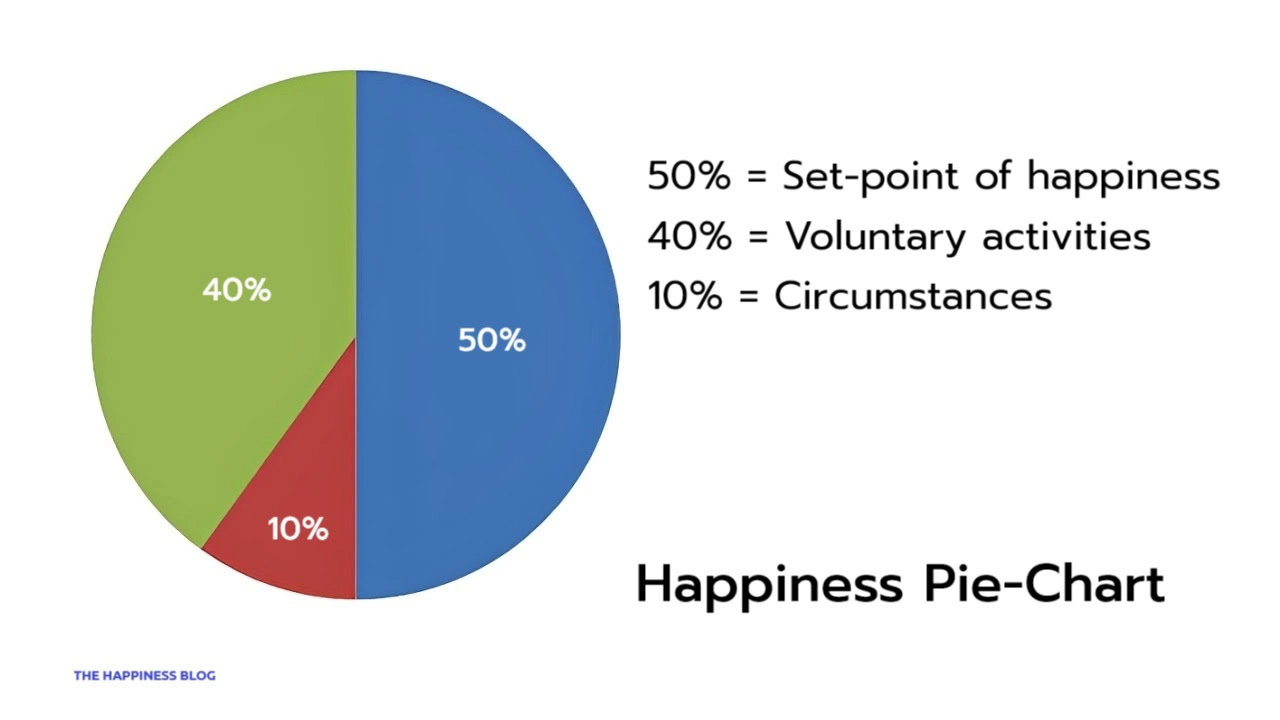
Emmons and McCullough considered this an important challenge for gratitude research. If people’s well-being were strongly fixed, a brief gratitude exercise should have limited effects.
Their studies provided evidence that gratitude interventions could change some measures of well-being, at least over the periods studied.
That does not prove that gratitude permanently resets a person’s happiness baseline.
The modern picture of happiness is more complicated than the old idea of a single fixed set point. Well-being reflects a combination of personality, circumstances, relationships, behavior, health, and other factors. People also differ in how strongly they adapt to changes in their lives.
Gratitude is one influence among many.
Beyond Happiness: What Does Gratitude Affect?
Gratitude research has examined much more than happiness: positive emotions, life satisfaction, optimism, social connection, sleep, physical symptoms, health behaviors, and mental health.
The findings are encouraging in several areas but not uniform.
- Diniz & Korkes (2023) reviewed 64 studies to find that gratitude interventions were associated with better mental health, fewer symptoms of anxiety and depression, and more positive emotions.
- Choi & Cha (2025) analyzed 145 papers involving over 24,000 participants to find that gratitude interventions produced an overall improvement, though small, in well-being.
- Coles & Dang (2026) tested 10,696 participants across 34 countries to find that gratitude practices produced small immediate improvements in positive affect, optimism, and life satisfaction.
The effect may be small, but that does not make gratitude practice meaningless. Small effects over time can snowball into a significant change. Moreover, most gratitude activities are inexpensive, accessible, and easy to repeat.
How to Practice Gratitude Without Forcing It
The simplest approach is to keep a gratitude journal. And you do not need to write several pages each day.
You can begin by listing three or five things you appreciated. They can be important events, ordinary experiences, people who helped you, or small details that made the day better.
Specific examples are usually more useful than vague statements.
Instead of writing:
“I am grateful for my family,”
you might write:
“My daughter called me after a difficult day and made me laugh.”
The second statement directs attention toward a particular experience.
You can also write about why you appreciated something. This adds detail and may make the exercise more meaningful.
Another approach is to express gratitude directly. Send someone a message. Thank a colleague. Tell a friend what you appreciate about them.
For children, gratitude practices can be concrete. A family gratitude jar or a short gratitude ritual at dinner can make the practice easier to understand and remember. Research by Jeffrey Froh, Giacomo Bono, and colleagues has also examined gratitude in children and adolescents.
Another approach Emmons suggests: remembering the difficult times and recognizing the people or circumstances that helped you get through them.
That does not require pretending that hard things weren’t hard. It’s about recognizing that you survived through the painful experiences and made it to the other side.
Gratitude and acceptance of difficulty can exist together.
How Much Gratitude Do You Need?
The research does not provide a single ideal gratitude schedule for everyone.
The influential Emmons and McCullough study used weekly gratitude lists in one experiment. Other studies have used daily exercises, gratitude letters, reflections, or other formats.
The broader research suggests that gratitude interventions can help, but their effects depend on the type of practice, the outcome being measured, and the comparison condition.
That means you do not need to turn gratitude into another demanding self-improvement project.
A short weekly reflection may be enough to begin.
You might ask yourself:
- Who helped me?
- What went well this week?
- What ordinary thing did I enjoy?
- What would I miss if it were suddenly gone?
- What did someone do for me that I appreciated?
The point is to pay deliberate attention to things that are easy to overlook.
The Thanksgiving Effect
Thanksgiving gives gratitude a special place in American culture. It offers an annual occasion to reflect on one’s blessings. However, the psychological benefits of gratitude may also be worth considering beyond this holiday.
Research suggests that regularly practicing gratitude can improve some aspects of well-being. The effects are generally modest, and they vary across studies. Still, gratitude remains one of the simpler positive psychology practices to test in your own life.
The famous finding by Emmons & McCullough that gratitude increased happiness by 25% should be viewed as a potential outcome rather than a guaranteed result.
The more durable lesson is simpler. When we deliberately notice what we value, we give those parts of life more attention. And that can influence how we experience our days, how we think about other people, and how we evaluate our lives.
Thanksgiving gives us one day to practice that attention. Gratitude gives us the option to practice it throughout the year.
FAQs
1. Does gratitude really make you happier?
Gratitude practices can produce noticeable, though small, improvements in well-being and positive emotions. So gratitude should be viewed as a useful practice rather than a guaranteed way to become happier.
2. Is the 25% gratitude effect real?
The 25 percent figure comes from Robert Emmons and Michael McCullough’s 2003 research. They found that the gratitude group scored about 25% higher on the well-being scale than the comparison groups. It does not mean that everyone who practices gratitude becomes 25% happier.
3. How long does it take for gratitude to work?
There is no single answer. Different studies have used different schedules. The Emmons and McCullough research included a 10-week weekly gratitude exercise and a separate 21-day study involving adults with neuromuscular disease. Some benefits were observed during those study periods, but the research does not establish a universal number of days required for gratitude to work.
4. Can gratitude improve sleep?
Studies suggest that gratitude practices can improve subjective sleep quality. Emmons and McCullough found better sleep duration and quality after a 21-day gratitude intervention among adults with neuromuscular disease. This does not mean gratitude should be considered a treatment for insomnia or other sleep disorders.
5. What is the best way to practice gratitude?
There is no single method proven to work best for everyone. Common approaches include keeping a gratitude journal, listing things you appreciate, writing a gratitude letter, or intentionally expressing appreciation to another person. A simple practice you can maintain regularly, such as once a week, is a reasonable place to start.
6. Can gratitude become toxic positivity?
Yes, if gratitude is used to dismiss or suppress genuine distress. Healthy gratitude does not require you to deny grief, anger, fear, or other difficult emotions. You can recognize what is good in your life while still acknowledging what is painful or difficult.
References
- Emmons, R. A., & McCullough, M. E. (2003). Counting blessings versus burdens: An experimental investigation of gratitude and subjective well-being in daily life. Journal of Personality and Social Psychology, 84(2), 377–389. https://doi.org/10.1037/0022-3514.84.2.377
- Froh, J. J., Sefick, W. J., & Emmons, R. A. (2008). Counting blessings in early adolescents: An experimental study of gratitude and subjective well-being. Journal of School Psychology, 46(2), 213–233. https://doi.org/10.1016/j.jsp.2007.03.005
- Diniz, G., Korkes, L., Tristão, L. S., Pelegrini, R., Lacerda Bellodi, P., & Bernardo, W. M. (2023). The effects of gratitude interventions: A systematic review and meta-analysis. Einstein (São Paulo), 21, eRW0371. https://doi.org/10.31744/einstein_journal/2023RW0371
- Choi, H., Cha, Y., McCullough, M. E., Coles, N. A., & Oishi, S. (2025). A meta-analysis of the effectiveness of gratitude interventions on well-being across cultures. Proceedings of the National Academy of Sciences, 122(28), e2425193122. https://doi.org/10.1073/pnas.2425193122
- Coles, N. A., Dang, A. V., Oishi, S., et al. (2026). A multinational megastudy of the effects of gratitude practices on subjective well-being. Proceedings of the National Academy of Sciences, 123(20), e2537789123. https://doi.org/10.1073/pnas.2537789123
Final Words
Gratitude is neither magic nor a cure-all, and it may not produce an instant dramatic change. But regular gratitude practice can help you become more positive-oriented, so you notice more of the good things in your life. Over time, it can lead to better well-being.
Positive psychologists, scientists who study the science of happiness, have explored gratitude over many years.
Robert A. Emmons, founding editor of The Journal of Positive Psychology and gratitude researcher, has shown us that gratitude practice can lead to increased happiness and well-being. In one of his studies, participants who kept a journal noting five things they were grateful for were 25% happier than the other groups.
Finally, this may be the most useful takeaway: A healthy gratitude practice makes room for noticing what is good without pretending that everything is good.
• • •
√ Also Read: The Gratitude Key: More Thankfulness Is More Happiness
√ Please share this if you found it helpful.
» You deserve happiness! Choosing therapy could be your best decision.
...
• Disclosure: Buying via our links earns us a small commission.