Today's Saturday • 17 mins read
— By Dr. Sandip Roy.
Some people get success after success easily, while others struggle. Why?
Maxwell Maltz’s classic bestseller “Psycho-Cybernetics” explains the why. And also solves the how.
What you’re going to read below is an in-depth summary of Psycho-Cybernetics. It includes all of Maltz’s lessons on how to switch into an abundance mindset and become your most successful version.
Free PDF: Summary of Psycho-Cybernetics: Mindset Mastery Made Easy
Psycho-Cybernetics in One Sentence: Maxwell Maltz argues that human psychology functions like a mechanical servo-mechanism directed by your internal self-image, meaning real change requires reprogramming your subconscious blueprint through mental visualization rather than raw willpower.
“Your self-image determines your self-worth.”
— Maxwell Maltz, “Psycho-Cybernetics”
Core Summary of Psycho-Cybernetics
Maxwell Maltz merged cybernetics (the science of self-regulating control systems) with clinical psychology to create Psycho-Cybernetics. He defined the practice as steering your mind toward productive, worthwhile goals to achieve genuine peace of mind.
7 Foundational Principles of Psycho-Cybernetics:
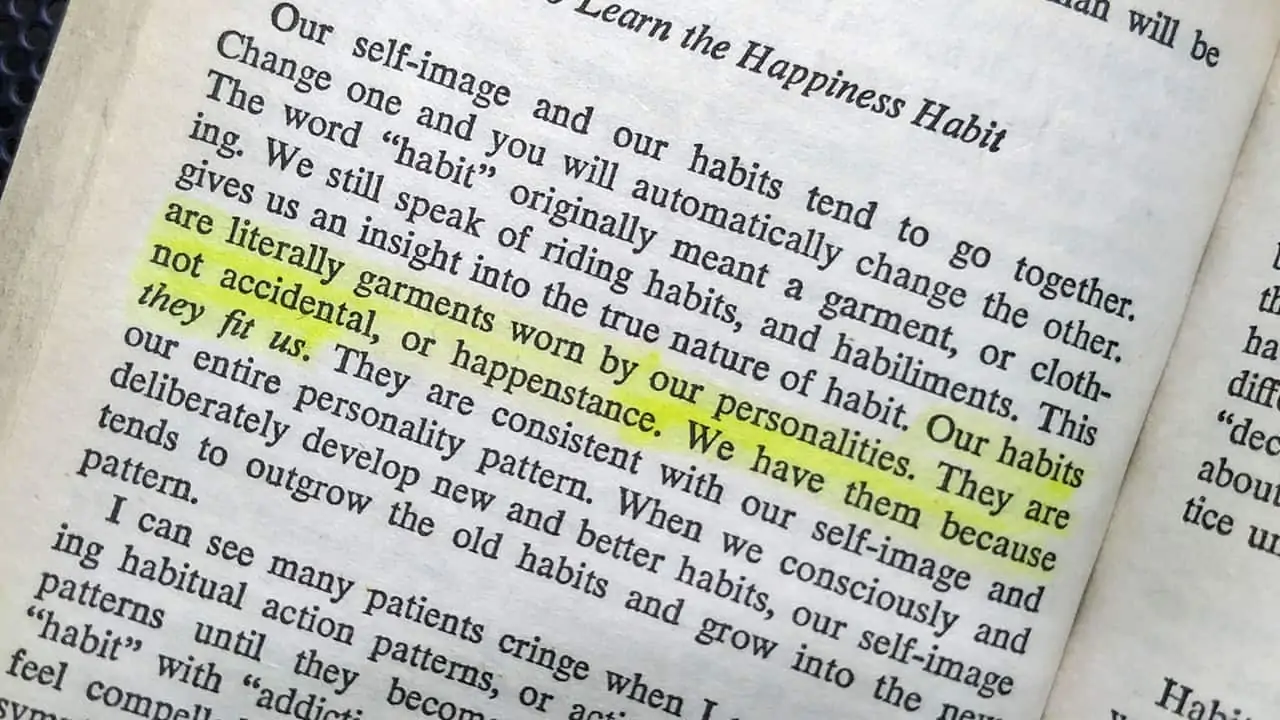
- The Self-Image as an Internal Blueprint: Your self-image sets the strict boundaries of your individual achievement. All actions, feelings, and behaviors consistently align with this subconscious mental picture. You can never outperform your self-image for long because the mind automatically acts to preserve it.
- The Brain as a Goal-Striving Servomechanism: Your nervous system functions as an automatic goal-seeking mechanism, much like a self-guided torpedo or guidance computer. It relies on conscious direction to steer toward a target, then executes the fine-tuning adjustments automatically.
- The Automatic Success Mechanism: When you supply your subconscious with clear targets and confidence, the Creative Mechanism operates as an Automatic Success Mechanism. If fed fear, doubt, and self-criticism, the exact same biological system activates as an Automatic Failure Mechanism.
- Synthetic Experience via Mental Rehearsal: The human nervous system cannot tell the difference between a real experience and one imagined vividly in detail. Mental practice, or “shadowboxing,” builds actual physical neural pathways, allowing you to train successful responses before stepping into the situation.
- Dehypnotizing False Beliefs: Limiting beliefs operate like post-hypnotic suggestions. Changing these behaviors requires using rational thought to dismantle false conclusions from past failures, recognizing mistakes as temporary course corrections rather than permanent identity flaws.
- Emotional Scars and Psychological Surgery: Old emotional injuries build thick psychological scar tissue that acts as a rigid defense mechanism against intimacy and growth. Forgiveness acts as the mental scalpel, cutting away past resentment to restore personal freedom.
- Present-Moment Action and Habitual Happiness: Happiness is a mental habit practiced in the present, not a future reward earned by external achievements. Setting clear, immediate objectives keeps your servo-mechanism focused on active solutions instead of passive worry.
“Our self-image subconsciously directs us toward success or failure. When we hold a negative self-image, failure becomes automatic. When we cultivate a positive self-image, success becomes our baseline. Maltz shows us how reshaping this internal blueprint puts our minds on autopilot toward happiness and achievement.”
The S.U.C.C.E.S.S. vs. F.A.I.L.U.R.E. Mechanism
Dr. Maltz observed that human behavior patterns cluster into two distinct personality profiles. He organized these operational habits into two memorable acronyms, showing exactly how the mind steers toward accomplishment or breakdown.
Ingredients of the Success-Type Personality
The Automatic Success Mechanism operates through seven distinct habits:
- S – Sense of Direction: You need a clear, realistic target. The automatic mechanism functions like an automated ship: without an active port destination, it drifts aimlessly.
- U – Understanding: You interpret reality objectively. Rather than letting irrational fears or emotional biases distort events, you separate factual data from personal assumptions.
- C – Courage: You take calculated, decisive action on your goals without waiting for absolute certainty. Action produces the feedback your servo-mechanism requires to course-correct.
- C – Charity: You value other people and treat them with genuine respect. Maltz found that high self-esteem always correlates with a high regard for the humanity of others.
- E – Esteem: You maintain a healthy self-respect based on your inherent human worth, refusing to equate a temporary performance error with personal inadequacy.
- S – Self-Confidence: You build internal confidence by deliberately remembering past successes while discarding and forgetting past mistakes after extracting the core lesson.
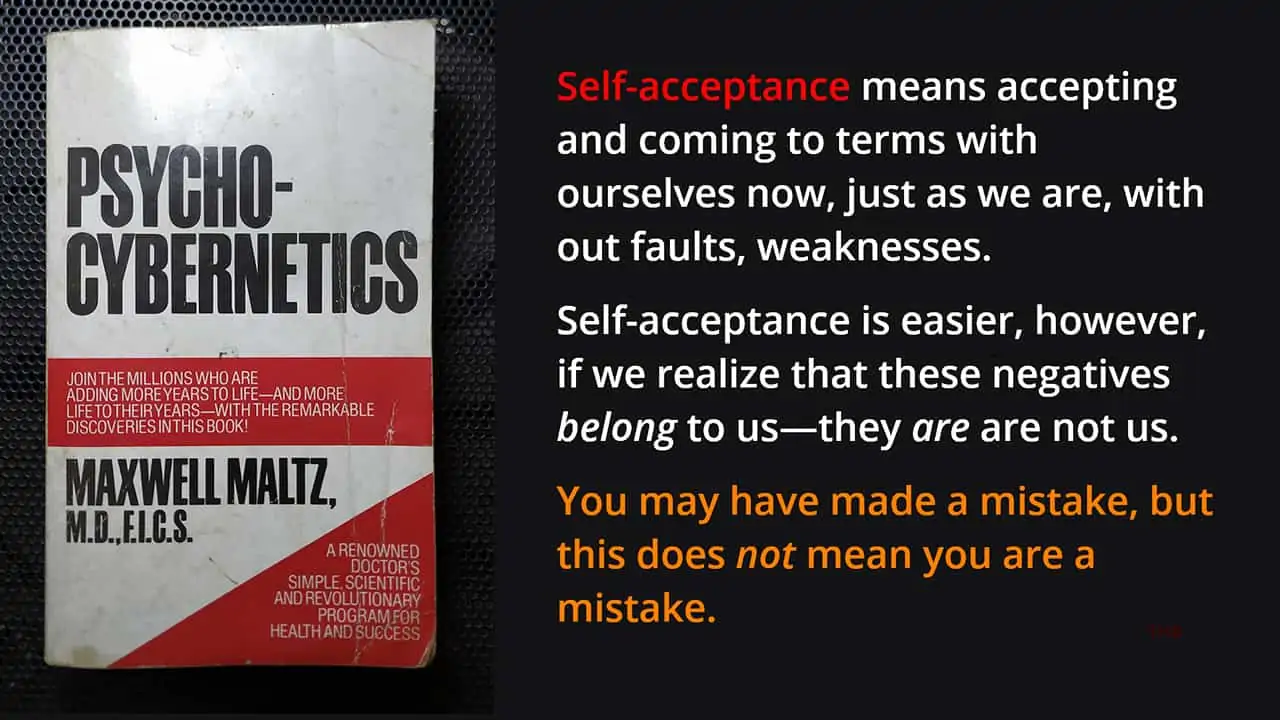
- S – Self-Acceptance: You accept yourself as you are right now, including your current flaws and limitations, while remaining committed to steady personal growth.
Warning Signs of the Failure-Type Personality
When the mind is fed negative data and restrictive beliefs, it engages the Automatic Failure Mechanism. Recognizing these symptoms allows you to diagnose and adjust your internal guidance system:
- F – Frustration: Emotional dissatisfaction that occurs when you set unrealistic demands on yourself or feel blocked from achieving a target.
- A – Aggressiveness: Misdirected emotional energy and hostility directed toward innocent bystanders or yourself instead of being channeled into constructive problem-solving.
- I – Insecurity: The chronic feeling of inadequacy that stems from comparing yourself to an impossible standard or competing against other unique individuals.
- L – Loneliness: Emotional isolation caused by building protective psychological walls, cutting yourself off from real connection with others.
- U – Uncertainty: Compulsive hesitation and fear of decision-making, which paralyzes your automatic guidance mechanism from taking necessary action.
- R – Resentment: Dwelling on past injustices and blaming outside circumstances for present failures, keeping emotional wounds constantly reopened.
- E – Emptiness: A persistent lack of purpose or emotional satisfaction that occurs when you abandon active goal pursuits.
How Psycho-Cybernetics Works: The Servo-Mechanism Concept
Psycho-cybernetics works by training your subconscious mind with conscious instructions.
Psycho-Cybernetics operates on a simple principle: your conscious mind gives the orders, and your subconscious mind executes them automatically.
Imagine your subconscious mind as an elephant and your conscious mind as its mahout. The elephant moves as per its mahout’s directions, and so does our subconscious mind dutifully follow the conscious mind’s instructions.

Maltz compared the human brain and nervous system to a sophisticated servomechanism, a goal-striving machine like a computer or a self-guided torpedo.
- The Conscious Mind (The Operator): The conscious mind evaluates data, sets the target, and decides what to focus on. It chooses the destination. It does not need to know how to coordinate all the physical and mental processes to get there.
- The Subconscious Mechanism (The Guidance System): The subconscious houses your Automatic Creative Mechanism. Once programmed with a clear target and emotional intensity, it automatically coordinates muscle memory, past experiences, and creative insights to hit that target.
Conscious Mind (Selects Target)
       │
       ▼
Subconscious Servomechanism (Executes Action)
       │
       ▼
Trial & Error (Negative Feedback Course-Correction)
       │
       ▼
Goal Realization
The Power of Negative Feedback
Just like a radar-guided missile continually corrects its trajectory when it veers off course, your brain uses mistakes as negative feedback.
When you learn to ride a bicycle or play an instrument, initial errors serve one purpose: telling the system what not to do. Once a successful attempt occurs, the servomechanism remembers the successful pattern and forgets the errors. Psycho-Cybernetics works when you stop fixating on the errors and let your automatic mechanism lock onto the successful target.
The Interesting Origin Story of Psycho-Cybernetics
Dr. Maxwell Maltz was a popular cosmetic surgeon. He noticed that when some of his patients met him after surgeries, they had become entirely new people. They had new behaviors, attitudes, habits, and lifestyles.
But what motivated them? As he dug in to know more, he realized:
When they saw a more beautiful self-image (in the mirror), their minds started “beautifying” the other parts of their lives.
Maltz understood now that they made these changes in their persona to match their better-looking faces. This led him to conclude that the human mind operates like a “servo mechanism” that tunes one’s entire life in sync with their self-image.
Servo-mechanisms are so constructed that they automatically “steer” their way to a goal, target, or “answer.”
— Maxwell Maltz, “Psycho-Cybernetics”
How To Use Psycho-Cybernetics To Succeed In Life
The strategy to harness the “psycho-cybernetics” system:

- A. Analyze your current self-image.
- B. Bring into play psycho-cybernetics.
- C. Create a brand new, positive self-image.
A. Analyze Your Self-Image
Answer these questions to review your self-image:
- Do I see a successful person in my mental mirror?
- In twenty words or less, who am I (only I will read it)?
- What are six of my most limiting opinions and beliefs?
- What do I believe about money, happiness, and success?
- Can I commit to doing what I say I will do for my success?
- How do I treat myself: with kindness, harshness, or criticism?
- Am I aware of what people think about me (did I ask others)?
- Do I blame others, situations, or past failures for my present state?
- What stories do I tell people about myself (are those entirely true)?
- Does this fear lurk in my mind that I will fail, no matter how hard I try?
Then write down in a few sentences what your self-trapping beliefs are. Examples below:
- I think I am unlucky.
- I think I am unlovable.
- I think I have no talent or expertise.
- I think I’m not made for success, fame, or a rich life.
- I think people would mock me for having lofty goals.
Maltz suggests how to deal with your negative self-beliefs:
- Realize that your negative self-belief is not a fact.
- Stop letting your negative self-belief define your self-image.
- You can change your self-beliefs, no matter where they came from.

B. Bring Into Play Psycho-Cybernetics
This step is about feeding your subconscious mind with a new manual.
1. Replace Unhelpful Beliefs:
Try to see the bright side of bad things.
Swap your limiting belief from your earlier self-analysis, say “I’m not good enough,” with an empowering one, like “I am capable and improving every day.”
For example, “I see this failure as a teaching moment for my next attempt.”
Write this new belief down and repeat it aloud twice daily, ideally in the morning and before bed, to start reprogramming your subconscious.
Over time, as Maxwell Maltz suggested, this deliberate shift acts like updating software, allowing your mind’s guidance system to steer toward positive outcomes rather than self-sabotage.
2. See Your Ideal Self:
Close your eyes in a quiet space and vividly imagine yourself embodying the traits you desire.
Do you want to have more confidence or resilience? Then picture your posture to the reactions of others around you.
Spend five to ten minutes daily on this mental rehearsal, engaging all senses to make the scene feel real, much like an athlete visualizing a perfect performance.
This will feed your subconscious a clear target, automatically adjusting your behaviors to align with that ideal image.
3. Create Affirmations:
Craft short, positive statements in the present tense that reflect your goals, for example, “I handle challenges with ease and creativity.”
Personalize them based on your self-image analysis, ensuring they counteract specific negative beliefs, and jot them on sticky notes placed where you’ll see them often, like your mirror or phone screen.
Recite these affirmations with genuine emotion during moments of relaxation, reinforcing the new manual for your mind’s servo-mechanism to foster lasting change.
4. Reflect on Successes:
Set aside time each evening to recall three past achievements, no matter how small.
Find time to journal about what skills or qualities made your past successes possible. Focus on the feelings that you had when you accomplished each.
This reflection creates a positive feedback loop. It trains your subconscious to recognize and build upon your strengths.
Gradually, incorporate these successes into your daily visualizations, creating a bridge between proven wins and future aspirations.
5. Challenge Negative Thoughts:
When a pessimistic idea arises, pause and question its validity by asking, “Is this based on facts or old habits?”
Then, reframe it constructively. For instance, turn “I’ll never succeed” into “What can I learn to improve next time?”.
Note down the shift in a dedicated thought journal.
Consistently interrupting negative thought patterns disrupts their automaticity. And allows your psycho-cybernetic system to redirect energy toward growth and resilience.
6. Seek New Experiences:
Step outside your comfort zone by trying one novel activity weekly, such as joining a class or networking event, to expose your mind to fresh evidence of your capabilities.
Observe and record how these experiences contradict limiting beliefs, using them as real-world data to update your subconscious programming.
As Maltz observed, this active exploration acts like calibration for your internal guidance system, fine-tuning it to navigate toward expanded possibilities with greater accuracy.
7. Practice Self-Compassion:
Treat yourself with the kindness you’d offer a close friend during setbacks by speaking gently, perhaps saying, “It’s okay, you’re learning,” instead of harsh criticism.
Incorporate brief daily rituals, like a mindful breathing break, to nurture this habit and reduce self-judgment.
Maltz highlighted that self-compassion clears emotional static, enabling your subconscious to receive and act on positive directives more effectively.
C. Create A New Self-Image
Some steps to build and solidify a new, positive self-image are:
- Decide To Reset: Consciously decide to reset the unhelpful parts of your current self-image.
- Positive Visualization: Start regularly visualizing a confident, successful version of yourself.
- Embrace New Roles: Actively take on roles and responsibilities that match your new self-image.
- Positive Peer Influence: Surround yourself with people who reflect the qualities you aspire to.
- Affirmation and Action: Combine affirmations with actions that reinforce your new self-image.
- Celebrate Small Wins: Own and celebrate even small achievements that match your new self-image.
- Record Progress: Keep a journal of your growth and changes in self-perception.
- Embrace Change: Be open to evolving and refining your self-image as you grow.
“To really live, that is to find life reasonably satisfying, you must have an adequate and realistic self-image that you can live with. You must find your self acceptable to you.”
— Maxwell Maltz
Case Study On Self-Image Transformation
Maxwell Maltz tells a story about his friend, Dr. Alfred Adler. Adler was a well‑known psychiatrist and neurologist. He founded Individual Psychology.
In school, Adler struggled with math. His teacher saw him as a student who disliked math and lacked talent. Adler believed this view. He began to think he would always be bad at math.
One day, he solved a hard problem. It shocked his teacher and him. That win gave him confidence. He changed his limiting self‑image and improved at math.
Maltz says that at any age, seeing true worth can spark big personal growth. As he writes, “one is never too young nor too old to change his self‑image and thereby start to live a new life.”
Later, Adler coined two terms we still use today: inferiority complex and superiority complex.
My best lesson from the book will always be this: You may have made a mistake, but this does not mean you are a mistake.

Taking steps is the only way to achieve your goals.
Positive Affirmations
Positive affirmations are short and simple positive declarations to yourself. They replace your negative self-talk with empowering beliefs.
Choose affirmations that feel real and convincing to you, or else you would be reluctant to repeat them. Repeat them daily to let them sink into your subconscious mind.
Some examples of positive affirmations:
- “I am worthy of success.”
- “I am confident and capable.”
- “I am attracting abundance into my life.”
- “I am achieving my goals one step at a time.”
Focus on the emotional side of your affirmations. Your subconscious receives the message more strongly when you feel the emotions you’d get with your desired result.
Mental Rehearsal
Mental rehearsal is like a “dry run” for your desired outcomes, where you visualize each step of your journey towards goals in your imagination.
How To Practice Mental Rehearsal:
- Set a few clear goals: Define what you want to achieve, and be specific. The more detailed your goal, the better you can rehearse it.
- Close your eyes and relax: Find a quiet place and get comfortable. Close your eyes and focus on your breath to calm your mind and enter a relaxed state. Maltz says, “Scientific experiments have shown that it is absolutely impossible to feel fear, anger, anxiety, or negative emotions of any kind while the muscles of the body are kept perfectly relaxed.”
- Visualize the process in detail: Imagine yourself completing each step of your goal. See yourself taking action, feeling emotions, and experiencing the positive outcome in vivid detail. Engage all your senses—sight, sound, smell, touch, and even taste—to make the visualization as real as possible.
- Feel the emotions: Immerse yourself in the positive emotions you would feel upon achieving your goal. Feel the confidence, joy, and satisfaction of reaching your desired outcome.
- Repeat and refine: Practice your mental rehearsal regularly. The more you do it, the more your subconscious mind will be programmed for success. As you practice, you can refine your visualization and make it even more vivid and powerful.
Tips for Effective Mental Rehearsal:
- Daily visualization: Dedicate time each day to practice mental rehearsal.
- Start small: Start with simple goals to build your confidence in the technique.
- Be specific: Visualize in clear detail to make your mental rehearsal more effective.
- Feel the emotions of success: Imagine and embrace the positive emotions of success.
- Diverse Scenarios: Practice with different success aspects/scenarios to build versatility.
- Reflect on Progress: After a few days, track your progress and reflect on insights gained.
How To Make Your New Self-Image Attract Success?
- Stop comparing yourself to others. Embrace your uniqueness. Maltz’s advice, “You as a personality are simply not in competition with any other personality because there is not another person on the face of the earth like you.”
- Keep tuning your self-image positively. Keep enhancing your self-image. Increase your optimism, positive outlook, and self-belief. Take mistakes as feedback to fine-tune and autocorrect.
- Use the brain’s feedback mechanism: Actively give your brain feedback. The brain stores successful responses and learns what to do more of and what to stop.
- Trust your journey. Psycho-cybernetics works, so start to believe in its efficacy. Let it work automatically after installing a positive self-image, without forcing it to work.
Learned Helplessness: Self-Image of A Failure
Martin Seligman, the Father of Positive Psychology, found out that dogs learn to feel helpless in certain situations.
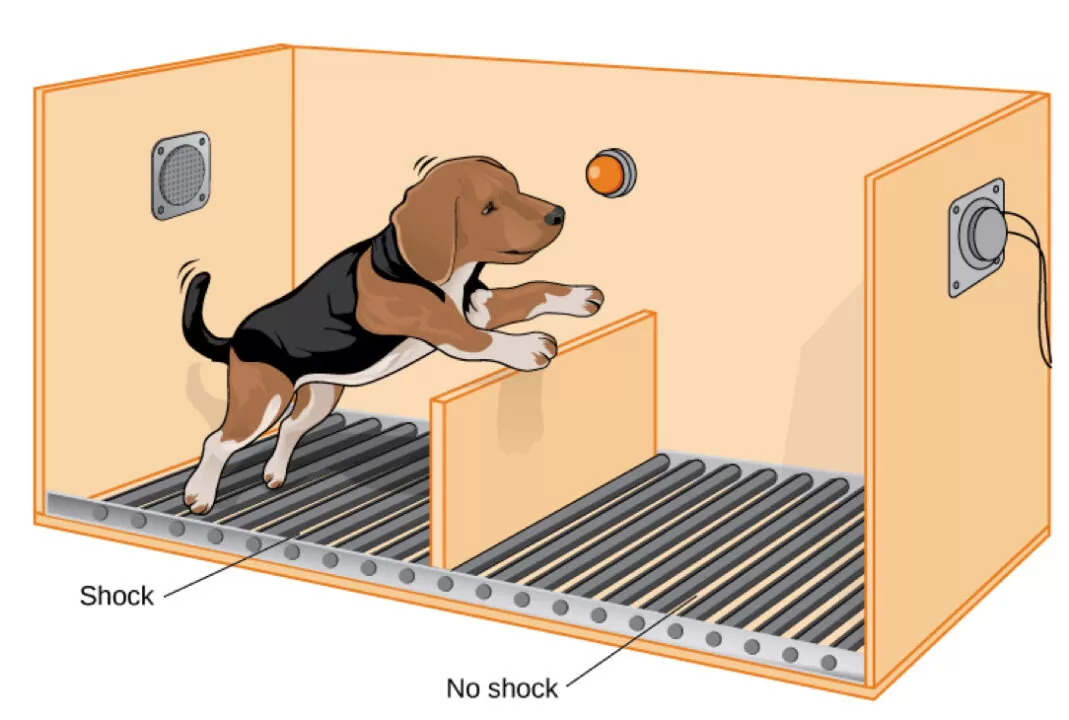
- First, dogs were put in a box and given electric shocks, from which they could escape by jumping over a low partition.
- Then, they were given shocks and not allowed to escape. Gradually, as the dogs found they could not escape the shocks, they lay down whimpering, feeling helpless.
- Later, when these “helpless” dogs were put into boxes with a low partition that they could jump over, and given shocks, they did not try to escape and instead lay whimpering. These dogs had learned helplessness.
Seligman said this may be similar in humans too, where people experiencing uncontrollable negative events become passive and give up trying to improve their situation.
Seligman’s idea was similar to Maltz’s. Maltz had earlier suggested that our self-limiting beliefs are at the root of our failures.
FAQs
1. What is Psycho-Cybernetics?
“Psycho-cybernetics” refers to our mind’s automatic success mechanism that can help us live richer and happier lives. We can instruct our minds to create a positive self-image. This then helps us achieve our goals on autopilot.
2. Who was Maxwell Maltz?
Maxwell Maltz was born in Brooklyn, New York, in 1909. He received his medical degree from Columbia University in 1934. Maltz specialized in cosmetic surgery and was a busy practitioner. His book Psycho-Cybernetics came out in 1960, became a bestseller, and was named one of the 50 Best Self-Help Classics of all time.
Final Words
Psycho-cybernetics has influenced nearly every major “self-help” expert, from Zig Ziglar to Brian Tracy to Tony Robbins to James Clear. Maltz’s work has touched the lives of more than thirty million readers.
- Self-image is the mental blueprint for success and goal achievement.
- A “cosmetic surgery on self-image” can enhance our chances of success and fame.
- Often, a person’s full potential can be limited by negative self-talk due to past failures.
- The success system can be activated via mental rehearsal of psycho-cybernetics principles.
The “self-image”, the individual’s mental and spiritual concept or “picture” of himself, was the real key to personality and behavior.
— Maxwell Maltz, “Psycho-Cybernetics”
√ Also Read:
- Psycho-Cybernetics: Quotes To Thrive Every Day of The Year
- How To Overcome Negative Self-Talk With Psycho-Cybernetics
√ Please spread the word if you found this helpful.
» You deserve happiness! Choosing therapy could be your best decision.
...
• Disclosure: Buying via our links earns us a small commission.