
Today's Monday • 15 mins read
— By Dr. Sandip Roy.
I have been into positive psychology and happiness science for over a decade and have read Dr. Sonja Lyubomirsky’s book The How of Happiness at least five times.
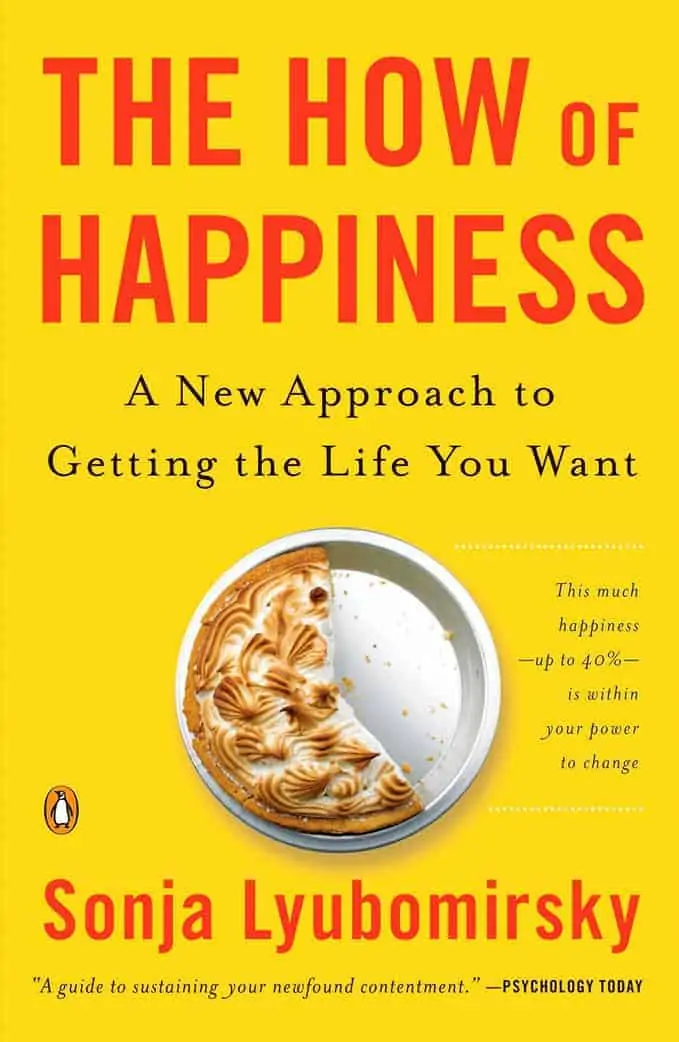
The How of Happiness: A New Approach to Getting the Life You Want is one of the most informative and practical guides on the science of happiness. You’d love to read how to be happier using science, in a smart and fun way, from a pioneering positive psychologist.
“The star of The How of Happiness is science. To my knowledge, this is the first how-to-become-happier book authored by someone who has actually conducted research revealing how people can achieve a greater sense of happiness in their lives. Every suggestion that I offer is supported by scientific research.” — Sonja Lyubomirsky
Quick Summary of The How of Happiness
The How of Happiness presents research‑backed methods to increase our well‑being. Sonja Lyubomirsky explains the concept of a natural “happiness set point” and offers a toolbox of twelve practical strategies to cultivate joy, strengthen relationships, and deepen meaning in life. This informative book helps readers change their approach to happiness with a personalized, science‑based plan for lasting well-being.
12 Happiness Activities From The How of Happiness
We can create our own happiness.
Forty percent of our happiness depends on the activities we do with intention. Experts call these activities positive interventions. We could call them happiness interventions or happiness-boosting actions.
Lyubomirsky’s 12 Happiness Boosters
- Savor life’s joys
- Learn to forgive
- Express gratitude
- Cultivate optimism
- Nurture relationships
- Take care of your body
- Commit to your goals
- Practice acts of kindness
- Develop strategies for coping
- Practice religion and spirituality
- Do more activities that truly engage you
- Avoid overthinking and social comparisons
These strategies above do not involve making major shifts to one’s current life situations and can be used by anyone, whatever their genetic makeup.
The book thoughtfully offers a Person-Activity Fit Diagnostic scale to find out which activities could be the best for your personality and asks you to pick from those your 4 best-fitting happiness strategies.
What Determines Your Happiness
Lyubomirsky & Sheldon received more than a million dollars from the National Institute of Mental Health to study what makes happy people happy, and how to use that knowledge to raise the happiness of the general population.
Their research found almost 50% of our happiness is determined by our genes, 40% by our intentional activities, and the remaining 10% by our circumstances or life events.
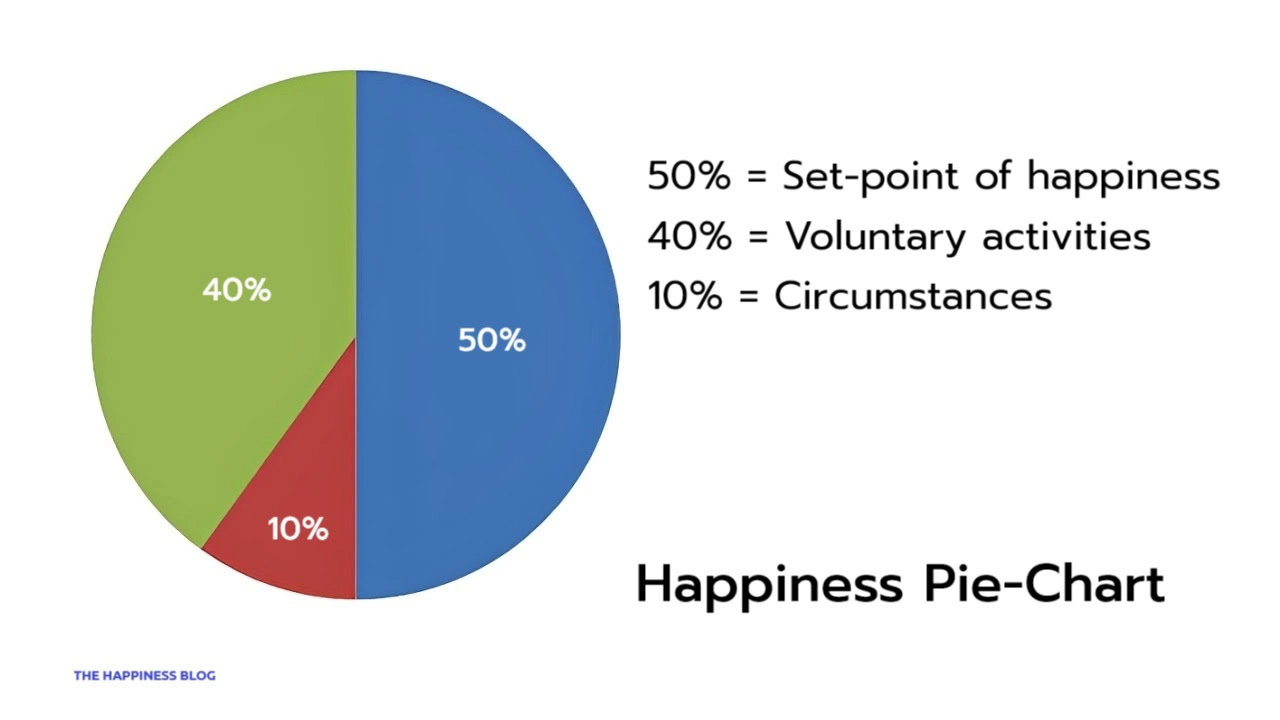
“Our happiness doesn’t depend on our circumstances as much as we think. … Trying to become happier by changing external circumstances—even if they were not terrible to begin with—is unlikely to deliver great results.” — Sonja Lyubomirsky
How Much Of Your Happiness Can You Control
You can’t do much about 50% of your happiness. It is your genetic set point of happiness. If your parents tend to be upbeat, you’re more likely to inherit that baseline, and the reverse is also true.
Life events account for roughly 10% of your long‑term happiness. So a lottery win or an accident does not impact more than 10% of our overall happiness.
That leaves about 40% you can influence through intentional choices and actions. With effort and commitment, you can increase much of your happiness by changing your behaviors, thoughts, and routines.
Lyubomirsky calls this the “40 percent solution.”
You have the power to control 40% of your happiness.
What Things Do Not Make You Happy
We live our whole lives with many happiness myths.
For one, if you think a new relationship, looking younger, losing weight, having more money, or a new job will give you unending happiness, you’re wrong.
Circumstances and changes that happen to us, however great, don’t affect our happiness too much for too long.
We tend to settle back to our base level after any happiness boost we get from a positive life event. The reason behind this is a common quirk of human nature called hedonic adaptation.
Hedonic adaptation means we quickly become habituated and inured to most of the changes in our lives.
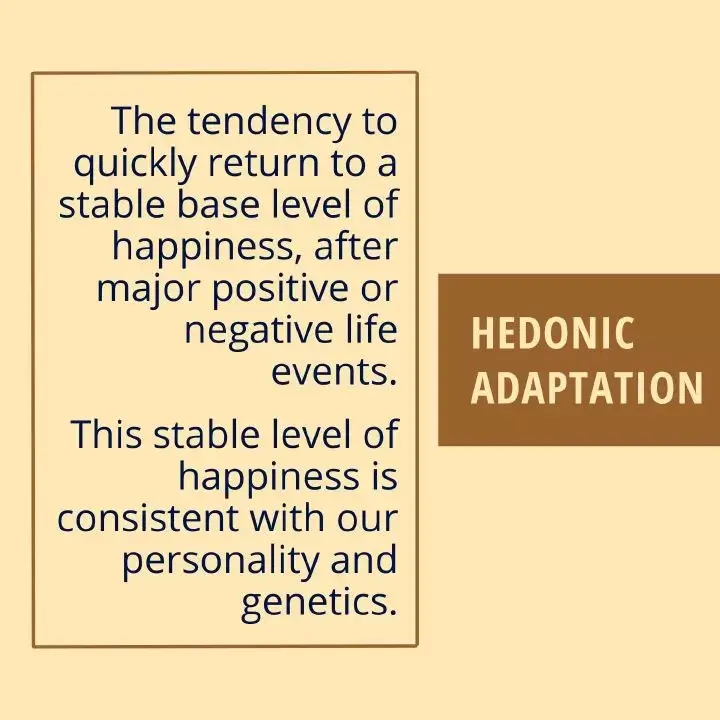
Things we think are going to make us lastingly happy actually do not make us lastingly happy. And the things we think are going to keep us forever sad do not actually keep us forever sad.
Another myth about happiness is attaching an “If” or “When” to your happiness journey. Such as:
- I’ll be happy if that happens, or
- I’ll be happy when that happens.
Both are wrong.
About The Book “The How of Happiness”
“The How of Happiness” draws on positive‑psychology research to offer practical strategies for increasing well‑being.
For example, happiness and sadness both tend to fade over time.
- We quickly adapt to positive events, like big purchases, successes, marriages, promotions, or windfalls. The initial high doesn’t last as long as we think.
- We also do not remain terribly sad for long after a hapless event like job loss, divorce, or bereavement. The emotional pain usually reduces more than we expect.
This tendency toward emotional adaptation is central to why we need intentional practices to sustain lasting happiness.
In this book, I describe strategies that you can start doing right away and that will immediately boost your feelings of well-being, even if you are deeply despondent. — Sonja Lyubomirsky
The book is divided into three main parts.
- Part One examines whether we can become really and lastingly happier. And helps us grasp the keys to happiness and the limits of life events on our well-being. It also shows how to find happiness-boosting activities that fit our unique interests, values, and needs.
- Part Two shares specific happiness-boosting activities. Like practicing gratitude, optimistic thinking, social connections, managing stress, committing to personal goals, and practices like meditation, physical activity, and spirituality.
- Part Three reveals the five factors behind sustainable happiness: positive emotion, optimal timing and variety of activities, social support, motivation and commitment, and the development of positive habits.
9 Insights Summarized From The How of Happiness
1. Three easy ways to boost daily happiness: Mindfulness, Savoring, and Flow.
Mindfulness.
Mindfulness is paying attention to the “here & now” events without judgment. Mindful people tend to be happier, less worried, and more likely to succeed at work. They are also more resilient and can rebound faster and better after difficult times.
A quick way to be mindful:
- Find a comfortable, distraction-free place to settle in. Close your eyes or gaze softly ahead.
- Focus on your breathing, noticing the sensation of air moving in and out as you inhale and exhale.
- Stay curious and non-judgmental. If your mind wanders, be gentle to redirect it back to your breath.
Savoring
Savoring is extending a happy moment by fully appreciating its presence and meaning in our lives. Those who know how to savor are happier.
You practice savoring when you take a moment to fully appreciate the delicious flavors of a favorite meal, the warmth of a loved one’s embrace, or the beauty of a sunset.
You could learn to build your savoring skills.
Flow
Flow is a state of deep immersion in an activity. You are so intensely focused on the thing you’re doing that you lose the sense of time. People who experience regular Flow in their lives are happier.
Three key conditions to reach the flow state:
- The activity should have a clear set of goals and provide immediate feedback, so you know how well you’re progressing.
- The challenge of the activity should be well-matched to your skills and abilities, neither too easy nor too difficult.
- The activity should allow you to focus your attention completely, minimizing distractions and the sense of self, immersing you in the present moment.
2. Marriage can give us a happiness boost that lasts ~2 years.
Marriage has an impact on your happiness, but a tiny one. The happiness boost of marriage lasts for an average of 2 years.
Lyubomirsky writes,
And although married people are happier than single ones, the effect of marriage on personal happiness is actually quite small; for example, in sixteen countries, 25 percent of married people and 21 percent of singles described themselves as “very happy.”
The book asks us not to tell newlyweds this bit of news, from a study by Lucas & Clark, 2003:
In a landmark study, residents of West Germany and East Germany, including citizens, immigrants, and foreigners—25,000 in all—were surveyed every year for fifteen years. Over the course of the study, 1,761 individuals got married and stayed married. Using this spectacular data set, scientists showed that alas, marriage has only a temporary effect on happiness. It appears that after the wedding husband and wife get a happiness boost for about two years and then simply return to their baseline in happiness, their set point.
Over time, a marriage or any other intimate relationship enters the phase of hedonic adaptation.
Both can feel bored and dissatisfied. They may start taking each other for granted and neglecting their partner’s needs. This can become a fuel for divorce or breakup.
Professor Bella DePaulo asks us to read this every time we hear that getting married will make us happier.
What are the secrets to a long-term, happy marriage after 2 years?
First, a vital secret to long-term happy marriages is how joyfully one responds to their partner’s successes.
When one partner shares good news, the other partner is as happy as if it were his/her own success. This leads to a big uptick in their relationship satisfaction.
- So, don’t quip, “I’m so happy for you.”
- Instead, say, “I’m so happy!”
Second, couples who idealize each other are less likely to lose love and satisfaction in their relationship. Idealizing is highlighting the strengths and virtues while minimizing the weaknesses and flaws.
Idealizing also works as a self-fulfilling prophecy, a psychological theory that says beliefs eventually turn real.
• Being Single: Single people are no less happy than married people. Singles can and do find their joy in other relationships, like friends, relatives, and groups.
3. Positive Aging strategies can boost happiness in old age.
It may surprise you that youth and early adulthood are not the sunniest times of our lives.
What research conclusively confirms is that older people are actually happier and more satisfied with their lives than younger people.
Happiness increases as we age, after around 40 years, and peaks after 60 years.
One key strategy for older people to get happier is to spend more time reminiscing, the act of retrieving autobiographical memories.
What reminiscing does is breed positive feelings and make the person feel more loved and protected.
The more time the seniors spend remembering their old times, the more positivity they add to their mood, morale, and self-esteem.
Find out how to grow old gracefully.

4. Following a faith or religion can actually make us happier.
• Religious people tend to have more security and meaning in life.
• Actively practicing divinity or spirituality is linked to better physical health, more pro-social behavior, and being more successful at keeping away from unhealthy behaviors such as smoking.
• Those who are religious are happier, healthier, and cope better when they fall into bad times. It may be because of the social support of their religious group.
5. Money can make us happier, but only up to a certain point.
What about using money to buy happiness?
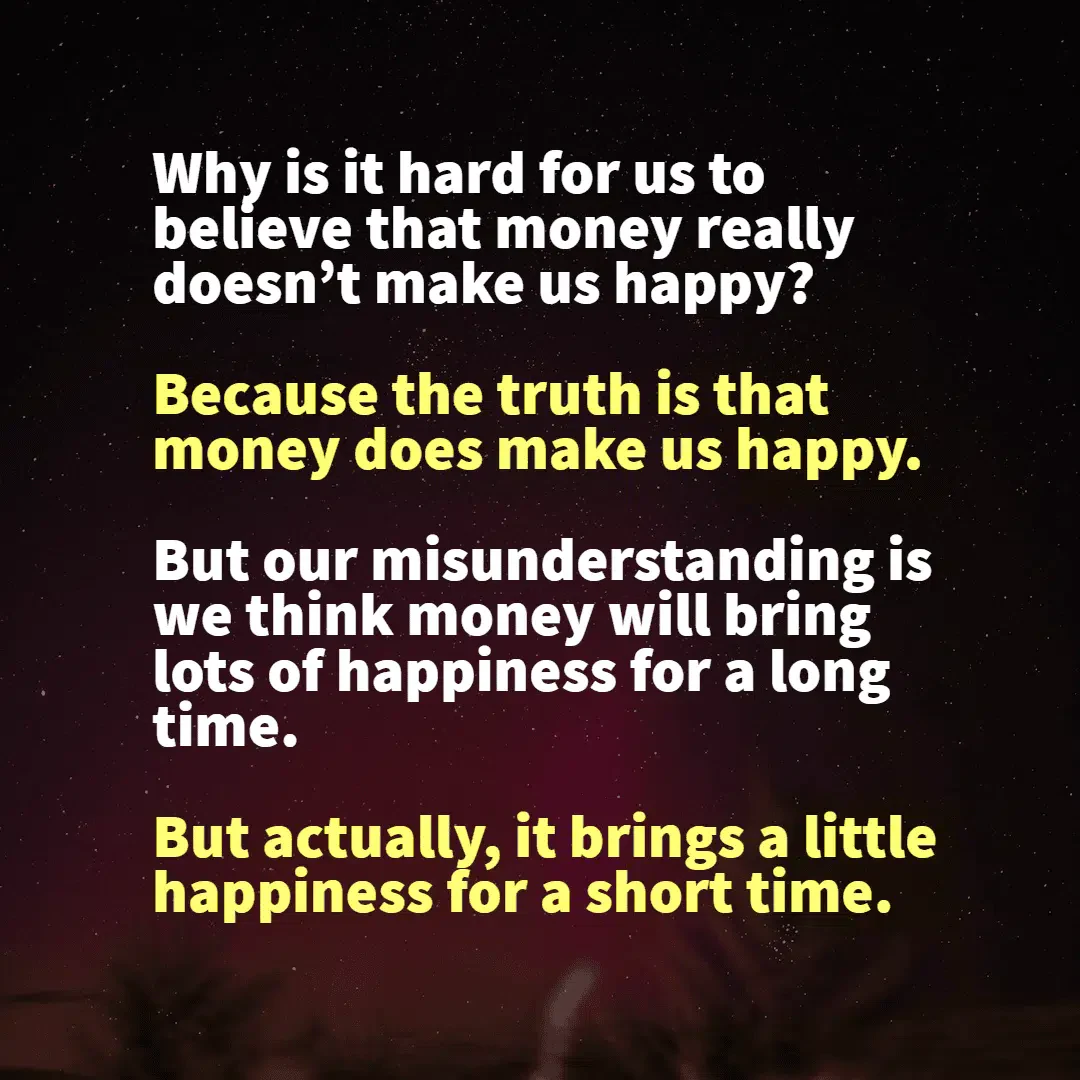
• Research shows that as long as you meet your basic needs, it’s how you spend your money, not how much you possess, that influences your happiness more. The key is not in how financially successful you are, but what you do with it and how you deal it out.
• We humans are prone to hedonic adaptation. Hedonic adaptation is the notion that after positive or negative events, followed by an increase in positive (or negative) feelings, people return to a relatively stable, baseline level of affect (Diener, Lucas, & Scollon, 2006).
• So, if you keep on amassing wealth for the sake of it, it will not make you happier and happier — but less and less happy. Because you rapidly get used to that wealth.
• In short, money makes us happier, but only till our basic needs are met, and thereafter, when we spend it in certain happiness-boosting ways.
6. Buying experiences can give us more happiness than buying things.
Research finds it is not the things that keep us happy for long, but our experiences. Things we collect lie outside us, while our experiences nest inside us.
Experiences are superior to goods and assets in making us happier because:
- First, most of the stuff we buy doesn’t change much after we have bought it. We adapt to them a great deal faster. Note the word: Adapt. This is the hedonic adaptation we talked about earlier.
- Second, an experience is in itself more social. We are more likely to share and relive our fond memories with others, much more than our stuff.
- The third reason experiences make us happier is that we are less likely to compare them to those of others. You don’t usually claim your holiday happiness was bigger than your friend’s, do you?
It does not take us long to start feeling that our prized acquisitions have been there forever. In time, they grow old and dull, and we get eager to replace them with new shiny things we’d soon get adapted to.
In contrast, experiences grow in value and joy as time passes. A fun-filled weekend, a lovely dinner, or a meaningful conversation can be embedded into our memories and bring happiness every time we revisit them.
7. Charity or philanthropy (Altruism) increases our happiness.
Altruism is an action or behavior that benefits another person.
More specifically, we are being altruistic when we act out of concern for others without expecting any reward.
• Charity and altruism make us doubly happy. With altruism, both the giver and the receiver feel happier.
• When we give freely, we not only feel more positive about ourselves but also about those who receive – that they are worthy of our kindness and respect.
• When we’re charitable, we actively go out to reduce the distress of poverty and suffering in the world. In the process, we distract ourselves from our own petty problems, gain a greater appreciation for our good fortune, and step away from our worries.
Altruism is the opposite of selfishness.

8. Setting goals and striving for success can bring us happiness.
All of us have goals in life that define us.
• When we pursue our life goals, it adds structure and purpose to our lives. They raise our self-esteem and self-confidence and make us creative and productive. Most often, each of our major life goals is made up of many smaller goals.
• When we achieve these small goals, each makes us happier. It starts a positive feedback loop. Those many moments of small joys now drive us toward our bigger goals.
• So you see, when we feel happy and good while striving towards our major life goals, we are more likely to keep working at it. Thus, happier people have greater chances of becoming successful.
• Happiness comes before success and drives it.

9. Expressing gratitude for things that you receive raises your joy.
• Those who are routinely grateful are more energetic and optimistic, have better mental and physical health, have better relationships, and are high on happiness.
• Feeling regularly grateful can bring us a bunch of benefits for physical and mental health.
• Eight Reasons Gratitude Makes You Happier:
- Gratitude encourages morality
- It raises self-worth and self-esteem
- It helps prevent hedonic adaptation
- It helps to stop comparing yourself to others
- It fosters the savoring of positive experiences
- It may reduce feelings of anger, resentment, and greed
- It can help you cope better with stressful and traumatic events
- help build new social bonds and strengthen existing ones
Lyubomirsky writes:
They also tend to be more helpful and empathetic, more spiritual and religious, more forgiving, and less materialistic…[and] less likely to be depressed, anxious, lonely, envious, or neurotic.
• Find out how to build your gratitude muscle.
How Can You Measure Your Happiness
The book lays out a way to measure your happiness before you begin, and after you end, the process of adding happiness interventions to your life. After all, how else would you know if you’re better off doing what it suggests?
The short four-question test Lyubomirsky and her colleagues devised for this is called the Subjective Happiness Scale. You could check out your level of general happiness here.
Final Words
Download the PDF of this: The How of Happiness Summary (PDF)
Can you be happy after a breakup or divorce? Yes. Studies indicate that people can be happier than they have ever been in their marriages in about four years after their breakup or divorce.
Do you need a partner to be happy? No. Studies show that single people are no less happy than married ones. Also, many singles have been found to enjoy greater happiness and fulfillment from their non-partnered relationships and pursuits.
If you didn’t know, here’s how to pronounce the author’s name: Son-yuh Lyu-bo-mirs-ky.
Lyubomirsky holds a Ph.D. in Social and Personality Psychology from Stanford University and is one of the founding parents of the positive psychology movement.
√ Also Read: What Stops Us From Being Happy: A Summary of “The Happiness Trap”
√ Please share it with someone.
» You deserve happiness! Choosing therapy could be your best decision.
...
• Disclosure: Buying via our links earns us a small commission.