
Today's Friday • 10 mins read
— By Dr. Sandip Roy.
If you’re a sensitive person, learn these rules to handle criticism with confidence and nonchalance. Be stronger than the negative words thrown at you.
Criticism raids our ego harder and faster than we think. Many people who claim that words don’t affect them sulk when criticized in public. Just a few harsh words from someone important can make them feel fragile. This doesn’t even include internet trolls who criticize for fun or profit.
Then, some people get touchy at the slightest criticism. It’s said that feedback lands hard when you feel deeply. If so, you may belong to the highly sensitive people (HSP), a term coined by psychologist Elaine Aron.
Highly Sensitive People (HSPs) tend to feel emotions more intensely and deeply, are more attuned to details that others might miss (like subtle changes in tone or expressions), have stronger reactions to sensory inputs (like pain, hunger, light, and noise), and have high empathy and compassion. They have rich inner lives, find change and uncertainty difficult to handle, and are often repelled by destructive behavior and cruelty.
7 Rules To Handle Criticism For Sensitive People
Accepting criticism can be painful for highly sensitive people, who tend to feel intensely and often internalize feedback. Here are seven practical tips for handling it.
Rule No. 1: Assume Good Intent and Extract the Kernel
Don’t reject the positive aspect straight away.
When someone offers criticism, your instinct may be to defend or reject it outright. Instead, start by assuming they mean well, even if the delivery stings.
Ask yourself these clarifying questions:
- What specifically is being criticized: my work, my behavior, or my character?
- Is there a kernel of truth here, even if I disagree with how they said it?
- What underlying issue does this point to?
Treat criticism as an instruction manual for improvement, not a judgment of your worth. The feedback is about what you did or made, not about who you are.
When you separate the message from the messenger, you can extract what’s useful without internalizing shame. You stay calm, process the words objectively, and decide what actually deserves to change.

Rule No. 2: Distinguish Criticism from Personal Attack
If they are being offensive, stop it right there.
Criticism targets behavior or work, while an attack targets you as a person. Feedback that opens with insults, smears, or belittlements is not constructive.
That said, give them one chance to clarify. Ask directly: “What specifically bothers you about this, and what do you want me to do about it?”
That question does two things: it forces them to articulate a concrete issue (which often reveals whether they have one), and it gives them a path away from personal attack toward actual feedback.
If they can’t or won’t answer, and the conversation remains personal rather than specific, you’ve learned what you need to know: this person isn’t offering feedback; they’re venting frustration, and you are not obligated to absorb it.
You can acknowledge them politely and disengage. As Dale Carnegie observed, “Any fool can criticize, complain, and condemn—and most fools do.”
The key is speed. You don’t need to sit in discomfort for long. Within the first exchange, you’ll know whether this is worth your energy.
- Busy now? Download the Checklist To Become Tough To Criticize.
Rule No. 3: Set a Boundary, Then Honor It
Inform them why you are clearing out.
Constructive criticism targets a specific issue. Malicious fault-finding is personal, relentless, and designed to wound.
That distinction matters because unfair criticism, whether wrong or irrelevant to your work, often says more about the critic’s own deficiency than about you.
But knowing the difference isn’t enough; you need to act on it.
If someone is habitually harsh, dismissive, or telling you that you’re worthless, name it directly: “I find your tone obnoxious and unacceptable. If you have genuine feedback, frame it constructively. Otherwise, I’m ending this conversation.”
This is positive aggression. You’re not attacking them; you’re stating and enforcing a non-negotiable boundary.
If they continue after that warning, you leave. Not angrily. Not with drama. You simply disengage.
On the lighter side, Ray Bradbury, the celebrated visionary behind Fahrenheit 451, used to say, “I have never listened to anyone who criticized my taste in space travel, sideshows, or gorillas. When this occurs, I pack up my dinosaurs and leave the room.”
A boundary without enforcement is just a wish. The key is follow-through. The elegance is in the exit: calm, decisive, final.
Rule No. 4: Don’t Be Bullied. Don’t Be The Bully.
When you know the exact reason for a given criticism, you can use that to make changes. Otherwise, it’s bullying, not critiquing.
The freelance journalist Maham Barbar explains the difference:
Constructive criticism is a process of offering well-intended remarks on the work of others so they can know their strengths and weaknesses, which helps them improve in the future.
Bullying is unwanted aggressive behavior that is used to exploit someone. This behavior is repeated, and it can affect the person’s physical and mental health.
The same holds for you: don’t be that narcissistic dirtbag. Don’t insult others like they are idiots. Instead, offer them well-meaning, constructive, insightful feedback, especially when you know they are sensitive to criticism.
Rule No. 5: Respond With Your Thinking Brain (Not The Reactive Brain)
Some people handle criticism better than others. They seem to have a special ability to defuse a tense situation and disarm the critic. They take control instead of feeling helpless or angry.
To be that kind of person, stop yourself from reacting immediately. Instead, pause and think rationally before responding. This lets you process the information with a calm and open attitude.
- Our first response to criticism comes from our reptile brain. That’s because we see the criticism as a threat and react to survive.
- But if you give it a few moments, you can engage your higher, thinking brain, and see clearly whether it’s helpful criticism or not.
And not everyone who doesn’t see things the way you do is criticizing you. Ralph Waldo Emerson had this self-advice: “Let me never fall into the vulgar mistake of dreaming that I am persecuted whenever I am contradicted.”
If your rational brain decides it’s negative criticism, do these:
- Express the pointlessness of their point, but be polite.
- Do not respond to the tone of the criticism.
- Say, “I don’t agree with you, and that’s final.”

How To Handle Criticism (Flow Chart):
- First, ask yourself if the criticism is well-intended. If it’s not, consider whether you care about the person’s opinion. If you don’t, let it go, as you’re good enough as you already are.
- If you care, check if the criticism is constructive. If it’s not, realize you can’t please everyone, and move on. If it is constructive, ask yourself if you agree with it.
- If you do, use it as a chance to improve. If you don’t, tell yourself not all criticism deserves a response and let it go.
Rule No. 6: Do Not Let Criticism Bother You
Not every criticism deserves a response.
Read that again: Not every criticism deserves a response from you.
The person criticizing would have criticized someone else in your position. Their nature is to criticize others. Such criticisms are invalid and don’t deserve a response from you.
Do not allow their words to damage your self-esteem and self-confidence. Ignore them.
And figure out the people in your life who want the best for you. Most of the time, their criticism of you is an open dialogue with you.
Rule No. 7: Stop Taking Criticism Personally
Whoever the criticism is from, tell yourself that it’s about your work or behavior, not your worth as a person.
You could say in your mind, “His words can’t pierce my work attire to reach my person.”
Separate your identity from their feedback. Don’t let their words decide what you are worth to yourself.
When you take criticism personally, it clouds your judgment, seeds regrets in you, and blocks your growth.
- Until you get better at it, practice self-compassion.
- Offer them compensation for your mistake if there was a mistake.
- As the person who has been criticized, do not be resentful or gossip about the critic.
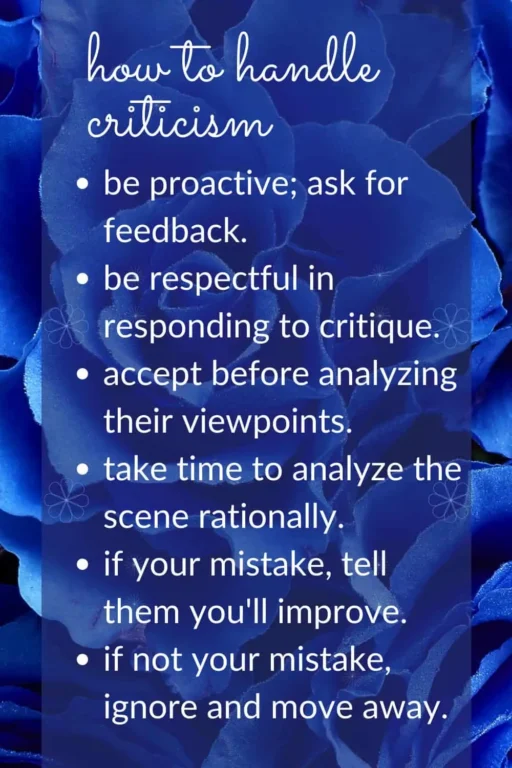
Bonus Rule: Set Clear Boundaries
Setting clear boundaries is key to handling criticism better.
Boundaries are the psychological fences that lay out what’s acceptable to you. They tell others what behaviors of theirs you will tolerate when they interact with you.
Boundaries create a safe space that lets you take feedback more constructively. Since you know your limits, you can easily sift out criticism that doesn’t align with your values or goals.
When you maintain your boundaries, you’re less likely to feel hurt by criticism. Instead, you can impersonally assess whether the feedback is useful and relevant to your work.
Overall, boundaries help you respond thoughtfully rather than reactively, keep your self-esteem intact, and make it easier to take lessons from good criticism without feeling too sensitive.
Remember, if a critic is targeting your work, it should be accepted and even welcomed, but must be left at the workplace.
Cancel Culture
“Cancel culture” is a modern term for social ostracism in which someone is forced out of professional or social circles, online or in person. Those subjected to this ostracism are said to have been “canceled.”
It can be a devastating blow to one’s reputation, especially one built over years. The speed and scale of digital pile-ons mean that even people who claim imperviousness to criticism can find themselves isolated quickly.
What makes cancel culture distinct from ordinary criticism is its collective nature and its potential for real-world consequences, like job loss, lost opportunities, or damaged relationships, that often come without formal process or appeal.
The term itself is contested. Supporters argue it holds people accountable for genuine harm. Critics contend it can be disproportionate, driven by incomplete information, or used to silence legitimate speech. The debate often hinges on a simple question: Is this accountability, or is it mob justice?
Final Words
Handling criticism gracefully is a learnable skill. The first step is simple: stop preparing your rebuttal while they’re still speaking. Listen actively instead. Only then can you decide whether this person and their feedback deserve your continued engagement.
Here’s the harder part: check yourself for a double standard. When others criticize you, do you dismiss them as unfair, oversensitive, or harsh? Yet when you criticize others, do you believe you’re being helpful and honest? This inconsistency is common, and it’s worth examining.
John C. Maxwell, author of Leadership Gold, reminds us: “The price of leadership is criticism. When you’re in front, everything gets noticed. So it is important to learn to handle criticism constructively.”
The same applies whether you’re leading others or simply living authentically. You will be criticized. The question is whether you’ll let that silence you, harden you, or help you grow.
√ Also Read: How Stoics Handle Insults: Ancient Techniques That Still Work
√ Please share this with someone.
» You deserve happiness! Choosing therapy could be your best decision.
...
• Disclosure: Buying via our links earns us a small commission.