Today's Monday • 10 mins read
Narcissists carry an inflated, often unshakeable sense of entitlement. They believe they deserve special treatment or recognition despite doing little or nothing to merit it.
But what makes them difficult, and even dangerous in close relationships, is beyond entitlement. Research links narcissism to all forms of aggressive behavior: indirect, direct, physical, verbal, and bullying, in both reactive and proactive forms, across gender, age, and culture (Kjærvik & Bushman, 2021).
The pattern in narcissistic relationships follows a distinct arc: charm at the start, control in the middle, retaliation at any hint of criticism.
The 25 quotes below come mostly from psychologists, researchers, and clinicians who have spent careers studying this behavior. They can help you see the pattern before it’s too late.
25 Experts On Narcissists & How They Operate
You will find these quotes on narcissists and narcissism quite revelatory:
Shahida Arabi’s research found that “both vulnerable and grandiose narcissism and psychopathy can significantly and uniquely contribute to PTSD symptomatology related to the relationship.”
Narcissists are like tornadoes: wherever they go, they leave a path of destruction behind them.
— Shahida Arabi
Psychologist Scott Barry Kaufman confirms that narcissists know they are narcissists:
1. Narcissists think they are hot stuff. Those scoring high in narcissism measures tended to rate themselves as more intelligent, physically attractive, likeable, and funny than others. Interestingly, they also rated themselves as … being power-oriented, impulsive, arrogant, and prone to exaggerate their abilities. In other words, narcissists are aware that they are narcissists.
— Scott Barry Kaufman

2. Love doesn’t reach a natural end. Love has to be ended, either by neglect or narcissism.
— Frank Salvato
This study found narcissism was related to all forms of aggressive behavior: indirect, direct, displaced, physical, verbal, and bullying. It is also related to both reactive and proactive hostility. The relationship between narcissism and hostile behavior was noticeable in men and women of all ages.
3. Individuals high in narcissism have “thin skins” and prone to aggression when they are provoked. Practically, these results suggest that narcissism is an important risk factor for aggression and violence.
— Kjærvik & Bushman (2021)
4. How starved you must have been that my heart became a meal for your ego?
— Amanda Torroni
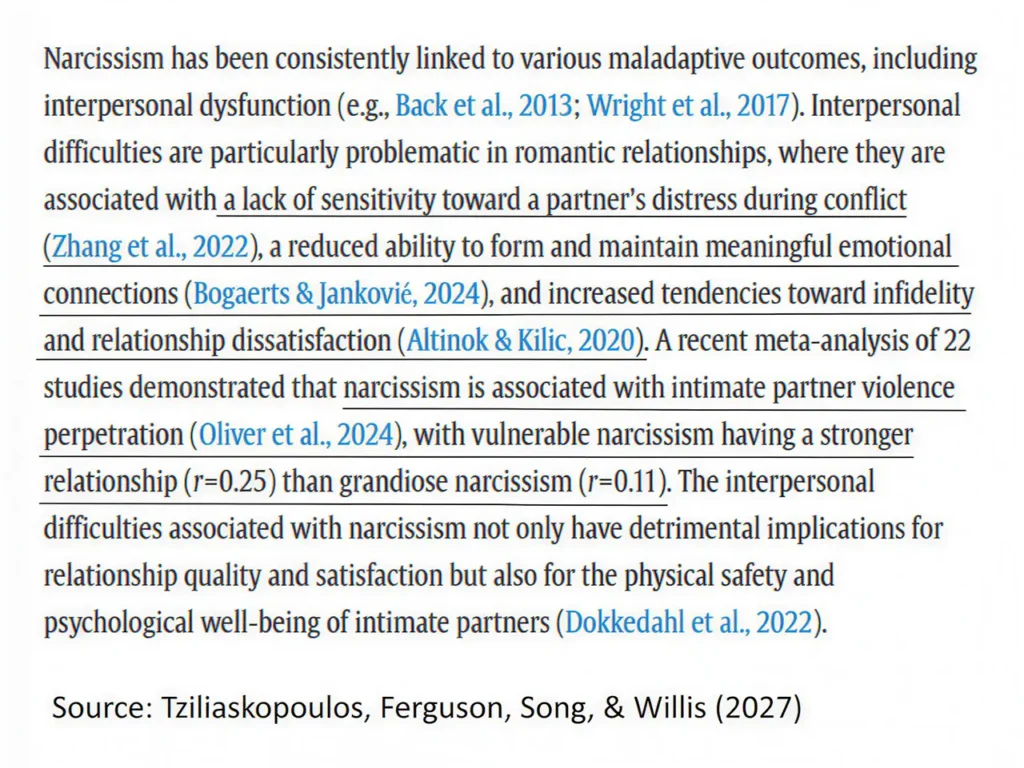
5. They barrel through life, using relationships and people as objects, tools, and folly. While they often seem as if they are cruel or harsh, that is in fact giving them too much credit. They are simply careless. And they do expect other people to clean up their messes.
— Ramani Durvasula, Ph.D., author of Should I Stay Or Should I Go?
6. Since narcissists deep down feel themselves to be faultless, it is inevitable that when they are in dispute with the world, they will invariably perceive the dispute as the world’s fault.
— M. Scott Peck
7. Narcissism includes self-absorption, self-love, and self-aggrandizement as attempts to gratify infantile needs.
— Sigmund Freud
8. Americans are experiencing a crisis in narcissistic behavior in a culture that is intrinsically self-conscious and selfish, and citizens are encouraged to pursue happiness and instant gratification of their personal desires.
— Kilroy Oldster
9. When I look at narcissism through the vulnerability lens, I see the shame-based fear of being ordinary. I see the fear of never feeling extraordinary enough to be noticed, to be lovable, to belong, or to cultivate a sense of purpose.
― Brené Brown, author of Daring Greatly
10. The narcissist’s greatest fear is being exposed for who they truly are: empty, devoid of empathy, and desperate for validation.
― Dr. Ramani Durvasula
11. The main condition for the achievement of love is the overcoming of one’s narcissism. The narcissistic orientation is one in which one experiences as real only that which exists within oneself, while the phenomena in the outside world have no reality in themselves, but are experienced only from the viewpoint of their being useful or dangerous to one. The opposite pole to narcissism is objectivity; it is the faculty to see other people and things as they are, objectively, and to be able to separate this objective picture from a picture which is formed by one’s desires and fears.
― Erich Fromm, The Art of Loving
12. Narcissists are seldom able to sustain a sense of superiority on their own and so are drawn to the limelight and the praise, applause, and recognition from others that keep them inflated.
— Sandy Hotchkiss, Why Is It Always About You?

13. Narcissists are consumed with maintaining a shallow false self to others. They’re emotionally crippled souls that are addicted to attention. Because of this, they use a multitude of games, in order to receive adoration. Sadly, they are the most ungodly of God’s creations because they don’t show remorse for their actions, take steps to make amends or have empathy for others. They are morally bankrupt.
― Shannon L. Alder
14. Narcissists are neither carefree nor innocent. They have learned to play the power game, to seduce and to manipulate. They are always thinking about how people see and respond to them.
— Alexander Lowen, Narcissism: Denial of the True Self
15. Pathological narcissists can lose touch with reality in subtle ways that become extremely dangerous over time. When they can’t let go of their need to be admired or recognized, they have to bend or invent a reality in which they remain special despite all messages to the contrary.
― Bandy X Lee, The Dangerous Case of Donald Trump: 27 Psychiatrists and Mental Health Experts Assess a President
16. The sadistic narcissist perceives himself as Godlike, ruthless and devoid of scruples, capricious and unfathomable, emotion-less and non-physical, omniscient, omnipotent and omnipresent, a plague, a devastation, an inescapable verdict.
― Sam Vaknin, renowned expert on NPD, author of Malignant Self-Love: Narcissism Revisited
17. Narcissists will destroy your life, erode your self-esteem, and do it with such stealth as to make you feel that you are the one that’s crazy.
— Rhonda Freeman
18. Self-love: Being content with the work-in-progress you are. Not seeking approval from others. Being yourself. Comparing yourself only to who you were in the past, not to others. Not thinking you are better than anyone else. Narcissism: None of the above.
— Zero Dean, author and life coach
19. Narcissism is the enemy of empathy.
— Simon Baron-Cohen
20. Realize that narcissists have an addiction disorder. They are strongly addicted to feeling significant. Like any addict they will do whatever it takes to get this feeling often. That is why they are manipulative and future fakers. They promise change, but can’t deliver if it interferes with their addiction. That is why they secure backup supply.
― Shannon L. Alder
21. A healthy dose of narcissism can facilitate career success, because reasonable concern with the self helps a person think of achieving important goals and being admired as a leader. The moderately narcissistic person often appears to be self-confident and charismatic. Yet extreme narcissism can hamper success because the narcissist irritates and alienates others in the workplace as well as in personal life.
― Andrew DuBrin
22. Narcissism is the fast food of the soul. It is easy to get and immediately enjoyable — but it’s not good for you, and it’s not good for the people around you.
— Jean M. Twenge & W. Keith Campbell
23. Narcissism is the art of deception, where the narcissist creates an illusion that she is something she is not, in order to get what she wants.
— W. Keith Campbell
24. “Narcissism is the antithesis of leadership, because leadership is all about others.
— Denise Morrison
25. Narcissism falls along the axis of what psychologists call personality disorders, one of a group that includes antisocial, dependent, histrionic, avoidant and borderline personalities. But by most measures, narcissism is one of the worst, if only because the narcissists themselves are so clueless.
— Jeffrey Kluger
A classic gaslighting technique used by narcissists to invalidate other people’s feelings and emotions is this: “You’re just being too sensitive.” If you are not sure you can spot a narcissist, check out the 20 Signs and Red flags of Narcissism.

FAQs
1. What makes someone a narcissist?
Narcissism exists on a spectrum from mild to extreme, with only the severe end meeting the clinical threshold for Narcissistic Personality Disorder (NPD). The American Psychiatric Association defines NPD as a pervasive pattern of grandiosity, need for admiration, and a lack of empathy. About 5% of the general population meets the full clinical criteria.
2. Do narcissists know they are narcissists?
Often, yes. Psychologist Scott Barry Kaufman found that people who score high on narcissism tend to rate themselves as more intelligent, attractive, and capable than others, and also rate themselves as arrogant, impulsive, and prone to exaggerating their abilities. They are aware of the trait, and they simply don’t experience it as a flaw.
3. Can a narcissist change?
Change is possible but rare without sustained, voluntary therapeutic intervention. But narcissists rarely seek therapy because they don’t experience their traits as the problem. Therapy focused on empathy-building and emotional accountability can produce modest results. Expecting change in the absence of professional help and genuine motivation is not a sound basis for staying in a difficult relationship.
4. Do narcissists love the people close to them?
Narcissistic people may claim to love, and may even believe it. Their attachment, however, tends to be conditional and self-serving.
They are oriented around how a partner reflects on them, meets their needs, or validates their self-image. Emotional reciprocity, the basic currency of healthy relationships, is what they consistently struggle to provide. Even when they have good intentions, they consistently fail to respond to others’ feelings with care or adjustment.
5. Are female narcissists different from male narcissists?
The short answer is: same core traits, different expression. Research suggests males more often display grandiose narcissism (overt, dominant, and status-seeking), while females more often present with vulnerable narcissism, which can be harder to identify and is sometimes misdiagnosed. For a full breakdown, see: Signs of a Female Narcissist.
Final Words
A strange behavior of narcissists: They cannot hear you praising others; they tend to quickly pull down the person you’re praising. If they can’t, they’ll be irritable until they find a way to belittle that person.
If you’re dealing with a narcissist, do not convince yourself that you can change them for the better. You cannot.
Let’s end this with a quote from one of the highest authorities on psychological disorders:
Narcissistic personality disorder is named for Narcissus, from Greek mythology, who fell in love with his own reflection. Freud used the term to describe persons who were self-absorbed, and psychoanalysts have focused on the narcissist’s need to bolster his or her self-esteem through grandiose fantasy, exaggerated ambition, exhibitionism, and feelings of entitlement.
― Donald W. Black, DSM-5(r) Guidebook: The Essential Companion to the Diagnostic and Statistical Manual of Mental Disorders, Fifth Edition
√ Also Read: What Happens When A Narcissist Knows You Love Him/Her
√ Please share this with someone.
» You deserve happiness! Choosing therapy could be your best decision.
...
• Disclosure: Buying via our links earns us a small commission.