
Today's Monday • 10 mins read
Stoicism began as a Hellenistic philosophy founded by Zeno of Citium in Athens. It drew from Socratic thought and the Cynics, then moved from Greece to Rome, where it flourished under thinkers such as Seneca, Epictetus, and Emperor Marcus Aurelius.
Stoicism teaches that a good life comes from living with virtue, through clear thinking, self-control, and sound judgment.
It is a practical philosophy meant for daily life, followed by both rulers and ordinary people.
35 Stoic Quotes On Life And Happiness
Stoicism focuses on how to live well using reason, self-control, and disciplined thinking. Many quotes online sound Stoic but drift away from the original texts.
This collection separates what is reliable, what is adapted, and what lacks a clear source. Quotes are cited from standard translations where possible.
I. Authentic Stoic Quotes (with verified sources)
These come directly from primary texts or widely accepted translations.
1. “True happiness is to enjoy the present… without anxious dependence upon the future.”
— Seneca, Letters, 5
Enjoy what you have now. Depending too much on the future creates anxiety.

2. “If what you have seems insufficient to you, then though you possess the world, you will yet be miserable.”
— Seneca, Letters
If your mindset is lack, nothing will feel enough.
3. “Today I escaped anxiety. Or no, I discarded it, because it was within me, in my own perceptions.”
— Marcus Aurelius, Meditations, 9.13
Anxiety often comes from how you interpret events, not the event itself. Change your view, and the feeling shifts.
4. “How long are you going to wait before you demand the best for yourself…”
— Epictetus, Discourses, 1.2
Stop delaying self-improvement. Start now.
5. “There is only one way to happiness and that is to cease worrying about things which are beyond the power of our will.”
— Seneca, Letters, 71
Focus only on what you can control. Worrying about the rest drains you.
6. “Set aside a certain number of days during which you shall be content with the scantiest and cheapest fare, with coarse and rough dress, saying to yourself the while, ‘Is this the condition that I feared?’”
— Seneca, Letters, 18
Practice discomfort on purpose. It builds mental strength and reduces fear of loss. Stoics call this premeditatio malorum, or “negative visualization.”
7. “If you take riches away from the wise man, he still possesses everything that is truly his.”
— Seneca, Letters to Lucilius, 9
External loss does not destroy inner stability.
8. “If it is not right, do not do it; if it is not true, do not say it.”
— Marcus Aurelius, Meditations, 12.17
Use truth and ethics as your filter. Before acting or speaking, pause and check both.
9. “The happy man is content with his present lot, no matter what it is, and is reconciled to his circumstances.”
— Seneca, Letters to Lucilius
True happiness comes from steady reasoning, not shifting emotions.
10. “Life is very short and anxious for those who forget the past, neglect the present, and fear the future.”
— Seneca, On the Shortness of Life, 3
Staying stuck in regret or fear makes life feel rushed and stressful. Stay present, in the now.
11. “Why do you summon up sufferings that are past, and make yourself miserable now because you were miserable then?
— Seneca, Letters to Lucilius, 78
Stop reliving past pain.
12. “No man can live a happy life, or even a supportable life, without the study of wisdom.”
— Seneca, Moral Letters (Letter 16)
Clarity and truth are required for lasting peace.
13. “Don’t seek for everything to happen as you wish it would, but rather wish that everything happens as it actually will.”
— Epictetus, Enchiridion, 8
Accept reality instead of resisting it. That reduces frustration.
14. “You have power over your mind, not outside events. Realize this, and you will find strength.”
— Marcus Aurelius, Meditations, 12.36
Your control is internal. You cannot control what happens around you. You can control how you think and respond. That is where your strength lies.
15. “If you really want to escape the things that harass you… be a different person.”
— Seneca
Change yourself instead of your surroundings.
16. “What upsets people is not things themselves, but their judgments about these things.”
— Epictetus, Enchiridion, 5
Events are neutral. Your interpretation, your judgment, gives them emotional weight.
17. “For a man can lose neither the past nor the future; how could you lose what you don’t have?”
— Marcus Aurelius, Meditations, 2.14
The whole quote is poetic and needs no explanation: Even if you’re going to live three thousand more years, or ten times that, remember: you cannot lose another life than the one you’re living now, or live another one than the one you’re losing. The longest amounts to the same as the shortest. The present is the same for everyone; its loss is the same for everyone; and it should be clear that a brief instant is all that is lost. For you can’t lose either the past or the future; how could you lose what you don’t have?
18. “Begin at once to live, and count each separate day as a separate life.”
— Seneca, Letters, 101
Treat each day as complete. Do not postpone living.
19. “It never ceases to amaze me: we all love ourselves more than other people, but care more about their opinion than our own.”
— Marcus Aurelius, Meditations, 12.4
You value yourself, yet you let others decide your worth. That creates unnecessary pressure.
20. “Very little is needed to make a happy life; it is all within yourself, in your way of thinking.”
— Marcus Aurelius, Meditations, 7.67
Happiness depends on how you think about what you already have. It does not depend on having more possessions.
21. “You act like mortals in all that you fear, and like immortals in all that you desire.”
— Seneca
Your fears and desires are out of balance. You fear small risks but chase endless desires. That imbalance creates tension.
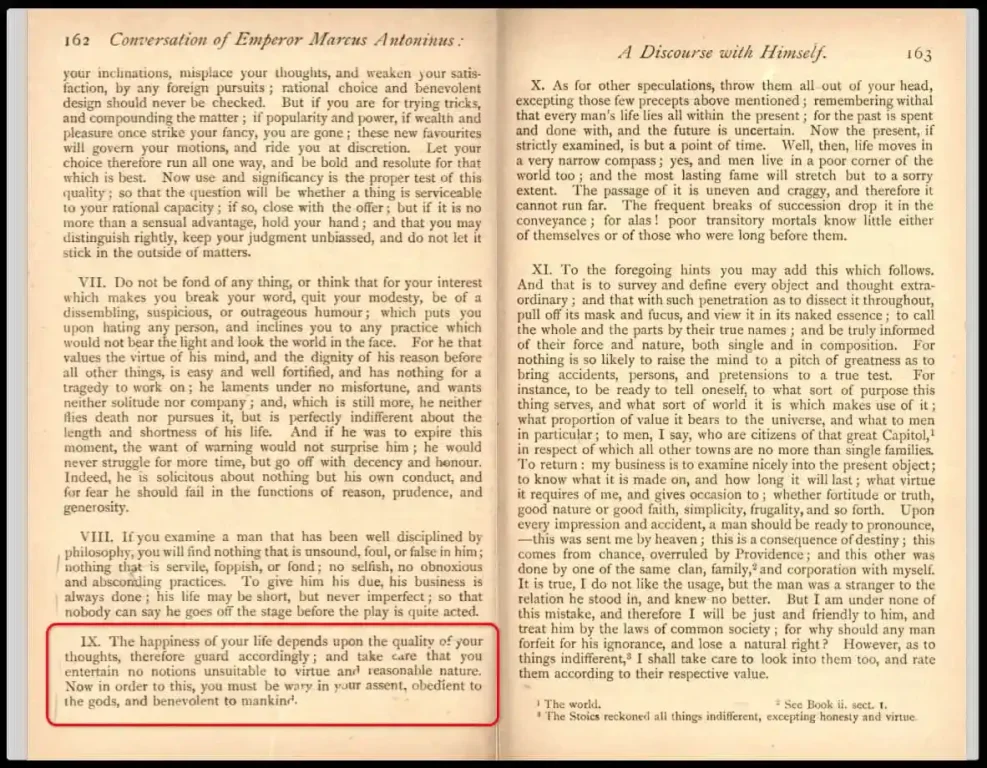
22. “The happiness of your life depends on the quality of your thoughts.” — Marcus Aurelius, Meditations (trans. Jeremy Collier, 1702)
Marcus is saying that your thoughts shape your experience of life. Change how you think, and your experience changes. Poor thinking creates distress. Clear and disciplined thinking creates stability and well-being. So if you want a better life, train your mind to think well.
II. Paraphrased Quotes (Stoic ideas, modern wording)
Some widely shared quotes reflect Stoic ideas but are modern summaries rather than direct translations. These reflect real Stoic teachings but are simplified or reworded.
23. “Just keep in mind: the more we value things outside our control, the less control we have.” — Based on Epictetus, Enchiridion
Stoic idea: When your peace depends on things outside your control, you give away your stability. The more you rely on external outcomes, the more anxious and reactive you become. Real control comes from focusing on your choices, your judgments, and your actions.
24. “The essence of philosophy is that a man should live so that his happiness depends as little as possible on external things.” — Based on Epictetus, Enchiridion
Stoic idea: Build your life such that your peace does not rise and fall with outside events. When happiness depends on things you cannot control, it becomes unstable. Focus on your thoughts, choices, and actions. That is where steady contentment comes from.
25. “No person has the power to have everything they want, but it is in their power not to want what they don’t have, and to cheerfully put to good use what they do have.” — Based on Seneca, Letters
Stoic idea: You cannot control what you get, but you can control what you want. The more you reduce unnecessary desires, the more content you become. Use what you have well, instead of chasing what you lack.
26. “That man is happy, whose reason recommends to him the whole posture of his affairs.” — Based on Seneca, Letters
Stoic idea: Happiness comes from living in line with reason. When your decisions match your values, your life feels steady and ordered. Inner alignment matters more than changing circumstances.
27. “If virtue promises happiness, prosperity and peace, then progress in virtue is progress in each of these, for to whatever point the perfection of anything brings us, progress is always an approach toward it.” — Based on Epictetus, Enchiridion
Stoic idea: A good life grows from good character. As you improve your discipline, honesty, and judgment, your life improves with it. Progress in virtue is progress in living well.
28. “If what you have seems insufficient to you, then though you possess the world, you will yet be miserable.”
— Based on Seneca, Letters.
Stoic idea. Desire expands endlessly if unchecked. If you always want more, nothing will feel enough.

29. “If you want to escape what troubles you, you need to change yourself, not your location.”
— Based on Seneca, Letters
Stoic idea: Your problems follow your thinking, not your location. Changing places does not fix inner unrest. Lasting relief comes from changing how you think and respond.
30. “No person can have everything they want, but they can choose not to want what they lack.”
— Based on Seneca, Letters
Stoic idea: You cannot have everything you want, but you can choose what to want. The more you reduce unnecessary desires, the less restless you feel. Contentment grows when you stop chasing what is missing and use well what is already in front of you.
III. Popular but Untraceable Quotes
These quotes below sound Stoic but lack reliable sources in primary texts. So we can say these are misattributions, though highly popular.

31. “Circumstances don’t make the man, they only reveal him to himself.” — Based on Epictetus, Enchiridion
Origin: Modern quote inspired by Stoic ideas. No reliable source in Epictetus. It reflects a core Stoic view that difficult situations expose your true character, showing how you actually think and respond.
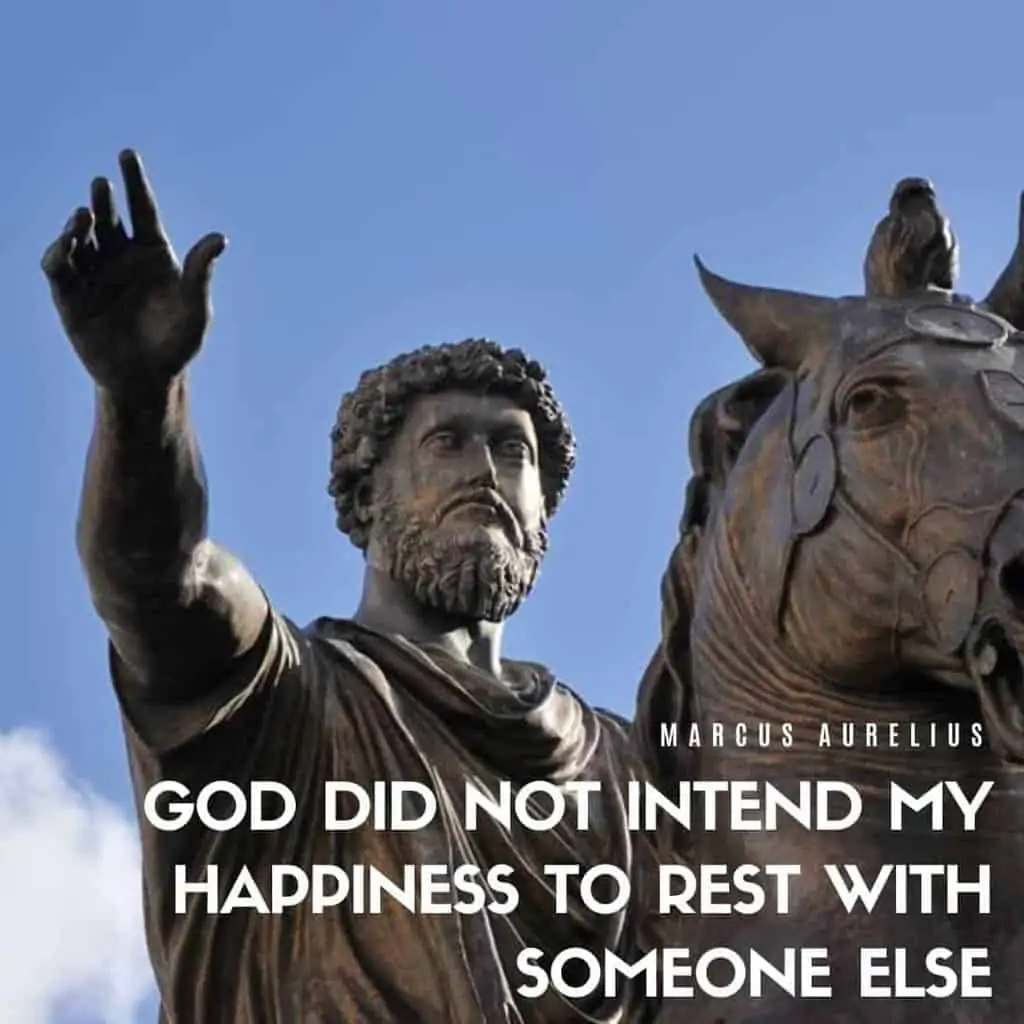
32. “God did not intend my happiness to rest with someone else.” — Based on Marcus Aurelius, Meditations
Origin: No evidence in Meditations. Likely a modern interpretation of Stoic self-sufficiency. The idea fits Stoicism in that your peace should not depend entirely on another person.
33. “Try to enjoy the great festival of life with other men.” — Based on Epictetus, Enchiridion
Origin: No verified source in Epictetus. Likely a later interpretation. It reflects the Stoic view that humans are social and meant to live cooperatively.
34. “It is impossible that happiness and yearning for what is not present should ever be united.” — Based on Epictetus, Enchiridion
Origin: Likely a philosophical summary, not a direct quote. The idea aligns with Stoicism. Desire for what you lack blocks your contentment.
35. “One ought to seek out virtue for its own sake, without being influenced by fear or hope, or by any external influence. Moreover, that in that does happiness consist.” — Based on Zeno of Citium
Origin: Reconstructed doctrine, not a direct quote. We have almost no verbatim writings from Zeno. Most quotes attributed to him come from later sources like Diogenes Laertius and are often paraphrased. The idea here is to do the right thing because it is right, not for rewards.
Final Words
Stoicism often gets diluted online through repetition and loose attribution. The ideas remain useful, but attribution matters if you want intellectual credibility.
Stoicism has had an extensive, yet mostly unsung, influence on Western philosophical thought throughout the Middle Ages, Renaissance, and into modern times (Long, 2003).
√ Also Read: How To Practice Stoicism: 18 Stoic Exercises For Modern Life
√ Please share this with someone.
» You deserve happiness! Choosing therapy could be your best decision.
...
• Disclosure: Buying via our links earns us a small commission.