Today's Saturday • 11 mins read
Most of us might have come across a narcissist at some point. A parent, a partner, a boss, or a close friend who turns out to be not so close after all.
It’s common. About 1–6% of the general population meet criteria for Narcissistic Personality Disorder (NPD), a formal clinical diagnosis. Subclinical narcissism, meaning persistent narcissistic traits that fall short of a full diagnosis, appears in roughly 10–12% of adults.
And yet, narcissistic behavior rarely announces itself. It tends to creep in quietly, disguised as charm or confidence, until one day you realize something feels consistently, deeply off.
The behaviors below, when they appear repeatedly, across different situations, and with no real remorse, may be indicative of a narcissist around you.
Once you know what you are regularly seeing, it gives you something to ponder on.
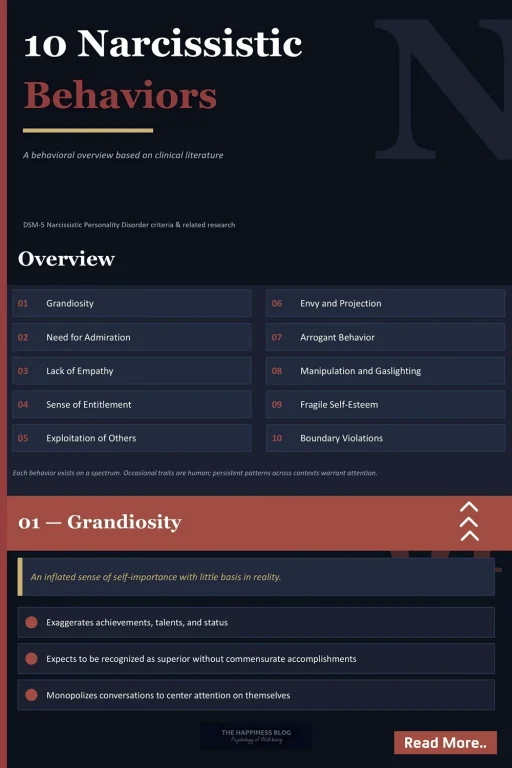
Here are 10 typical narcissistic behaviors:
1. Grandiosity
A narcissist is far more than someone with high self-esteem. Narcissistic grandiosity is linked to toxic rivalry, an inflated sense of physical attractiveness, and reduced feelings of shame.
Their grandiosity lacks self-awareness. They don’t realize it’s wrong to overstate their abilities. They operate from a belief that their extraordinary status doesn’t need any proof.
They often exaggerate their successes, drop impressive names, and talk over people without bothering. If you point out that their story doesn’t quite add up, expect irritation, insult, or aggression.
Now, let it be clear: this isn’t confidence, pride, or low-level smugness. It’s a worldview where they sit permanently on a high seat at the center, and everyone else is the supporting cast down below.
Sometimes, especially in covert narcissists, the grandiosity is a quiet, ironclad assumption of superiority.
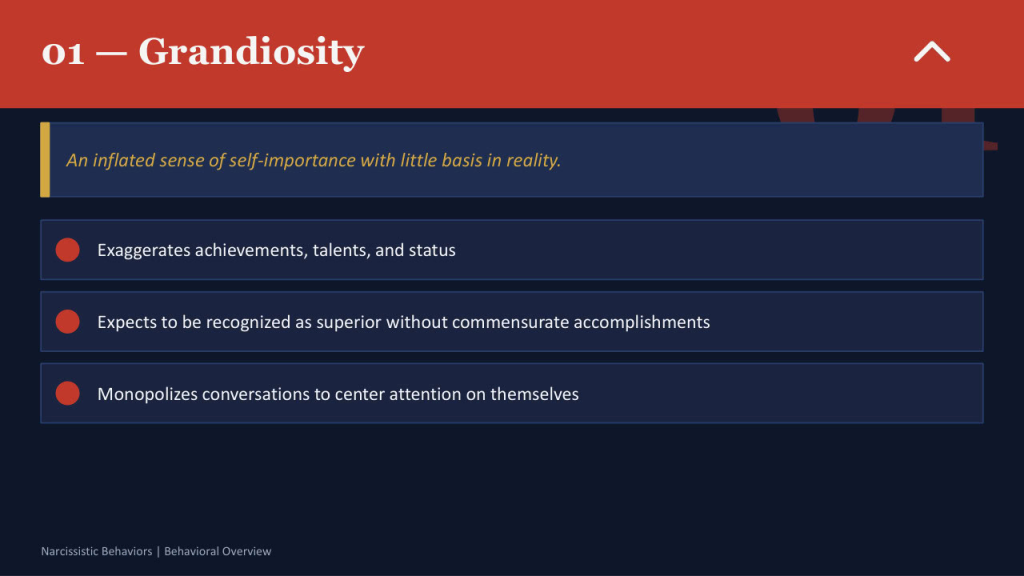
2. Need for Admiration
Admiration is not a nice-to-have for a narcissist. It is a daily requirement, as essential to their functioning as fuel is to an engine.
This need is tied to what psychologists call “narcissistic supply.” It’s described as the steady stream of praise, attention, and validation that keeps their self-image intact.
They fish for compliments in ways that seem charming. At first, you might let it pass as childlike attention-seeking.
Over time, you notice the loop: conversations circle back to them, their achievements get restated, and neutral feedback lands like a personal insult.
This neediness is not the same as that one feels when in love. No amount of reassurance can fully satisfy a narcissist’s need for admiration.
It is built into their basic nature. It is a core feature of the disorder (American Psychiatric Association, DSM-5, 2013).
The praise they receive only briefly boosts their fragile self-esteem before it gets quickly depleted. They need a constant supply of it.
When narcissistic supply dries up, their behavior changes fast. They may react with withdrawal, ghosting, cold irritability, or even sudden hostility.
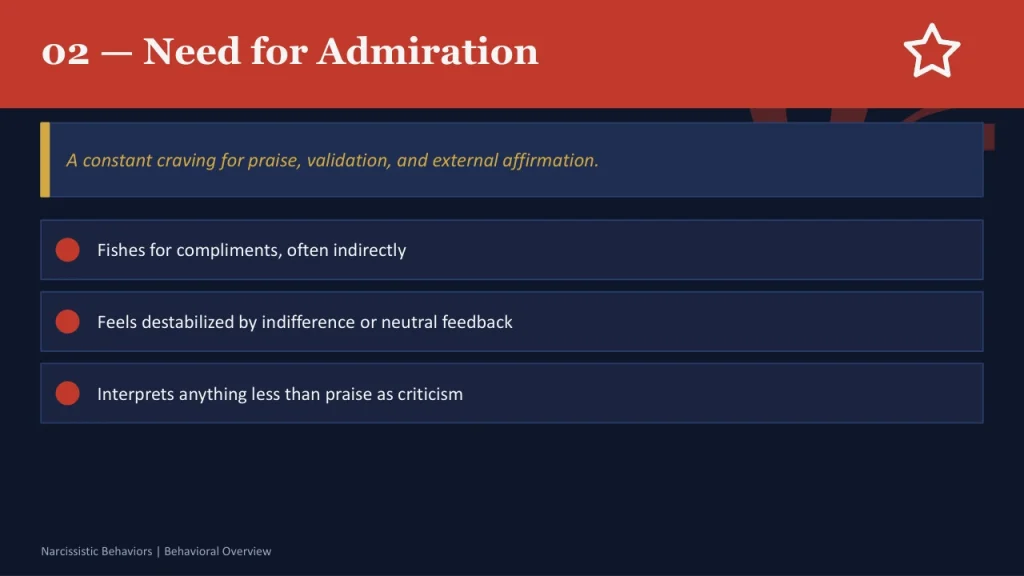
3. Lack of Empathy
This is the behavior that confuses people most, because narcissists can perform empathy when it serves them. They can read a room, mirror emotions, and say the right things at the right time.
But that is cognitive empathy: the ability to identify what someone feels. What is largely absent is affective empathy: actually feeling it with them, and being moved to care.
Research shows narcissists have reduced gray matter volume in empathy-related brain regions (Schulze & Dziobek, 2013). The authors wrote:
“More specifically, smaller gray matter volume was found in the left anterior insula, rostral and median cingulate cortex, as well as dorsolateral and medial parts of the prefrontal cortex.”
So, this may explain why they don’t experience your pain as pain. They experience it as information, or an inconvenience, or an opening.
This is why asking a narcissist to “just be kinder” produces so little. Kindness requires empathy as its foundation. Without it, you are asking someone to build on ground that isn’t there.
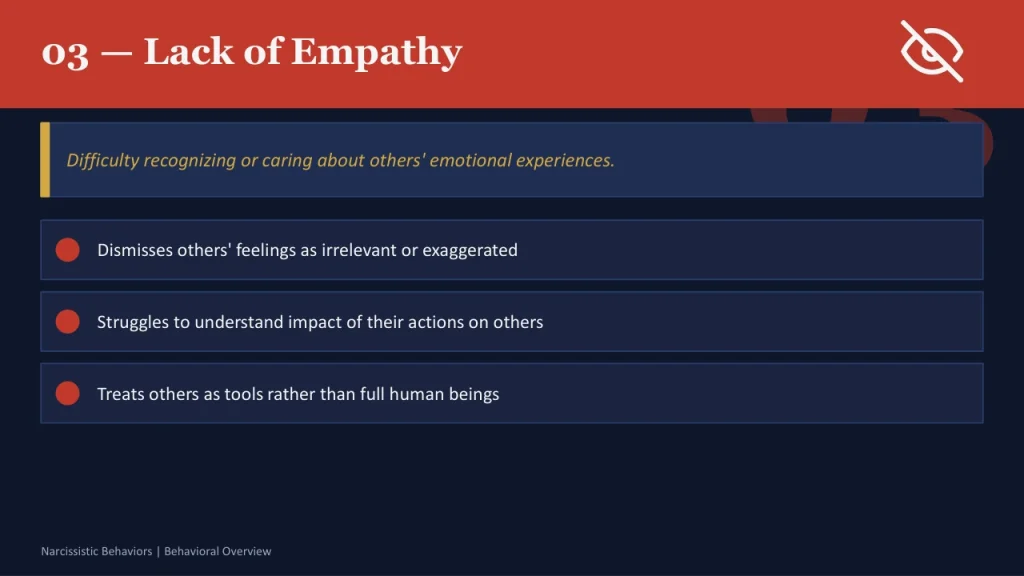
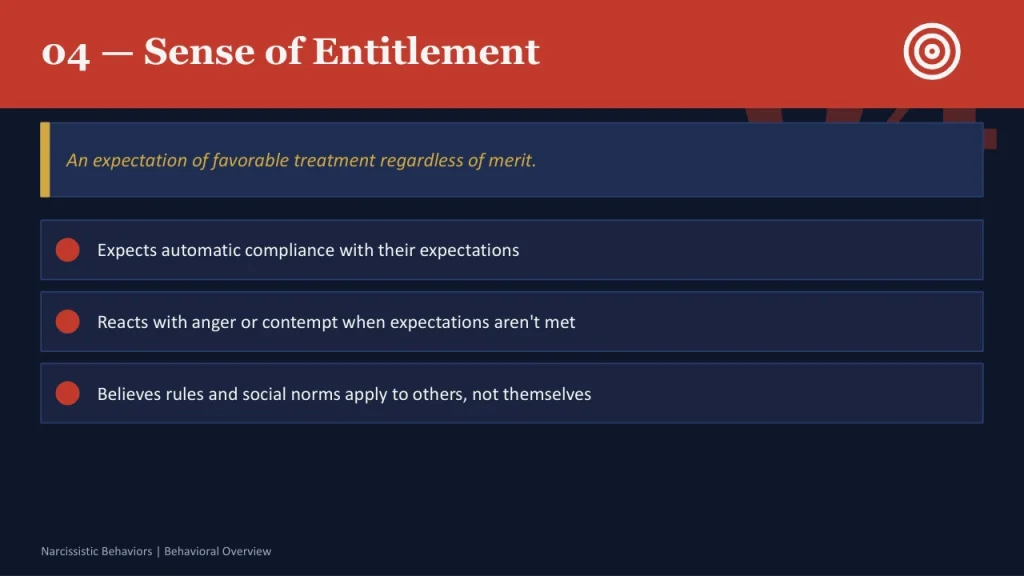
4. Sense of Entitlement
Entitlement refers to the belief that one deserves special treatment or recognition despite doing little or nothing to deserve it.
Narcissists feel entitled by nature. They expect you to give them the best treatment when you invite them, because their specialness deserves it.
As a result of their innate entitlement, they believe the rules of fairness, patience, and reciprocity do not apply to them.
They expect exceptions without earning them. They treat any pushback or ignoring them as ordinary as an insult.
You will often see them cut in line, literally and figuratively, and genuinely do not register that they have done something worth apologizing for.
Studies link narcissistic entitlement specifically to anger and aggression when expectations go unmet. This is not frustration. It is perceived injustice (Reidy & Zeichner, 2008). The authors wrote:
“Results indicated that narcissistic entitlement and exploitativeness were the narcissistic subtraits that best predicted all measures of aggression.”
What exhausts people who are in proximity to this behavior is its consistency. There is no off day, no moment of “you are right, I should wait my turn.” The entitlement is always on.
And over time, it tends to escalate rather than soften. So, what happens to a narcissist in the end: better or worse?
5. Exploitation of Others
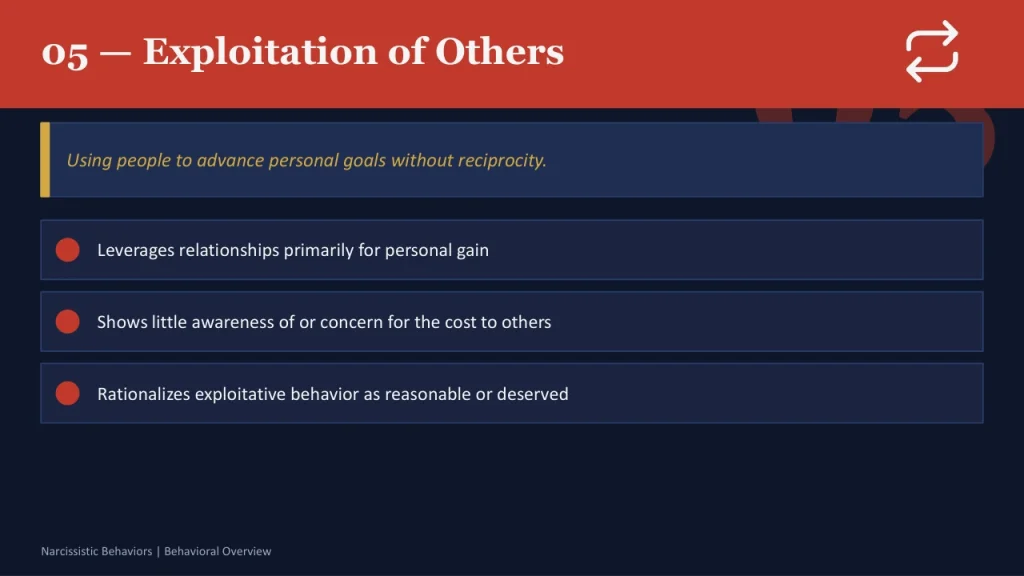
A narcissist does not experience relationships the way most people do. To them, relationships are instruments. The question running in the background is always: what does this person provide?
Exploitation does not always look predatory. Often it looks like charm, generosity, and intense attention, right up until you are no longer useful.
Then the warmth disappears, and you are left wondering what changed. What changed is that the transaction stopped being profitable for them.
If you feel chronically depleted around someone but cannot point to a single dramatic incident, this is often the explanation. It does not arrive in one blow. It accumulates quietly, in small withdrawals, until the pattern becomes impossible to deny.
They do not track the debt because, in their framework, there is no debt. What you gave was simply owed.
6. Envy and Projection
Narcissists are often intensely envious of others. They hold malicious envy for their colleagues, friends, and even partners.
But they rarely acknowledge it, because envy is incompatible with the grandiose self-image they are working hard to maintain.
So they project it. The voice in their head often shrieks, “Everyone here is jealous of me. They want to pull me down.”
Actually, it’s their own envy getting attributed outward, and the mental reversal keeps their self-concept intact.
In practice, this shows up as subtle put-downs dressed as jokes, unexplained coldness toward high achievers, and a consistent pattern of minimizing others’ wins.
If someone’s success reliably lowers the energy in a narcissist’s presence, envy-projection is often the driver.
Envy, the desire to possess another’s quality, skill, achievement, or possession, or the wish that they lacked it, can be of two main types: benign and malicious. Benign envy involves recognizing someone else’s advantages and feeling motivated to improve oneself. Malicious envy is marked by a desire to bring down the person who has what the envious person lacks.
Research links narcissistic envy to what is called “pulling down” behavior: not just wanting what others have, or benign envy, but wanting others to have less, or malicious envy (Lange et al., 2018).
That distinction matters. It makes the behavior more actively harmful than simple jealousy.

7. Arrogant Behavior
Arrogance is the behavior layer on top of grandiosity. In a way, arrogance is grandiosity made visible.
Where grandiosity is the internal conviction, arrogance is how it lands in every interaction.
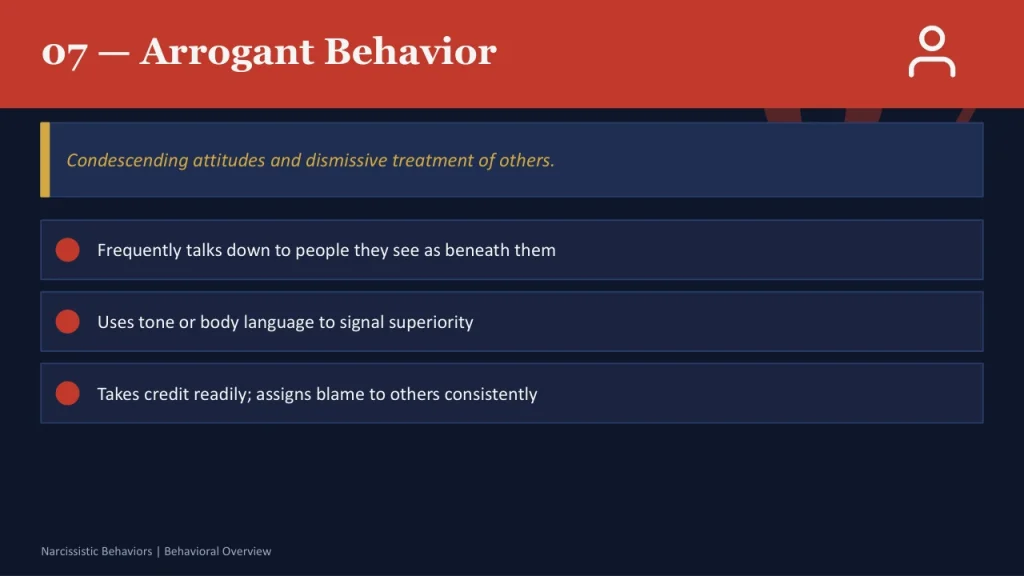
Condescending remarks. Dismissive body language. Taking credit reflexively and assigning blame just as reflexively. Talking at people rather than with them. These are not personality quirks. They are behavioral expressions of a fixed belief: that they are simply better than most people around them.
People often confuse narcissistic arrogance with confidence. The difference is structural. Confidence does not require someone else to be lesser. Arrogance does.
A confident person can celebrate others without it costing them anything. A narcissist finds that genuinely difficult, because another person’s success registers as a subtraction from their own.
Watch out for who they talk about when no one who might object is in the room. That tells you more than almost anything else.
8. Manipulation and Gaslighting
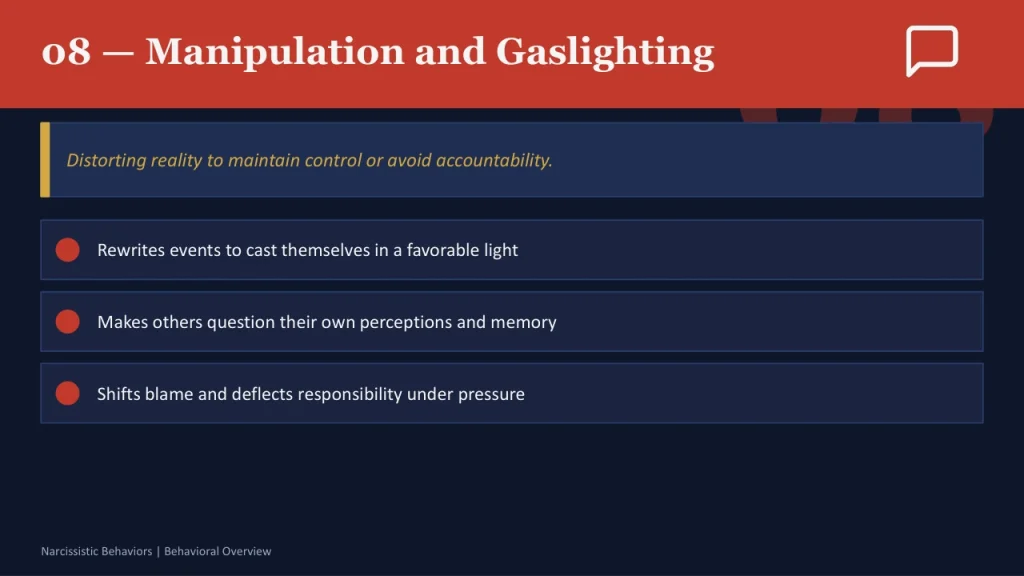
Gaslighting: a type of psychological abuse aimed at making victims seem or feel “crazy,” creating a “surreal” interpersonal environment.
Gaslighting is the process of making someone question their own memory, perception, and judgment. In narcissistic relationships, it often begins too gradually to notice.
A comment you clearly remember gets flatly denied. An event you know happened gets reframed as something you invented, misread, or blew out of proportion.
Over time, you start editing yourself before you even speak, anticipating the correction.
Research by sociologist Paige Sweet found that gaslighting is particularly effective when combined with an existing power imbalance. The narcissist does not need to be calculating for it to cause harm.
Often, the rewriting of events is reflexive: their version simply has to be the accurate one, because any alternative threatens the self-image (Sweet, 2019).
Narcissistic gaslighting is, by whatever name, an abuse that’s thinly veiled as a communication problem, explained as unintentional when caught.
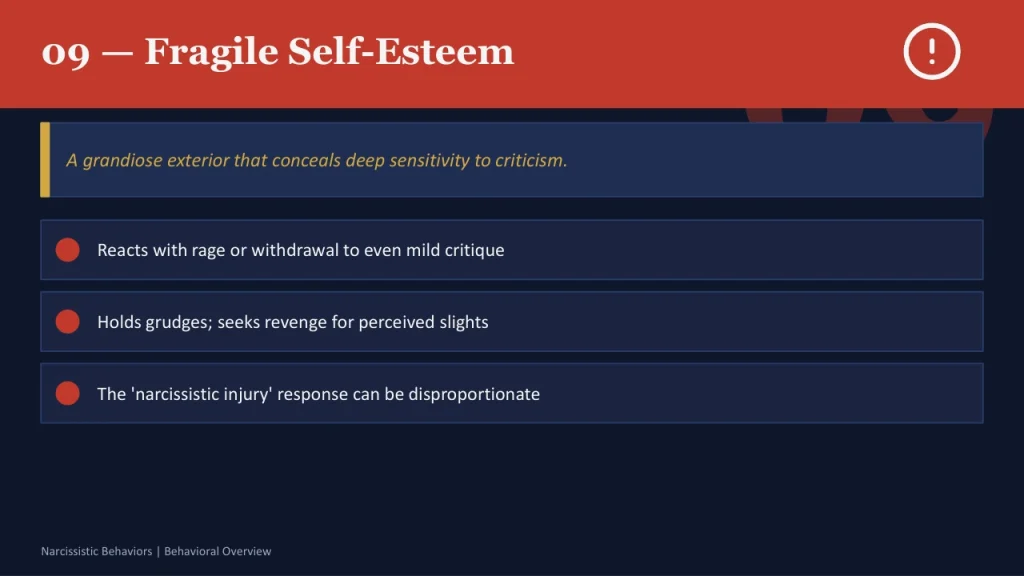
9. Fragile Self-Esteem
The grandiose exterior is real. So is the fragility underneath it. These two things are not contradictions. They are the same structure viewed from different sides.
Narcissists are unusually sensitive to criticism. Not the vicious kind. Just ordinary feedback, a mild correction, a neutral observation that a secure person would absorb without drama. The clinical term for what follows is “narcissistic injury,” and the responses it triggers are disproportionate: cold withdrawal, explosive rage, or a slow and deliberate retaliation that can last months.
Research by Rhodewalt and Morf found that narcissists’ self-esteem is highly unstable and contingent on external feedback, far more so than in non-narcissistic individuals (1998, Journal of Personality and Social Psychology).
The armor is thick, but the skin underneath is thin.
This is one of the most disorienting things for people in close relationships with narcissists. The same person who performs total invincibility in public can be derailed by a single offhand remark in private.
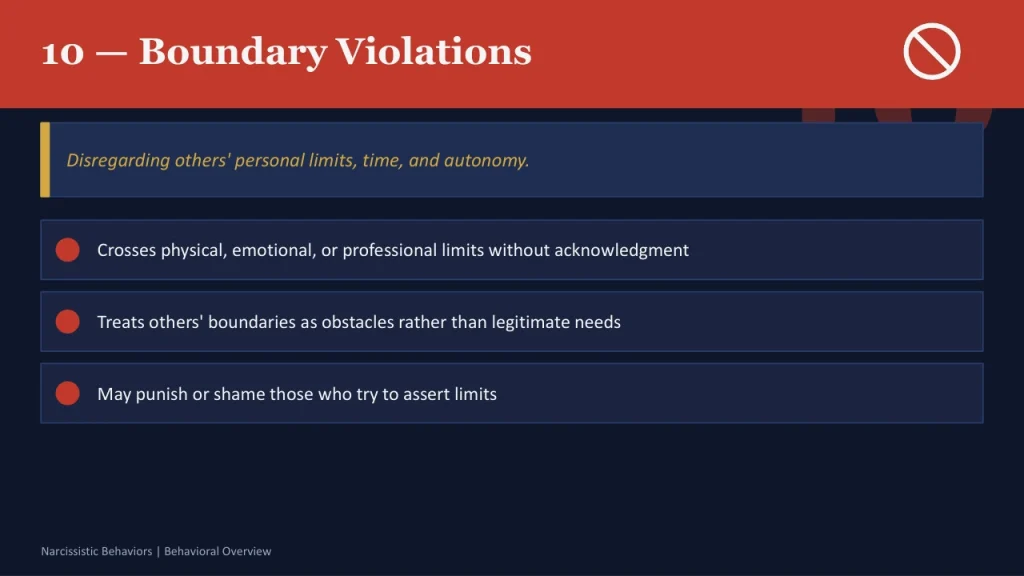
10. Boundary Violations
Narcissists do not see your boundaries as legitimate. They see them as preferences you hold loosely, negotiable under sufficient pressure.
Your need for space, time, privacy, or emotional consistency does not register as something worth respecting for its own sake. It registers as an obstacle. And obstacles, to a narcissist, exist to be worked around.
Saying no rarely resolves the issue. It tends to escalate it. They push harder, reframe your limit as selfishness, or make you feel that you are the unreasonable one for having it. Over time, many people in these relationships quietly stop asserting limits altogether.
That outcome is calculated. Narcissists are not consciously engineering your capitulation in most cases. But the pattern of behavior reliably produces it.
The boundary violations are less about malice and more about an absolute inability to register anyone else’s needs as equal to their own.
Final Thoughts
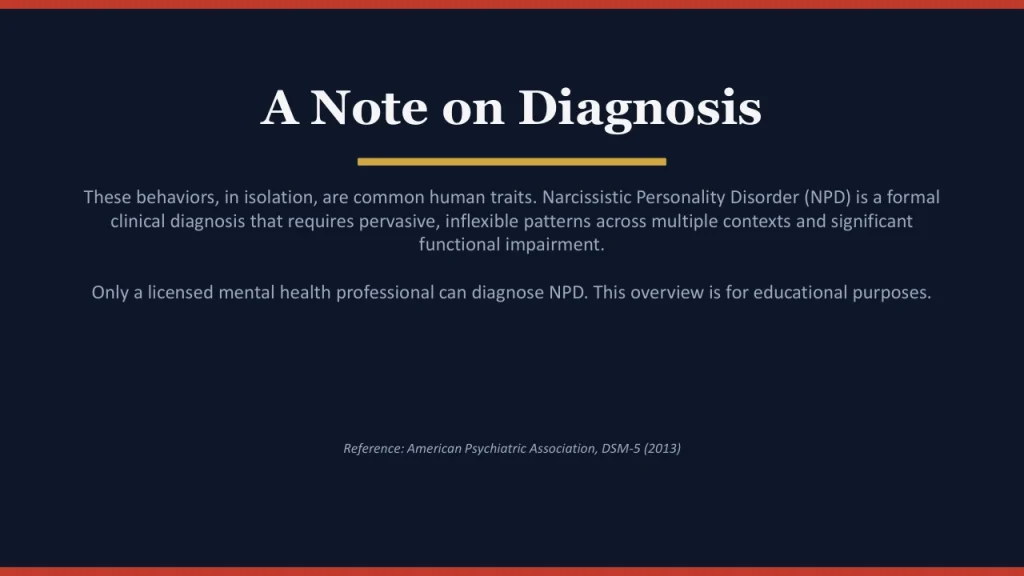
These ten behaviors exist on a spectrum. All of them appear in ordinary human behavior from time to time. The difference with narcissism is persistence, breadth, and the consistent absence of genuine accountability.
One difficult moment does not make someone a narcissist. A years-long pattern across multiple relationships and contexts is a different matter entirely.
There is one more thing worth saying plainly: narcissistic personality disorder is highly resistant to change, particularly without the person’s sustained motivation to seek treatment.
That may seem pessimistic framing, but it is an honest one. Many people stay in damaging relationships far longer than is good for them because they keep waiting for the insight that does not come.
Protecting yourself does not mean giving up on someone. Sometimes it is the most rational decision available to you.
If you recognize these patterns in someone close to you, speaking with a therapist who has experience with personality disorders is a strong first step. You deserve clarity, not just coping.
√ Also Read: What Happens When A Narcissist Knows You’ve Figured Them Out?
√ Please share this with someone.
» You deserve happiness! Choosing therapy could be your best decision.
...
• Disclosure: Buying via our links earns us a small commission.