
Today's Tuesday • 9 mins read
Aging is difficult for most people. For a geriatric narcissist, it is a particular kind of crisis.
A geriatric narcissist is someone with Narcissistic Personality Disorder (NPD) traits that last into old age. These traits include a high sense of self-importance and entitlement, a strong need for admiration, and a lack of empathy.
Narcissistic personality structure depends on a steady supply of external validation: admiration, status, physical presence, professional power, and social relevance. Aging strips all of those away.
The looks fade. The career ends. The authority that came with a dominant role in the family or workplace gradually transfers to others. The audience shrinks.
What remains when those external props are gone is the disorder at its most exposed form.
If you are caring for an aging narcissistic parent, spouse, or family member, find out how their psychology changes, what you can expect in real life, and how to preserve your mental peace and physical health.
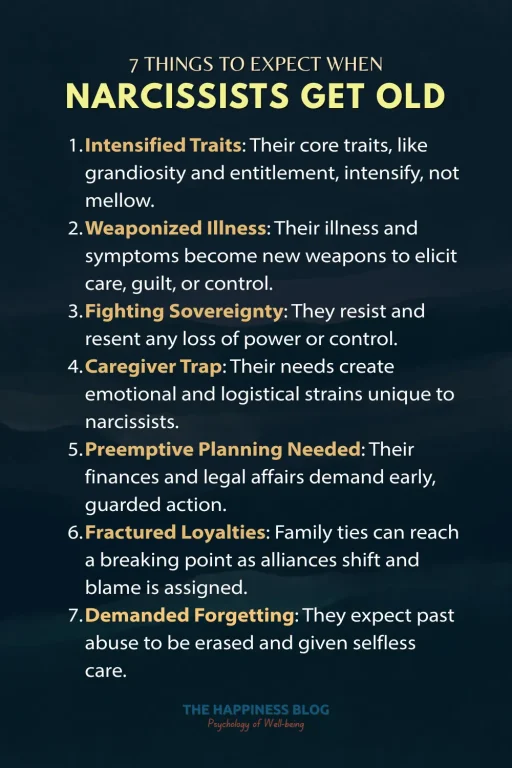
Aging Narcissists: 7 Things To Expect When A Narcissist Gets Old
1. Their core traits intensify.
You may think that age mellows down narcissists. But the fact is, old narcissists are often bitter versions of their younger selves.
Research has indeed shown that the core features of narcissistic personality, entitlement, lack of empathy, and need for admiration, tend to persist and even intensify in old narcissists (Oltmanns & Balsis, 2011).
Oltmanns & Balsis met a woman who was highly narcissistic throughout her life. Even near ninety, she pushed people out of her inner circle, engaged only when interactions boosted her self-worth, and could not see things from others’ perspectives. She habitually shifted attention back to herself, showed extreme callousness toward others’ pain, and consistently held distorted views of herself and others.
The narcissist who was demanding at 50 is likely to be more demanding at 75. If they spent all their youth dismissive of other people’s feelings, they wouldn’t develop emotional sensitivity in old age.
What changes is the context: they now have more legitimate needs, more dependency on others, and fewer social consequences for bad behavior. That combination tends to make the traits more visible, not less.
For caregivers, this means never losing sight of the realistic expectations. Hoping that age has humbled your narcissist is an understandable hope, but planning as though it will happen is a mistake.
2. Their illness and symptoms become new weapons.
For most people, illness and physical decline produce vulnerability and, often, genuine gratitude for care received. For a narcissist, these same circumstances tend to become leverage.
Physical complaints get amplified to command attention. Dependency, rather than producing humility, produces escalating demands.
Every visit, every call, every act of caregiving becomes an opportunity to extract more: more time, more sacrifice, more proof of your devotion.
Medical appointments become performances. Symptoms are selectively reported or exaggerated depending on the audience.
Many aging narcissists ratchet up their demands due to a deep panic about losing control and relevance. Faking or exaggerating symptoms is often how they keep themselves relevant and talked about.
But the impact on caregivers is the same regardless of intent. Recognizing this pattern early helps you set boundaries before the demands become unmanageable.
3. They resist and resent losing control.
Control is central to narcissistic personality functioning. It’s native to them.
So decisions about living arrangements, medical care, finances, and daily routine are almost territorial rights to an aging narcissist.
Expect irritation-laced resistance to any change that takes their decision-making power away, even when it is medically necessary or legally appropriate.
They may refuse their diagnoses. Reject care arrangements you have carefully put in place. Undermine medical advice that conflicts with their preferred self-narrative.
In some cases, they will accuse caregivers of trying to take over, steal from them, or sideline them, even when the caregiver’s actions are entirely in their interest.
Adult children and spouses dealing with this resistance often describe a disorienting experience: being accused of harm while providing care.
The best way is to document the decisions you made, the advice you gave, and the actions you took. It might feel like paranoia, but it can save you from their shaming darts.

- Do you know why narcissists admire powerful narcissists?
4. Their caregiving needs create a unique challenge.
Standard caregiving guidance assumes a care recipient who is, at baseline, grateful, cooperative, and emotionally reciprocal. Caregiving a narcissist operates outside those assumptions entirely.
The emotional labor is significantly heavier. There is rarely any acknowledgment of the care you provide. Instead, criticism is frequent. Affection, when it appears, is often conditional on compliance.
Caregivers of narcissistic family members report disproportionately high rates of burnout, anxiety, and depression, not because they are less capable than other caregivers, but because the relational dynamic actively works against them (Greenberg et al., 2004).
Practical steps that help: establish a caregiving team rather than shouldering it alone. Limit the number of decisions you make unilaterally, since each one becomes a potential grievance.
Set visit schedules and stick to them, because unpredictability feeds their anxiety and escalates demands. And seek support from a therapist familiar with narcissistic family dynamics, because the emotional toll of this work is real and specific.
5. Their legal and financial affairs require early planning.
This is the area where delayed action causes the most lasting damage, and where adult children and spouses are most often caught unprepared.
Aging narcissists often resist legal and financial planning. One main reason is that documents like a power of attorney, healthcare proxies, and wills require them to plan for dependency on others and their end.
They threaten the omnipotence their self-concept requires. They may refuse to engage, delay indefinitely, or change documents impulsively in response to perceived slights, rewarding whoever is currently in favor and punishing whoever has recently disappointed them.
Key steps to take as early as possible. Have an attorney, ideally one familiar with high-conflict personalities, facilitate conversations about power of attorney for finances and healthcare decisions before a crisis makes them urgent.
Get clarity on asset ownership, beneficiary designations, and existing estate documents.
If siblings or other family members are involved, establish communication protocols now, because an aging narcissist will exploit divisions between family members strategically, often playing one against another to maintain control.
If cognitive decline (like dementia or Alzheimer’s) enters the picture alongside narcissism, the complexity increases manyfold. A narcissist with early dementia may lack the legal capacity to execute documents while still being manipulable by anyone seeking to influence their decisions.
Geriatric care managers and elder law attorneys are valuable resources in this scenario, and involving them early is consistently better than engaging them in a crisis.
6. Their family dynamics can reach a breaking point.
Aging has a way of bringing long-suppressed family dynamics into the open. In families with a narcissistic parent or spouse at the center, the caregiving period frequently triggers conflicts that have been managed, avoided, or minimized for decades.
Sibling splits are common. One child becomes the primary caregiver, often the most compliant or geographically closest, while others stay peripheral.
The narcissistic parent may actively encourage this imbalance, playing siblings against each other to maximize their own supply and control.
The caregiver sibling carries the weight and often the resentment. The distant siblings carry the guilt and sometimes the opinions.
Spouses of aging narcissists face a different version of the same dynamic. Decades of managing the narcissist’s behavior have often left the spouse depleted. They are left with few independent social connections.
When the narcissist’s health declines, the caregiving role intensifies and expands, but the appreciation and reciprocity remain absent.
Family therapy with a therapist who understands narcissism is genuinely useful here. The treatment goal is less to change the narcissist, which is unlikely, and more to help the family system function around them without destroying itself.
7. They expect you to forget past abuse and give selfless care.
This is the point that is rarely discussed in caregiving literature. But it needs to be said directly.
Providing care for an aging family member is meaningful and often the right thing to do. However, it is not an unlimited obligation.
Two things of note:
- The fact that they are old does not retroactively erase the harm they caused when they were young.
- That you are young does not obligate you to absorb unending mistreatment as their caregiver.
Setting limits on what you will and will not do is a legitimate act. Hiring professional caregivers rather than providing all care yourself is a legitimate choice.
Maintaining boundaries around your own time, mental health, and finances is not neglect. It is sustainability.
Many adult children of narcissistic parents carry years of conditioning that makes any limit feel like a moral failure. Working with a therapist to disentangle genuine obligation from conditioned guilt is one of the most practical things you can do when navigating this period.
Final Words
Aging exposes and deepens a narcissist’s core wounds, not heals them.
With age, the external scaffolding of status, physical dominance, professional authority, and social relevance is gone.
What remains is the undefended disorder: the shame of being unimportant, the rage at being dependent, the inability to charm others, the scarcity of admirers, and people knowing who they really are.
There is something painfully clarifying about this. The aging narcissist is no longer performing for a wide audience. They are performing for you, in your living room, at the kitchen table, in the hospital waiting room.
And you are seeing, perhaps for the first time with full clarity, what was always underneath.
That clarity will not change them, unfortunately. But it can free you from the decades-long work of trying to understand what you did wrong, why they are the way they are, and whether things might eventually be different.
In old age, the answer becomes visible: this was never about you. It was always about what your narcissist could not bear to feel about themselves.
√ Also Read: How Narcissists Guilt-Trip You, And How To Push Back
√ Please share this with someone.
» You deserve happiness! Choosing therapy could be your best decision.
...
• Disclosure: Buying via our links earns us a small commission.