
Today's Sunday • 8 mins read
Narcissists seem confident and fearless, but they are not. Actually, they hide their fears well beneath their arrogance, rudeness, and an air of superiority.
Survivors of narcissistic abuse reveal that one thing is what narcissists fear the most. If you’ve ever lived with a narcissist or known them from close quarters, you would want to know.
Read the psychological facts behind this dark personality’s fears. Share it with someone you care about who might be dealing with a narcissist. Save this for when you need clarity.
What Do Narcissists Fear The Most: 5 Truths Revealed by Survivors
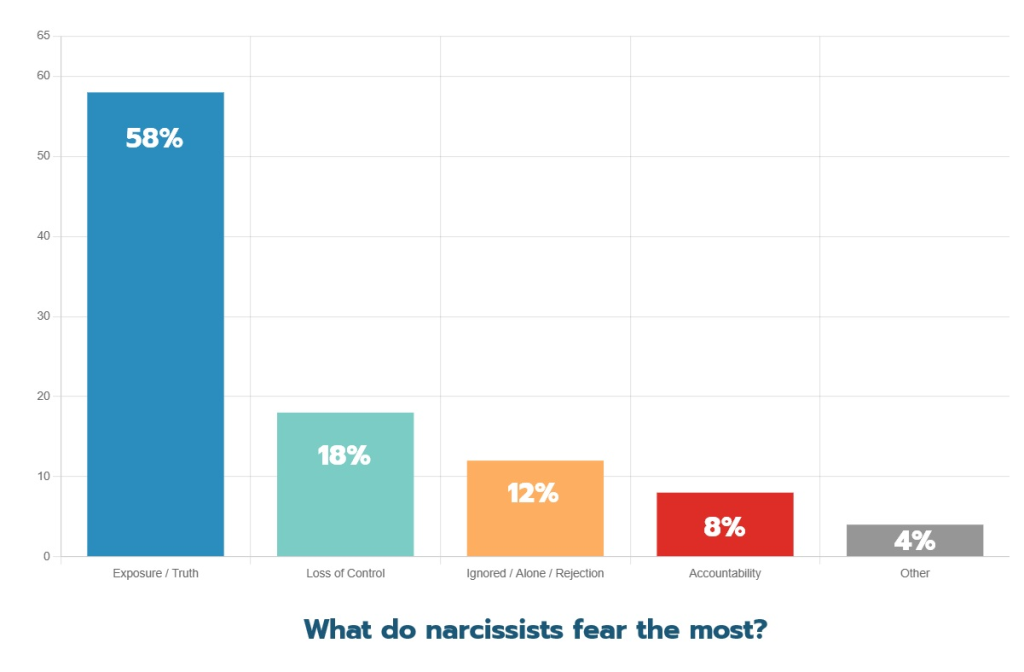
We asked members of a popular narcissistic recovery community one question: What do narcissists fear the most?
The responses were candid, detailed, and remarkably consistent.
People who have lived with narcissists know exactly what those fears look like in action. They know these are the very pressure points narcissists work hard, often obsessively, to protect.
Five themes emerged clearly:
- Exposure topped the list by a wide margin, at 58%.
- Loss of control came in at 18%.
- Being ignored or rejected registered at 12%.
- Taking accountability scored 8%.
- Everything else, including silence, financial ruin, and having no supply, made up the remaining 4%.
1. Exposure: Why Narcissists Fear Exposure Above Everything Else
Fifty-eight percent of respondents named exposure, in some form, as the narcissist’s deepest fear. The phrasing varied: “being found out,” “people knowing the truth,” “being outed for who they really are.” But the core fear was identical across all of them.
This makes clinical sense. Narcissistic Personality Disorder is organized around a curated identity built to attract admiration and deflect criticism (American Psychiatric Association, 2013).

That curated, false self requires constant maintenance. The narcissist cannot afford to be seen as anything but the public persona of a charming person with good manners.
When that prized image is threatened by exposure, they get afraid and respond with aggression, rage, gaslighting, and DARVO (Deny, Attack, Reverse Victim and Offender). The main goal is to shut you up.
They can also start vengeful smear campaigns against you. The point here is to get the potential audience to give no credence to their stories when they come out.
If you have ever tried to name a narcissist’s behavior to others and found yourself suddenly recast as the problem, that was the mechanism behind it.
Many believe that narcissists are shame-free. But actually, narcissists are shame-avoidant.
Research on narcissism and shame supports this. Psychoanalytic clinicians identify internalized shame as a key part of narcissism. They see narcissistic grandiosity being used as a defense against the sense that one’s entire self is defective, rather than just one’s behavior (Kohut, 1971; Morrison, 1989, as cited in Tangney & Wagner, 1992.
Exposure threatens to collapse that defense entirely. That is why their reaction to being outed is so out of proportion. What others might experience as embarrassment, for a narcissist, is an existential threat.

2. Loss of Control: How Loss of Control Drives Narcissistic Behavior
Eighteen percent of respondents pointed to loss of control, specifically losing control over other people or over the narrative of events.
Narcissists need to control what others think, feel, and do. This is a functional requirement of the disorder.
The narcissist’s self-esteem is externally regulated, meaning it depends on constant input from others in the form of admiration, compliance, or fear (Morf & Rhodewalt, 2001). When that input stops, or when someone refuses to behave as expected, the narcissist’s internal sense of stability collapses.
This explains the escalation patterns that survivors describe so consistently. A narcissist who sees they are losing control will escalate, not back down. They can do many extreme things to pull the situation back under their control.
They can manufacture crises, intensify gaslighting, and blame you for calling out their behavior. They can recruit allies (called the narcissist’s “flying monkeys”).
The fear of losing control is also why setting a boundary with a narcissist makes them feel so threatened. A boundary is, by definition, a limit on their control. They rarely accept your boundary with calmness. It is mostly a pushback or punishment.
Another side of this fear is this: losing their say in who’s an angel and who’s a villain.
Narcissists spend much energy managing how events are interpreted and who is seen as credible. When they lose that, and others start forming their own conclusions, the narcissist loses what they have worked hardest to maintain: the story in which they are always justified.
3. Fear of Being Rejected: The Paradox of Fearing Rejection While Rejecting Others
Twelve percent of respondents named being ignored, rejected, or made irrelevant as a core fear. This surprises people because narcissists are known to routinely discard others with indifference.
Actually, their fear of being rejected is about what rejection signals: that they are not special, not exceptional, not important, and not worthy of attention.
Narcissists require what clinicians call “narcissistic supply,” the ongoing stream of attention that regulates their self-image. Rejection threatens to cut that off.
This is why being ignored produces a stronger reaction in narcissists than direct conflict does. Conflict at least means you are still engaging. But indifference says they are not worth your energy. And that is a message they cannot handle easily.
It also explains hoovering, the pattern where a narcissist re-initiates contact after being left. Their tries to reconnect are mostly to get their supply back, and rarely from a place of real reconnection.
Research on rejection sensitivity in narcissism shows an important split:
- Grandiose narcissists tend to consciously dismiss rejection while reacting to it indirectly through aggression or devaluation (Twenge & Campbell, 2003).
- Vulnerable narcissists feel it acutely and openly.
In both cases, the fear of irrelevance is the engine. The difference is only in how it surfaces.
4. Accountability: Why Accountability Is Intolerable to a Narcissist
Eight percent of respondents named fear of being held accountable. Narcissists especially hate being called out as the one responsible, being caught, or being made to answer for what they did.
This is related to exposure but distinct. Exposure is about the truth becoming visible. Accountability is about being required to face the consequences of that truth.
A narcissist can sometimes survive exposure by discrediting the source. But accountability is harder to outrun because it involves external authority: an institution, a legal process, or a formal record that does not bend to charm.
Narcissistic defenses require that their image remain beyond blame. So when something goes wrong, the cause is always external: someone else’s failure, a misunderstanding, bad luck.
Taking genuine responsibility would need acknowledging fault, which activates the shame response they spend their lives avoiding.
This is why apologies from narcissists are rarely genuine. The words may be there, but accountability is not.
A narcissistic apology comes dressed up as an apology but is usually a tactic to de-escalate the situation, deflect the issue, or regain access to someone they need.
What To Do Knowing A Narcissist’s Fears
Be warned: Knowing what a narcissist fears does not give you leverage over them. That framing leads to escalation and retaliation.
What it really gives you is clarity. You understand this personality and their behaviors better. You see that:
- When they smear your name before you’ve spoken in public, they are managing the exposure risk.
- When they react with rage to a truthful, difficult conversation, you are watching fear in action.
- When they launch hoovering after months of silence, they are managing the rejection fear.
Most of it is really about the threat you represent to their carefully constructed image.
One thing: Knowing what fuels narcissistic behavior doesn’t make the behavior any less toxic. Instead, it lets you predict when that toxic behavior is about to occur and gives you a chance to protect yourself.
So, what do you do? The single most destabilizing thing you can do to a narcissist, as people who have lived with them say, is to stop being afraid of them.
Stop fearing what they can do to your reputation. Don’t let their approval, negative publicity, or silence get to you.
When you become indifferent to their doings, it takes away their leverage. That is when many survivors describe finally feeling truly free and happy.
Final Words
Narcissists are not fearless. They are people working hard to avoid specific fear-laden threats.
Exposure, loss of control, rejection, and accountability are the four walls of the cage they live in. Every manipulation, rage episode, and charm offensive maps back to one of those four.
One thing: this understanding does not require you to sympathize with the narcissist. It gives you a tool to see their behavior as functional to their personality type.
They are doing it for themselves because the alternative, sitting with the fear, is something they have never learned to do.
- Don’t take their insults personally; they don’t get to decide your self-worth.
- Don’t try to fix them; they are unfixable, even by many therapists.
The narcissist will spend a lifetime running from a mirror. That, in the end, is the real cost of narcissism.
√ Also Read: How To Stop Loving A Narcissist, Break The Spell, & Move On
√ Please share this with someone.
» You deserve happiness! Choosing therapy could be your best decision.
...
• Disclosure: Buying via our links earns us a small commission.