
Today's Tuesday • 16 mins read
Stoicism can seem simple until you meet its vocabulary. You start with advice about handling setbacks, then run into words like apatheia, prohairesis, and eudaimonia.
Even familiar words can mean something different. A Stoic “indifferent” can be something you deeply care about. “Virtue” means more than being polite. And freedom from “passions” does not mean becoming emotionally cold.
Stoicism is a philosophy founded by Zeno of Citium in Athens around 300 BCE. It teaches that a good life depends on the quality of our character: how wisely, fairly, courageously, and moderately we think and act.
- Virtue is the sole good. Wealth, health, and reputation cannot make someone morally good. The way they use those things matters.
- Our judgments and choices deserve our attention. Other people’s opinions and external outcomes are never entirely ours to determine.
- Human beings have responsibilities toward one another. Stoic self-discipline goes together with fairness, cooperation, and concern for the wider community.
This alphabetical glossary explains the core vocabulary of Stoicism, including Greek terms, their English equivalents, and practical concepts.
Terminology note: English translations and Greek spellings vary across books. This glossary uses simplified spellings and includes common equivalents to make terms easier to recognize.
Glossary of Terms: Stoicism & Stoic Philosophy
A
- Acceptance. Recognizing circumstances as they are so you can respond reasonably. In Stoic practice, accepting that something has happened leaves room for action: addressing an injustice, solving a problem, or preventing further harm.
- Adiaphora (Indifferents). Things that are neither moral goods nor moral evils in themselves, such as health, wealth, reputation, pain, and death. They can affect your circumstances profoundly, but possessing or losing them does not determine your character. See Preferred Indifferents.
- Amor Fati (Love of Fate). Embracing the life and circumstances you encounter, including difficulties, while choosing how to respond virtuously. The Latin phrase is especially associated with Friedrich Nietzsche and was adopted by modern Stoic writers; it was not an ancient Stoic technical term. Its connection to Stoicism lies in the practice of willingly accepting events while continuing to act responsibly.
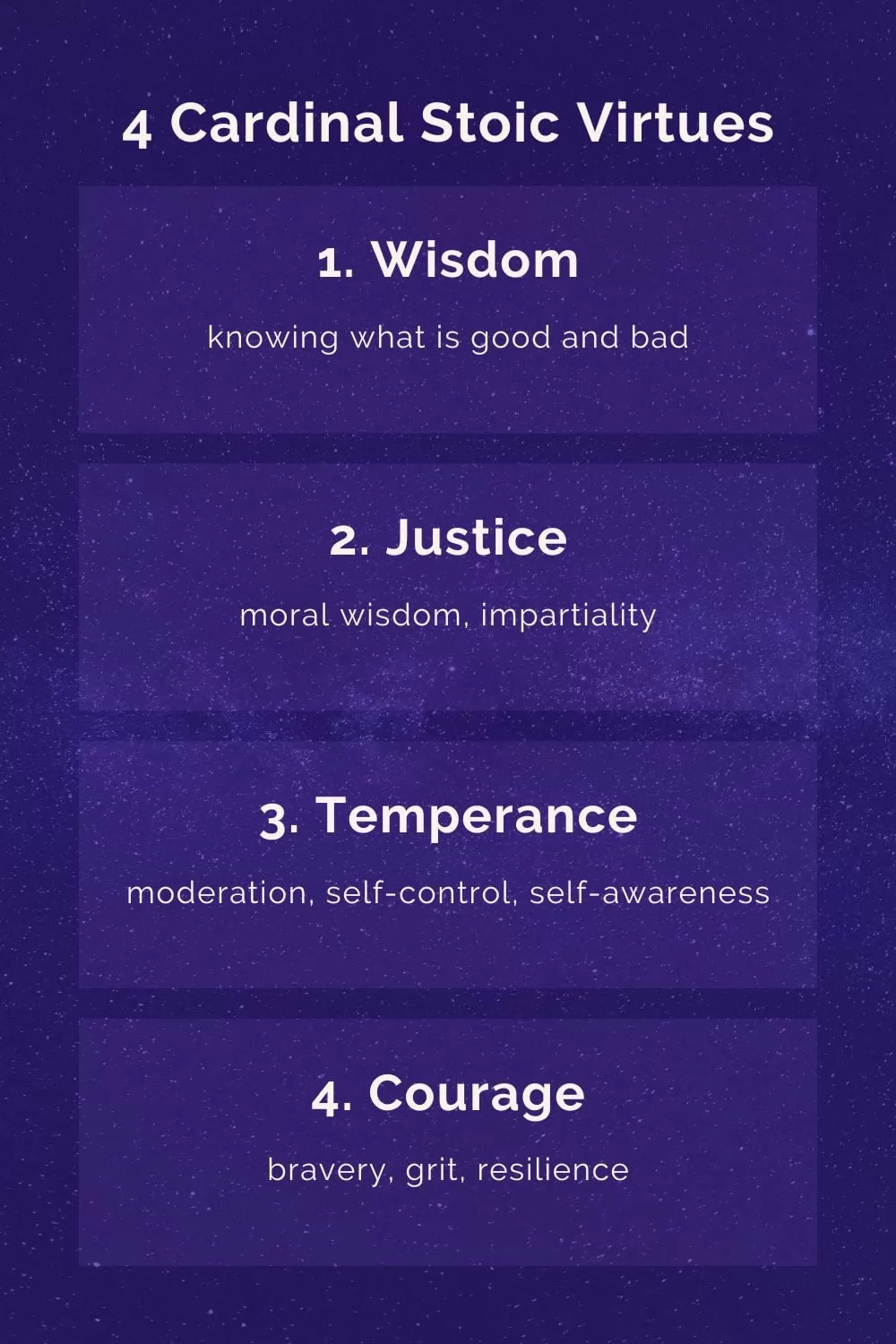
- Andreia (Courage). The virtue of understanding what deserves fear and what can be faced without abandoning your principles. Stoic courage includes enduring difficulty and doing what is right under pressure. Reckless risk-taking does not qualify.
- Apatheia. Freedom from irrational or excessive passions arising from mistaken judgments. It describes the Stoic ideal of emotional steadiness, without implying apathy, emotional numbness, or a lack of care for others.
- Appropriate Action. An action that fits your circumstances and can be reasonably justified, such as caring for your health or fulfilling a responsibility toward your family. The Greek term is kathekon. See Katorthoma for the stricter idea of a perfectly virtuous action.
- Arete (Virtue). Excellence of character, expressed through wisdom, justice, courage, and temperance. The Stoics regarded virtue as the only intrinsic good and as sufficient for a flourishing life.
- Askesis (Practice or Training). Deliberate exercises that turn philosophical understanding into better habits. These include examining judgments, practicing restraint, and preparing for difficulties. Reading about patience becomes useful when you practice it during an irritating conversation.
- Assent. Accepting an impression or judgment as true. Stoic practice asks you to examine what appears to be happening before endorsing your first interpretation. Someone’s silence, for example, does not by itself establish that they dislike you. See Synkatathesis.
- Ataraxia (Tranquility). Freedom from mental disturbance. In a Stoic context, tranquility follows from sound judgments and virtuous living. The term is also associated with other ancient philosophies, especially Epicureanism.
- Autarkeia (Self-Sufficiency). The idea that virtue is sufficient for flourishing, without making happiness depend on possessions, status, or favorable circumstances. This ethical independence remains compatible with friendship, cooperation, and social responsibilities.
C
- Cardinal Virtues. The four central Stoic virtues: wisdom, justice, courage, and temperance. Together, they guide how to judge situations, treat people, face difficulties, and manage desires.
- Character. The moral quality of a person’s judgments, choices, and conduct. Stoic practice aims to improve character rather than measure personal worth through wealth, recognition, or success.
- Cognitive Impression. An impression that meets the Stoic standard for a reliable grasp of reality. Simply feeling certain about something does not establish that your impression deserves this status. See Katalepsis.
- Common Good. The welfare of the broader human community. Stoic ethics connects personal excellence with social responsibility: your choices should account for the people affected by them.
- Cosmopolitanism. The view that human beings belong to a worldwide moral community through their shared rational nature. Duties of fairness and concern extend beyond family, nationality, and familiar social groups.
- Cosmos. The universe understood as an ordered, interconnected whole. Ancient Stoics regarded it as a living system governed by reason. See Kosmos and Logos.
- Courage. See Andreia.
D
- Desire. An impulse toward something perceived as good. Stoic training examines whether the desired thing genuinely deserves that judgment. Wanting recognition becomes troublesome when you treat other people’s approval as essential to your worth.
- Dialectic. The disciplined examination of reasoning, arguments, and claims. Within Stoic philosophy, dialectic helps distinguish sound conclusions from confused thinking and unsupported beliefs.
- Dichotomy of Control. The distinction between what is “up to us” and what is not, especially associated with Epictetus. Our judgments and moral choices belong on one side; possessions, reputation, and external outcomes belong on the other. You can influence many outcomes without being able to guarantee them.
- Dikaiosyne (Justice). The virtue of treating others fairly and giving each their due. It includes honesty, appropriate fulfillment of social duties, and consideration of the common good.
- Discipline of Assent. The practice of examining impressions before accepting them as true. It helps prevent a quick assumption from becoming an unquestioned belief that drives your behavior.
- Dispreferred Indifferents (Apoproegmena). Things ordinarily reasonable to avoid, such as illness, pain, and poverty, provided avoiding them does not require wrongdoing. They can seriously affect your life without making you morally worse. See Preferred Indifferents.
- Doxa (Opinion). An insecure or inadequately grounded belief. Stoic philosophy contrasts opinion with stable knowledge, warning against confidently accepting impressions without sufficient examination.
- Duty. A responsibility arising from human nature, relationships, or particular circumstances. Duties include caring for dependents, dealing fairly with others, and contributing appropriately to community life. See Kathekon.
E
- Ekpyrosis. The cosmic conflagration described in early Stoic physics, in which the universe is consumed by divine fire before being renewed. This belongs to ancient Stoic cosmology.
- Eph’ Hemin (Up to Us). The Greek expression behind the Stoic distinction concerning personal agency. It refers to judgments, desires, aversions, and actions insofar as they arise from our moral choice. See Dichotomy of Control.
- Episteme (Knowledge). Secure, systematic understanding that cannot easily be overturned by argument. In strict Stoic theory, the sage possesses this stable knowledge, while ordinary people often rely on less secure beliefs.
- Epistemology. The study of knowledge: how we form beliefs, what makes them reliable, and how we distinguish truth from error. Stoic epistemology examines impressions, assent, comprehension, and knowledge.
- Epoche (Withholding Assent). Suspending judgment when an impression is unclear or insufficiently supported. In everyday practice, it means allowing yourself to say, “I do not yet know enough to decide.”
- Equanimity. Steadiness of mind when circumstances change. Stoic equanimity develops through examining judgments and maintaining moral purpose during success, disappointment, pleasure, or pain.
- Ethics. The branch of Stoic philosophy concerned with how to live well. Its central subjects include virtue, flourishing, duties, choices, and our relationships with other people.
- Eudaimonia (Flourishing). A good and fulfilled life grounded in virtue. Often translated as “happiness,” it describes the quality of a whole life rather than a passing pleasant feeling. The Stoics held that virtuous character is sufficient for eudaimonia.
- Eupatheia (Rational Emotion). A well-reasoned emotional response grounded in correct judgments about good and evil. The plural, eupatheiai, describes the sage’s healthy emotions: joy, wish, and caution. These show why Stoic freedom from irrational passions does not mean becoming emotionless.
- Externals. Circumstances and possessions outside moral choice, including money, health, social standing, and other people’s behavior. Externals provide opportunities to act wisely or badly; they do not establish your moral worth by themselves.
F
- Fate. The interconnected chain of causes through which events unfold, according to ancient Stoic physics. Stoics understood fate as part of the rational order of the universe. See Heimarmene.
- Flourishing. See Eudaimonia.
- Freedom. In Epictetus’s ethics, freedom centers on the proper use of moral choice. It involves avoiding dependence on external conditions for one’s moral integrity and learning to examine the judgments that govern one’s responses.
H
- Hegemonikon (Ruling Faculty). The governing center of the mind or soul in Stoic psychology, responsible for impressions, judgment, assent, and impulse. Ancient Stoics understood it through their physical theory of the soul.
- Heimarmene (Fate). The universal causal order connecting events. The Stoics treated human deliberation and choice as compatible with this order, maintaining that people remain accountable for their judgments and conduct.
- Hexis (Cohesion). In Stoic physics, the condition through which pneuma holds a physical object together. It helps explain the unity and stability of inanimate things within the ancient Stoic account of nature.
- Hierocles’ Circles of Concern. A model of social relationships extending outward from oneself through family, community, and humanity. Hierocles encouraged bringing the outer circles closer, treating more distant people with greater concern and familiarity.
I
- Impression. The way something initially appears to the mind, whether through perception or thought. An impression may be accurate, misleading, or mixed with interpretation. Stoic practice emphasizes examining it before giving assent. See Phantasia.
- Indifferents. See Adiaphora.
J
- Judgment. An evaluation of what something means or whether it is good, bad, desirable, or threatening. Stoic ethics gives judgments a central role because they shape desires, emotional responses, and actions.
- Justice. See Dikaiosyne.
K
- Katalepsis (Comprehension). A reliable cognitive grasp achieved by assenting to an appropriately clear and trustworthy impression. It occupies a stronger position than mere opinion in Stoic accounts of knowledge.
- Kathekon (Appropriate Action). An action that fits nature and circumstances and has a reasonable justification. Caring for a child, honoring a responsibility, or looking after your health can qualify. The plural is kathekonta.
- Katorthoma (Perfectly Right Action). An action performed with the complete wisdom and virtuous disposition of the sage. The distinction concerns the agent’s understanding and character as well as the outward deed. The plural is katorthomata.
- Kosmos. The ordered universe, understood by ancient Stoics as an interconnected living whole governed by divine reason. Human beings participate in this whole through their rational nature.
L
- Living According to Nature. The Stoic description of the goal of life: living consistently with reason, human social responsibilities, and the larger order of existence. Following every spontaneous urge would not satisfy this ideal.
- Logic. One of the three main branches of Stoic philosophy, alongside physics and ethics. It concerns reasoning and related questions about language, argument, impressions, and knowledge.
- Logos. Reason or the rational principle ordering the universe. Ancient Stoics understood human reason as participating in this wider cosmic reason, connecting their account of nature with their ethics.
M
- Memento Mori (Remember That You Will Die). A Latin reminder of mortality, commonly associated with Stoic practice. Reflecting on life’s limits can help you clarify priorities, appreciate the present, and act with greater purpose. The aim is to encourage thoughtful living without becoming preoccupied with death.
- Moral Choice. The capacity to evaluate impressions and determine a course of action. Especially important in Epictetus’s teaching, it places responsibility on how we judge and choose. See Prohairesis.
- Moral Progress. Improvement in the consistency and quality of one’s judgments and conduct. Progress appears in daily behavior: fewer rash reactions, more reasonable decisions, and more dependable fulfillment of responsibilities. See Prokope.
N
- Natural Law. The universal rational standard underlying justice in Stoic thought. Human laws can approximate this standard, but legal permission alone does not establish that an action is just.
- Nature. In Stoicism, nature includes the constitution of individual beings and the rational organization of the universe. Human nature has both rational and social dimensions. See Physis.
- Negative Visualization. A common name for mentally considering possible difficulties or losses. As a practical exercise, it can help prepare a measured response to adversity. The purpose is preparation; endlessly rehearsing frightening possibilities would undermine that aim.
O
- Oikeiosis (Appropriation or Familiarization). The process through which living beings recognize and care for what belongs to their own constitution. In human ethical development, this concern extends toward others and supports social duties and community.
- Opinion. See Doxa.
- Ousia (Substance or Matter). In Stoic physics, the underlying matter shaped by the active organizing principle. It belongs to the ancient Stoic explanation of what physical things are made of and how they acquire their qualities.
P
- Passions. In technical Stoic usage, excessive or irrational impulses arising from mistaken judgments about good and evil. The term does not simply mean enthusiasm, affection, or having strong feelings. See Pathos.
- Pathos. A disruptive passion associated with a mistaken evaluation, such as treating wealth or reputation as indispensable goods. The plural is pathe. Stoic training examines the judgments sustaining these disturbances.
- Phantasia (Impression). A presentation to the mind: how an event, object, or thought appears to you. Stoics distinguish receiving an impression from assenting to its content.
- Phronesis (Practical Wisdom). The virtue of understanding what is genuinely good, bad, or indifferent and applying that understanding in particular situations. It helps turn philosophical principles into sound decisions.
- Physics. The branch of Stoic philosophy concerned with nature and the universe, including matter, causation, the soul, and divine reason. Its scope was broader than that of the modern scientific discipline sharing its name.
- Physis (Nature). The nature or constitution of a thing and, more broadly, the order of the natural world. For Stoics, understanding human nature helps explain what a good human life requires.
- Pneuma (Breath). The active, fiery breath that ancient Stoics believed permeated matter and gave things cohesion, life, and rationality. It is a concept from ancient physics, rather than a substance established by modern science.
- Preferred Indifferents. Things ordinarily worth selecting, such as health and adequate material resources, provided the choice remains consistent with virtue. “Preferred” recognizes their practical value; “indifferent” means they do not constitute moral goodness.
- Premeditatio Malorum (Premeditation of Adversities). The exercise of anticipating possible setbacks so you can prepare to meet them reasonably. You might consider how to respond if a plan fails, rather than assume that careful preparation guarantees success.
- Proegmena. The Greek term for Preferred Indifferents.
- Prohairesis (Moral Choice). The faculty of deliberate choice that Epictetus places at the center of ethical life. It concerns how we evaluate impressions and direct our intentions and conduct.
- Prokope (Progress). Advancement toward wisdom through study, self-examination, and repeated practice. Knowing more philosophical terms is insufficient by itself; progress should become visible in how you live.
- Prokopton (Person Making Progress). Someone working toward Stoic wisdom who has not attained the ideal of the sage. This describes the learner whose judgments and habits still need correction.
- Prolepsis (Preconception). A naturally developed general conception, such as a basic understanding of goodness or justice. Such starting points require examination and clarification before they can guide particular judgments reliably.
- Providence. The ancient Stoic belief that divine reason orders the universe. It connects their understanding of nature, fate, and the place of human beings within the whole.
- Psyche (Soul). The life-principle responsible for perception and impulse in animals and, in mature humans, rational activity. Ancient Stoics understood the soul as bodily pneuma, rather than an immaterial substance separate from the physical world.
R
- Reason. The capacity to examine impressions, assess beliefs, and guide choices coherently. In Stoic ethics, good reasoning must inform how we act and treat others.
- Responsibility. Accountability for the use of one’s judgments and moral choice. Stoic appeals to fate do not remove the obligation to act fairly, examine mistakes, and improve conduct.
S
- Sage (Sophos). The ideal wise person whose knowledge, judgments, and conduct are consistently virtuous. The sage represents the demanding standard of Stoic excellence, rather than the ordinary state of someone who practices the philosophy.
- Self-Sufficiency. See Autarkeia.
- Sophrosyne (Temperance). The virtue of moderation, sound restraint, and appropriate management of desires. It guides what to choose, what to avoid, and when enough is enough.
- Spermatikos Logos (Seminal Reason). The generative rational principle through which nature organizes and develops things. It belongs to ancient Stoic physics and expresses the idea that the universe develops through an internal rational order.
- Stoicism. The philosophical school founded by Zeno of Citium around 300 BCE. It integrates logic, physics, and ethics around the ideal of living rationally and virtuously in accordance with nature.
- Synkatathesis (Assent). The act of accepting an impression as true. Careful assent supports sound judgment; hasty assent can reinforce false beliefs and disruptive passions.
T
- Techne (Skill or Art). An organized practical competence developed through learning and experience. Stoic discussions distinguish particular skills from the comprehensive, stable understanding associated with wisdom.
- Telos (Goal or End). The ultimate aim toward which a life or activity is directed. For Stoics, the human telos is living in agreement with nature, expressed through rational and virtuous conduct.
- Temperance. See Sophrosyne.
- Theos (God). In ancient Stoicism, the divine rational principle present throughout the universe, closely identified with logos, nature, and providence. The Stoic God belongs within the cosmos and actively orders it. This concept helps explain the religious dimension of ancient Stoic philosophy.
- Tranquility. See Ataraxia.
U
- Unity of the Virtues. The doctrine that wisdom, justice, courage, and temperance are inseparable expressions of a fully rational character. Complete possession of one entails the others. A harmful act does not become virtuous simply because carrying it out required boldness.
- Up to Us. See Eph’ Hemin.
V
- Vice. Defective moral judgment and character, opposed to virtue. The Stoics regarded vice as the only genuine moral evil, distinguishing it from painful or unwanted external circumstances.
- Virtue. Excellence of character expressed through wisdom, justice, courage, and temperance. See Arete.
- Voluntary Discomfort. Deliberately practicing manageable simplicity or inconvenience to reduce dependence on comfort. As a Stoic exercise, its value lies in developing restraint and steadiness. It does not require dangerous deprivation or self-punishment.
W
- Wisdom. Sound understanding of what is good, bad, and indifferent, expressed in appropriate choices. Practical wisdom is phronesis; the fully wise person is the sophos, or sage.
Final Words
You do not need to memorize Greek vocabulary to begin practicing Stoicism. Start with three ideas: examine your impressions, take responsibility for your choices, and treat other people fairly.
When something unsettles you, ask: What happened? What am I assuming about it? What would a wise and fair response look like?
The value of this glossary is in helping you make those distinctions more clearly—and then use them in everyday life.
√ Also Read: Why Are Stoics Happier Than Us: 7 Secrets of Stoic Happiness
√ Please share this with someone who wants to understand Stoicism.
» You deserve happiness! Choosing therapy could be your best decision.
...
• Disclosure: Buying via our links earns us a small commission.