Today's Tuesday • 7 mins read
Narcissists love-bomb to make you feel like they are your “soulmate.” But this is only the beginning of an abusive relationship. It will only go downslope from here.
When your admirer showers excessive love on you, you get intoxicating hits. You may feel like you never want to get out of the phase.
But after a few weeks or months, it no longer feels as nice as it did at first. You start to feel like you’re being stalked even when your lover is not physically around.
Only much later do you realize you were in a type of relationship manipulation. By then, the gifts and love had trickled out and stopped.
What Is Love-Bombing (Intense Idealization)?
Love-bombing (or intense idealization) is when someone lavishes excessive compliments, attention, presents, and sweet words on their targeted mate to seduce them into a relationship, and later control them.
It is usually carried out by an expert manipulator, like a narcissist, psychopath, or Machiavellian.
While love-bombing can seem like a delightful and euphoric state of courtship at first, in due time, it devolves into a cruel state of abuse and control.
Love-bombers are blatant liars who freely use flattery and gaslighting to entice and control their lovers and partners.
Love-bombing always has a short shelf life. It evaporates as soon as the manipulator has effectively made you believe in them so much that you develop a strong attachment to them. It is at this point that they begin to exert power over you.
Love-bombing can elevate your self-esteem before crashing it to smithereens.
Why Narcissists Love-Bomb?
Narcissists use love-bombing to trick their date into thinking they are as good as their soul mates. As love-bombers, they lavish you with dependable and insatiable love. Narcissists pretend to be deeply in love with you while actually building you up to fulfill their own selfish needs.
When you fall for them, it inflates their egos because they feel proud of their ability to capture your attention.

What Love-Bombing Feels Like
Love-bombing is an overabundance of affection and attraction. And, at first, it feels exactly like that: loved, adored, and cared for.
Love-bombing usually feels fantastic in the initial stages, since it creates the illusion of being swept off your feet by someone who is hopelessly in love with you. In time, it begins to suffocate you, as the love-bomber invades your personal space, steals your me-time, and follows you wherever you go.
“Love-bombing” is a sweetly poetic phase. It feels like the moment when you’ve finally found the one person in the universe who was made especially for you.
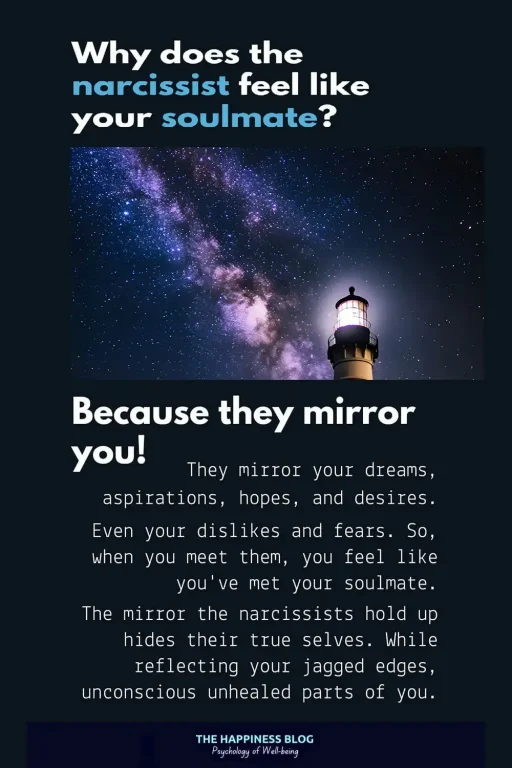
The way your narcissist makes you believe they are your soulmate has deep roots. They are subtly mirroring you: your gestures, dreams, hopes, desires, and even dislikes and fears.
After the initial euphoric phase, you grow an uneasy feeling, suspecting that those sweet crumbs they are throwing at your path will lead to a dark dungeon.
You start to notice how they blame you for neglecting them when you spend time with other people.
Love-bombing is a part of the “idealizing” phase of the narcissistic abuse cycle. It is absent in the next phases of “devaluing” and “discarding.” Love-bombing may return during the “hoovering” phase.
How is love-bombing different from falling in love?
True romantic love may include “excessively sweet” gestures of love and co-dependency, but it does not include boundary violations and usurpation of their lover’s independence.
Love-bombing is manipulative and calculative, eventually. It aims to get the person of interest under control in the garb of love, and then using them to draw a narcissistic supply.
A love-bomber lords so much over your time and attention that they may slowly isolate you from other people in your life.
So, when narcissists take back their shows of love, the target feels alone but has no one to turn to besides the narcissist.
Love-bombing can seem like the honeymoon phase of courtship, but it is not. It is driven by a cold desire to extract payback in the form of validation and submission.
Love-bombing will always include an element of feeling uneasy (queasy), encroached upon, and rushed into. Romantic love does not do those, even in whirlwind romances.
Romantics bear a healthy outlook on love, while love-bombers always have ulterior motives.
True Motive Behind Love-Bombing?
1. Desire To Control
Love-bombing can be a tool to trap their targets for sociopaths, narcissists, and borderline personalities.
Narcissists love-bomb to secure people as their narcissistic supply. Antisocial personalities (sociopaths and psychopaths) use love-bombing to kidnap their targets.
Love-bombing is ultimately abuse, not love. It disguises itself as love to grab attention.
The main goal of love-bombing is always to gain control of their targets, satisfy self-importance needs, and wield unchecked power.
Ted Bundy was a psychopath to the people he vandalized, but he was probably a charming narcissist to his wife.
2. Cultural Habit
However, excessive adulation and adoration might be a cultural and familial aspect. The person may have grown up in an environment of excessive affection.
They are usually innocent of the modern dating norms and mostly harmless. They agree to change their behavior when asked.
3. Prolonged Loneliness
A long period of being alone, whether forced social loneliness or self-imposed solitude, can make a person hanker for love. They may shower abnormal amounts of love in the hope of not losing you and being alone again.
Their sense of immediacy of partnering and show of over-affection may be because of an insecure attachment style (either avoidant, anxious, or a combination). These people tend to have low trust in others to satisfy their emotional needs.
This study showed that people with an insecure attachment style were more likely to engage in love-bombing.
Signs of Love-Bombing: How To Know It Early On
A love-bomber behaves much like “The Tinder Swindler,” a scammer who used the dating app Tinder to find girlfriends and then con them into funding an extravagant lifestyle for himself.
The signs to know that you are being love-bombed:
- They hold you in high praise and compliment you non-stop, even praising your dumb mistakes.
- They become overjoyed in your joys, overly concerned in your worries, and overly sad in your sorrows.
- They express their love for you early on and display public displays of affection (“touchy and feely”).
- They overwhelm you with extravagant gifts, which make you feel indebted to them.
- Their love gestures seem to come at you like a rapid-fire series of outbursts, without letting you think deeply.
- They invite you to exotic places for dinners and holidays, and are reluctant to accept your no for an answer.
- They behave like they have an excessive need for your emotional validation, are dependent on you for even small decisions, and are constantly seeking your attention.
- They always disregard your boundaries and explain them as romantic gestures.
- They communicate with you intensely and almost constantly, texting, calling, and messaging you at all hours of the day and night.
- They keep love-bombing at an incessant pace, without respite or breathing space, and will often disappear if you ask them to slow down the dating or the wooing process.
FAQs
1. Why is love-bombing a red flag?
Love-bombing is a red flag because it hints at a veiled attempt to entice the target, isolate them from their social networks, and finally control them. It forewarns of impending abuse and mistreatment if not stopped in its tracks.
2. Do all narcissists love-bomb?
No. Research shows love-bombers have low self-esteem. But neither do all narcissists love-bomb, nor are all love-bombers narcissists.
Final Words
Healthy love begins with a comfortable friendship. It then grows by accepting and negotiating each other’s differences, feeling supported without undue demands, and moving toward realistic future dreams.
Love-bombing occurs on the opposite end and breeds a toxic relationship.
If you are having an intuition that the person you are dating is a love-bombing narcissist, don’t brush it off. Narcissists usually wear a mask when they meet a new person.
If you suspect you are in their trap and cannot extricate yourself, then take the help of a mental health professional.
√ Also Read: 20 Hallmark Signs of A Narcissist.
√ Please share this with someone.
» You deserve happiness! Choosing therapy could be your best decision.
...
• Disclosure: Buying via our links earns us a small commission.