Today's Friday • 8 mins read
Narcissism is one of the most talked-about personality patterns, and yet it remains one of the least understood by the general public.
On social media, most people seem to have a theory about narcissists, usually built from a bad ex, a difficult boss, or a viral thread. Most of those theories fall apart under research.
Some myths make narcissism sound simpler than it is. Others make it sound scarier than the data supports (though there is an actual cruel type of narcissism called “malignant narcissism“).
Narcissistic personality disorder (NPD) is a serious mental health condition that can cause severe functional difficulties (Miller et al., 2007; Stinson et al., 2008).
Here are seven of the most common myths, tested against what studies actually found.
1. Myth: Narcissists Feel “Zero” Empathy
The DSM lists “lack of empathy” as a core trait of narcissistic personality disorder (NPD) solely based on clinical observation. But research paints a more specific picture than “zero.”
Empathy actually is of two types. Affective or emotional empathy is an emotional response to another person’s emotional state. Cognitive empathy is understanding another person’s perspective and representing their mental states.
People with NPD show clear deficits in affective or emotional empathy. Their cognitive empathy often stays intact.
A study compared NPD patients to healthy controls and found impaired emotional empathy, while their cognitive empathy stayed largely preserved (Ritter et al., 2011).
“The study’s conclusions were that while NPD involves deficits in emotional empathy, cognitive empathy seems grossly unaffected.” — Ritter & Dziobek, 2011
This is something many people notice after being around a narcissist for a while. Narcissists are good at reading the room. They can spot when you’re tense, upset, or crying. However, they are unlikely to care enough to feel the same way or act with compassion.
1. Truth: Narcissists May Have Empathy, but It Can Be Limited or Inconsistent
People with narcissistic traits may recognize another person’s feelings but are often unable or unwilling to respond with genuine concern. Narcissistic empathy can be situation-dependent, especially when their ego feels threatened, and is often a performance to get some benefit.

2. Myth: Narcissists Are Always Loud and Grandiose
The stereotype is a swaggering extrovert who dominates every room. That’s grandiose narcissism, and it’s only half the picture.
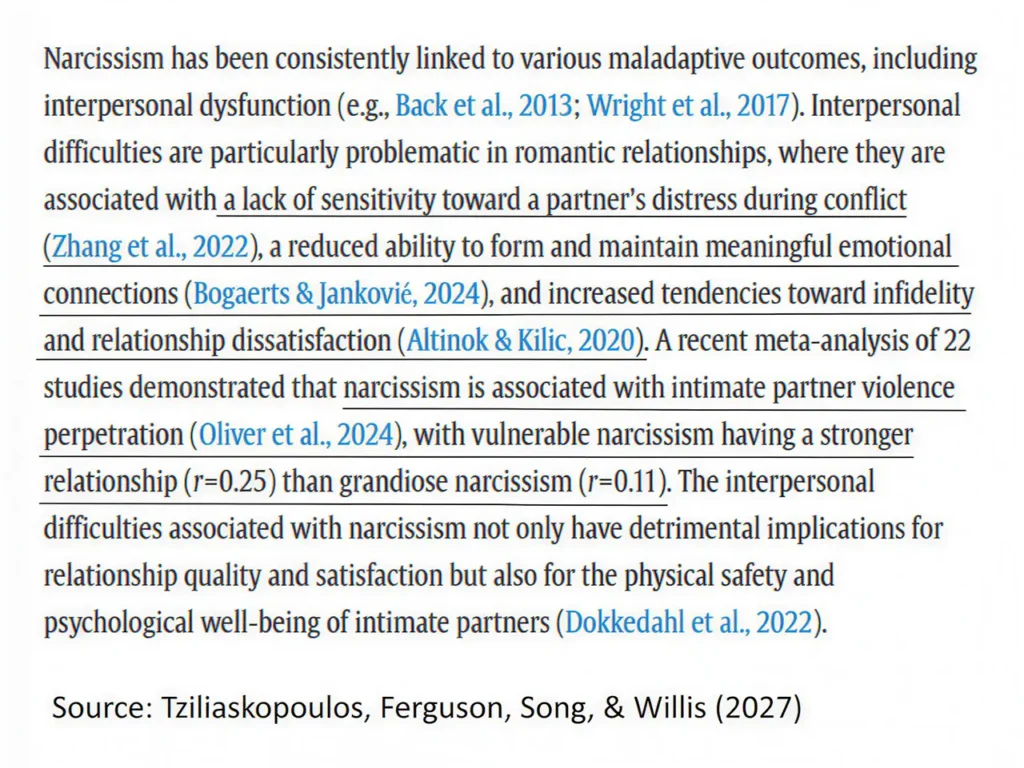
Vulnerable narcissism looks almost like the opposite. It shows up as withdrawn and hypersensitive to criticism. It carries a quiet conviction that the world owes more recognition than it gives.
Grandiose narcissism tracks with high self-esteem, outward confidence, and arrogance. Vulnerable narcissism tracks with low self-esteem, anxiety, and shame instead (Miller et al., 2013).
The vulnerable narcissist can meet the criteria for narcissistic traits but never once seem arrogant. In fact, they may appear to be fragile, anxious, or quietly resentful instead.
This distinction matters in close relationships. A partner or parent with vulnerable narcissism may not fit the movie version of a narcissist (the grandiose type), so we may not think of them as narcissistic.
They may seem hurt, sensitive, or easily wounded rather than cocky. The self-focus and the need for validation still drive the relationship. It just wears a different mask, and that mask is easy to mistake for simple insecurity.
2. Truth: Narcissism Can Be Loud, Quiet, or Hidden
Some narcissistic people appear confident and attention-seeking, while others seem shy, insecure, or overly sensitive to criticism. Narcissism can also appear through victimhood, resentment, or a need for special treatment.
3. Myth: Narcissists Know Exactly What They’re Doing
It’s tempting to picture narcissists as fully self-aware manipulators, calculating every move in advance. The truth is messier.
Research shows people high in narcissism do have some insight into their own tendencies. Most are not oblivious to being seen as self-centered (Carlson et al., 2011).
That’s where their self-awareness tends to stop, though.
Insight into the pattern isn’t the same as insight into its cost. Most narcissists underestimate how much damage that pattern does to the people around them over time.
Knowing you come across as self-focused is one thing. Understanding what that does to a partner over ten years is a much harder, and much rarer, kind of insight.
3. Truth: Narcissists May Not Fully Recognize Their Behavior
People with narcissistic traits may realize that others perceive them as manipulative or controlling. They often feel the need to justify their mistakes.
However, a deep-rooted sense of shame stops them from having genuine insight into themselves. Nonetheless, some narcissists can be more self-aware than their peers.
4. Myth: Narcissistic Personality Disorder Can’t Be Treated
This myth keeps people from seeking help in the first place. It also keeps families from believing treatment could work at all.
A 2024 review looked at psychotherapy outcome studies for NPD. It found real symptom improvement across most trials. Dropout rates run high, and large randomized trials are still rare. Even so, the direction of the evidence points toward progress rather than a definitive end (Szalay et al., 2024).
NPD is difficult, not impossible, to treat. It responds slowly, and progress rarely looks dramatic from the outside. Schema therapy showed particularly strong results among the approaches tested so far.
4. Truth: Narcissistic Personality Disorder Can Be Treated
Narcissistic personality disorder can be treated with psychotherapy. Treatment may help them develop greater self-awareness, regulate emotions and actions, improve relationships, and respond to criticism more constructively.
5. Myth: Confidence and Narcissism Are the Same Thing
Confidence rests on a stable sense of competence. It survives a bad meeting without needing outside validation to prop it back up.
Narcissism runs on supply. That supply is a steady stream of admiration, attention, and status.
It has to keep flowing, or else the narcissist’s self-worth structure starts to wobble. A confident person can hear “you were wrong” and adjust course. A narcissistic person often hears that same sentence and treats it as an offensive on their entire identity.
So the confidence and narcissism can look identical from a distance, especially at a party or in a job interview. But under pressure, they behave in noticeably different ways.
5. Truth: Confidence and Narcissism Are Not the Same Thing
Healthy confidence is based on a stable sense of self and does not require putting others down. Narcissism involves an excessive need for admiration, entitlement, or superiority, often alongside deep insecurity.
6. Myth: Selfies and Social Media Turn People Into Narcissists
This claim gets repeated so often that it sounds settled. It isn’t. However, most of the research linking screen habits to narcissistic traits is correlational, not causal.
People who already score high on narcissism may simply gravitate toward platforms built around self-presentation. That’s an entirely different claim from saying the social platforms create the trait in the first place.
The cause and effect here remain unclear. Researchers are still working out which direction the arrow points, and a tidy headline shouldn’t be mistaken for a settled answer.
6. Truth: Selfies and Social Media Do Not Automatically Cause Narcissism
Frequent selfies or social media use do not, by themselves, indicate narcissism or cause narcissistic personality disorder. However, social media may reinforce attention-seeking or validation-seeking behaviors in someone who already has those tendencies.
7. Myth: Narcissism Is “Everywhere” Now
Culture writers love to declare narcissism a global outbreak of our times. The data, however, doesn’t back up the headline.
A review of community samples put the prevalence of diagnosable narcissistic personality disorder (NPD) at around 1%. The range across studies runs up to roughly 6% of the general population (Stinson et al., 2008; Ritter et al., 2010).
That is a small slice of the population that is diagnosed with the condition. Milder, subclinical narcissistic traits are far more common.
Those are the traits most people actually mean when they toss the word “narcissist” around casually at work or in a group chat. The fully diagnosable disorder, called NPD, stays rare.
7. Truth: Narcissism Is Not “Everywhere”
Narcissistic traits exist on a spectrum, but narcissistic personality disorder is a specific mental health diagnosis. Increased awareness and greater visibility of self-focused behavior do not mean that everyone is narcissistic.
Resources:
- Ritter et al., 2011. A study comparing empathic functioning in NPD patients vs. healthy controls found an affective empathy deficit, with cognitive empathy preserved.
- Miller et al., 2013. The characterization of grandiose vs. vulnerable narcissism, including divergent self-esteem profiles.
- Carlson, Vazire, and Oltmanns, 2011. Research on narcissists’ self-insight into their own narcissistic reputation.
- Szalay, Hardaker & Tsakanikos, 2024. A systematic review of psychotherapy outcome trials for NPD.
- Dhawan, Kunik, Oldham & Coverdale, 2010. A systematic review of NPD prevalence in community samples.
Final Words
The detail most conversations about narcissism skip: it isn’t one fixed profile. Grandiose and vulnerable presentations can show up in the same person at different moments, sometimes within the same week.
That shifting quality is part of why partners, friends, and even clinicians struggle to pin it down. A textbook checklist misses people who don’t fit the loud, obvious version.
Treating narcissism as a spectrum instead of a stereotype changes how early you spot it, and how much realistic hope you can hold for change over time.
√ Also Read: 10 Signs Someone May Be A Covert Narcissist
√ Please share this with someone.
» You deserve happiness! Choosing therapy could be your best decision.
...
• Disclosure: Buying via our links earns us a small commission.