Today's Saturday • 9 mins read
Narcissists often lack what most people take for granted: the ability to hold others in mind when they are physically absent.
This deficit explains why they can suddenly discard people, replace relationships instantly, and show zero loyalty to those who once mattered deeply to them.
In narcissism, the deficit appears as grandiosity, entitlement, and devaluation, rather than the frantic abandonment behaviors seen in borderline personality disorder.
Object Constancy
Object constancy means knowing someone still cares about you and exists in your inner world, even when they’re not with you.
It’s a stable mental representation that lets you tolerate distance, frustration, and absence without panic or sudden devaluation.
Also called object permanence in developmental terms, it is the understanding that an object or person continues to exist even when out of sight.
Most children lack object permanence up until the age of two. Between ages two and four, they learn to understand, remember, and hold mental images of objects without having the object in front of them.
Impaired object constancy is the failure to form or maintain that internal, stable image of others when they are absent. This failure breaks emotional continuity in relationships. It can make people forget their close ones in their absence, and relationships can end abruptly.
Examples:
- Babies who have not yet formed object constancy react to peek-a-boo as if the caregiver really vanished, then respond with joy when the face returns.
- A child who has developed object permanence will look for a toy under a towel after they see it being hidden under the towel.
According to Piaget, there are four stages of normal intellectual development:
- Sensorimotor stage (0-2 years)
- Preoperational stage (2-7 years)
- Concrete Operational stage (7-11 years), and
- Formal Operational Stage (11 years to 18 years of age).
Object constancy allows you to retain a bond with a close person even if you find yourself upset, angry, or disappointed by their actions.
It lets you still emotionally connect with and have positive feelings for people you care about, even when they are away or when they have hurt you.
- Say, your partner frustrates you in the morning, but you still love them by evening.
- Your friend can cancel plans, and you don’t erase the entire friendship from your mental database.
It lets you hold complex, nuanced views of others.
Narcissists never fully develop object constancy.
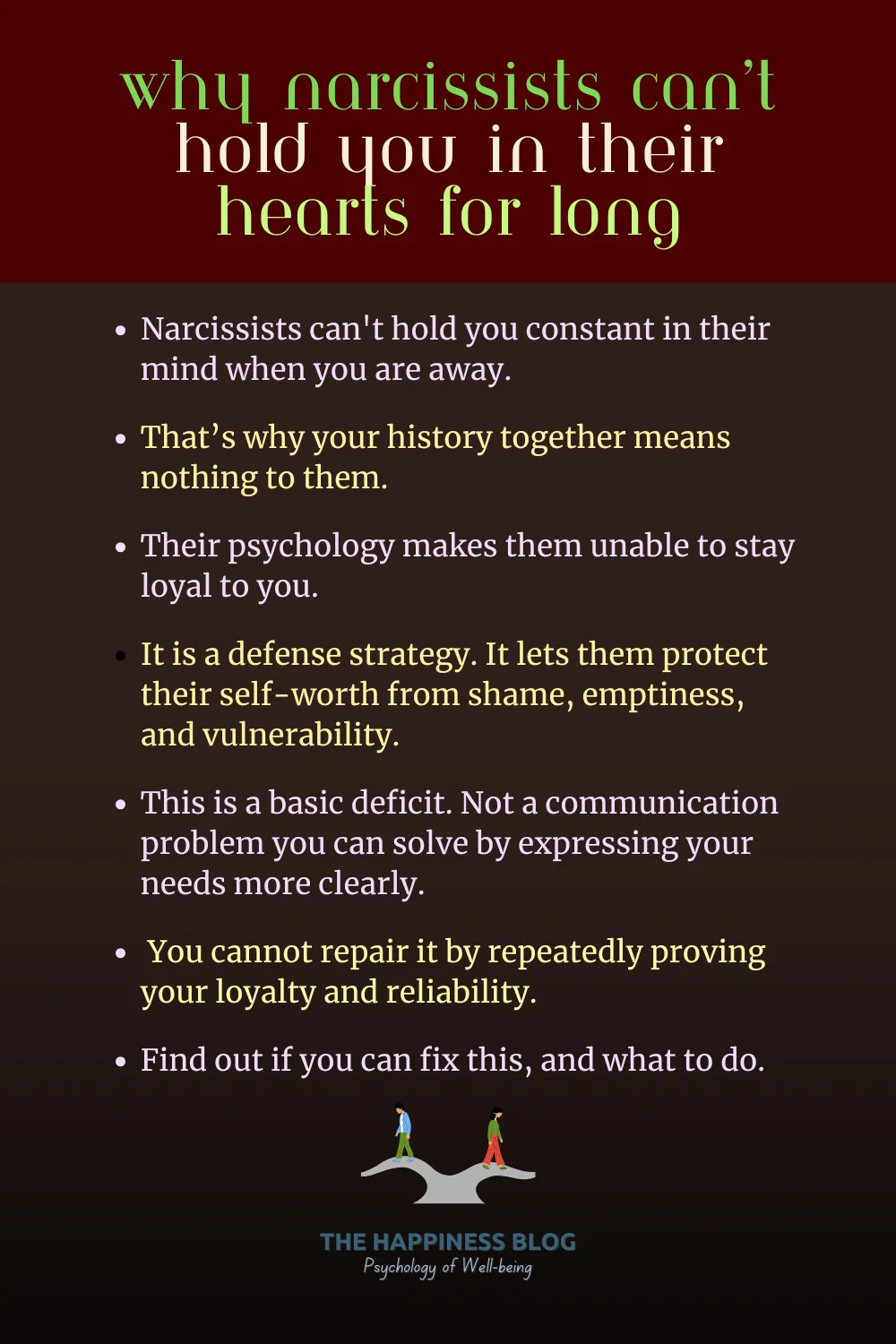
How Narcissists Show Emotional Inconstancy in Relationships
For narcissists, “out of sight, out of mind” operates literally. When you’re not physically present or actively meeting their needs, you essentially cease to exist in their emotional world.
This isn’t strategic withholding. They are not choosing to forget you as punishment. They genuinely don’t maintain the emotional infrastructure that would allow them to hold you in mind when you’re not right there being useful.
Your value to a narcissist depends entirely on what you’re providing in the present moment. The history you’ve built together doesn’t anchor their feelings. Past sacrifices don’t create goodwill reserves. Shared memories don’t generate sustained attachment.
This explains their shocking capacity for sudden abandonment.
You can be everything to them one day and nothing the next. The shift isn’t caused by anything you did. It’s that their emotional connection to you depended on immediate gratification, and that gratification stopped flowing.
The paradox is that narcissists also experience profound abandonment anxiety. A short absence may signal total abandonment to them.
When you’re physically away, they may feel a complete emotional disconnect, which triggers panic about being left. This isn’t love or attachment in the healthy sense. It’s panic at losing their source of supply.
The moment you return and meet their needs again, the anxiety vanishes. But so does any appreciation for your return, because they lack the capacity to hold both the relief and gratitude simultaneously.
Signs a Narcissist Lacks Object Constancy
People with intact object constancy can hold competing feelings simultaneously. They can be angry at you and still love you. They can be disappointed in a specific behavior while maintaining overall positive regard.
Narcissists operate in binary mode. You’re either all good or all bad. There’s no middle ground, no integration of positive and negative qualities into a realistic whole person.
When you fail to meet their needs, you become entirely bad in their minds. Every positive quality disappears. Every good memory gets rewritten as manipulation or obligation. You transform from idealized savior to worthless villain in minutes.
This is called splitting. It’s a primitive defense mechanism that people typically outgrow in early childhood as object constancy develops. Narcissists remain trapped in this black-and-white thinking because they never achieved the developmental milestone that would allow nuanced emotional bonds.
Why Narcissists Move On and Replace Partners So Fast
Object constancy creates emotional continuity. When you love someone with object constancy, that person occupies a stable space in your internal world. They can’t be instantly replaced because the bond has depth and history.
Narcissists don’t experience this continuity. They tend to relate more to internal mental snapshots of people rather than to who those people actually are as they change over time. These frozen images, called “imagoes,” don’t update with reality.
People in their lives are functionally interchangeable because they’re not seen as whole individuals with intrinsic value. They’re seen as need-meeting objects. When one person stops meeting needs, the narcissist simply finds another person to fill that functional role.
The replacement happens without grief, guilt, or conflict because there was no real attachment to the original person.
In fact, there was only an attachment to what that person provided. Relationships become unstable or short-lived because any threat to the narcissist’s self-image triggers splitting, devaluation, and distancing, which erodes long-term bonds.
This is why narcissists can move on with breathtaking speed after relationships end. They’re not moving on from you.
They never had you integrated into their emotional reality in the first place. They had a use for you. That use ended. They found someone else to serve that function.
Why Narcissists Can’t Be Loyal: The Object Constancy Problem
Loyalty requires object constancy. You remain committed to people during difficult times because your emotional connection to them persists independent of immediate circumstances.
Narcissists can’t access this kind of loyalty. Their positive feelings for you require constant reinforcement through admiration, service, or compliance. Stop providing those things, and the positive feelings vanish.
For many narcissists, a weak or disrupted object constancy functions as a defensive strategy.
When unable to tolerate painful feelings like shame, emptiness, vulnerability, they often shift to idealizing, devaluing, or emotionally distancing from others to protect self‑esteem. Losing hold of a partner’s inner presence can therefore serve to avoid dependency and painful self‑states.
That said, not every instance of emotional inconstancy in narcissism is the same. Narcissistic devaluation can erase past positive meanings for the narcissist, but objectively shared history still exists and can affect their behavior.
This explains why narcissists show zero gratitude for past sacrifices. The sacrifices exist in the past, which means they don’t exist at all in the narcissist’s emotional present. What you did for them yesterday holds no weight today if you’re currently disappointing them.
Your decades of dedication, your financial support, your emotional labor. None of it creates lasting goodwill. None of it protects you from sudden devaluation. The relationship exists only in the present moment, and the present moment is the only thing that counts.
That said, all loyalty failures aren’t solely explained by object‑constancy deficits; it may also be explained by their entitlement, lack of empathy, impulsivity, and relational goals.
Can You Fix a Narcissist’s Emotional Inconstancy?
Object constancy is a developmental achievement. It forms in early childhood through consistent, attuned caregiving. When a child’s needs are met reliably, they internalize a sense that others are trustworthy and relationships are stable.
Narcissists typically experience severe disruptions in this developmental process. Their early attachment relationships were chaotic, neglectful, or conditional. They never learned that people continue to exist and care when they’re not visible or immediately gratifying.
This is a structural deficit. It’s not a communication problem you can solve by expressing your needs more clearly. It’s not a trust issue you can repair by proving your reliability.
It’s an absence of psychological infrastructure that should have been built in the first few years of life. Most narcissists lack both the insight to recognize the issue and the sustained commitment to overcome it.
Therapy can sometimes help narcissists develop rudimentary object constancy, but it requires years of intensive work and genuine motivation to change.
What This Means for Your Relationship With a Narcissist
Understanding emotional inconstancy in narcissists doesn’t make their behavior less painful. It does make it less personal.
When a narcissist discards you, replaces you, or acts as if your shared history never existed, they’re not making a statement about your worth. They’re revealing their developmental limitations.
You existed fully. You loved fully. You invested fully. The problem is that narcissists lack the capacity to hold that fullness in their minds when you’re not actively serving their needs.
This is why no amount of sacrifice, loyalty, or love will ever be enough. You’re trying to fill a developmental void that can’t be filled from the outside. The work needed happened decades ago, and it didn’t happen.
Final Words
Emotional inconstancy is one of the most damaging features of narcissistic personality disorder (NPD). It ensures that relationships with narcissists lack the continuity, depth, and security that make intimate bonds meaningful.
Recognizing this pattern helps you stop blaming yourself for the narcissist’s inability to maintain a stable attachment. Their emotional inconstancy is about their stunted development, not your inadequacy.
You deserve relationships with people who can hold you in their hearts when you’re not in their line of sight. People who remember your value during conflicts. People whose positive feelings for you persist through disappointment and distance.
That’s what object constancy creates. That’s what narcissists can’t give you. That’s why leaving is often the only path to the stable, reciprocal love you deserve.
√ Also Read: 6 Reasons You Cannot Fix Or Change A Narcissist, Ever
√ Please share this with someone.
» You deserve happiness! Choosing therapy could be your best decision.
...
• Disclosure: Buying via our links earns us a small commission.