
Today's Monday • 8 mins read
— By Dr. Sandip Roy.
Every relationship has rough phases.
People disappoint each other more than they admit. Arguments happen for small reasons. Sometimes, both people are part of the problem. In most cases, they both try to repair it.
Some relationships follow a different pattern. The same issues repeat. You feel smaller over time. You start questioning yourself more than the situation.
This could be a narcissistic person you are related to. How can you tell the difference?
Quick Answer: 7 Signs of A Narcissistic Relationship
- Problems repeat in the same pattern
- You get blamed after most conflicts
- Your needs feel unsafe to express
- You carry most of the emotional burden
- Your reality is questioned or dismissed
- The relationship runs on their terms
- Promises of change rarely lead to real change
If you notice several of these in your relationship, you may be dealing with a narcissistic pattern rather than a difficult phase.
1. Problems repeat in the same pattern.
This is the most notable distinction: Difficult relationships have problems, while narcissistic ones have patterns.
This is what I mean:
- In a difficult relationship, problems show up in different ways. Sometimes you’re at fault, sometimes they are. And sometimes it’s timing or stress. There is variation and movement.
- In a narcissistic relationship, the problems form a loop. It follows a recognizable cycle described in clinical literature: idealization, devaluation, and discard (Kernberg, 1975; Ronningstam, 2005).
At first, narcissists make you feel chosen and valued. Then they start criticizing you and your choices, and it grows. Then they create distance with you and withdraw as and when they want. Later, things may reset briefly.
First, they put you on a pedestal, then they take you down, and then they throw you away.
You start noticing the repetition. The same arguments, the same emotional highs and lows, the same unresolved endings keep showing on and on.
Difficult relationships feel uneven. Narcissistic ones feel repetitive.

2. The relationship runs on their terms.
In a healthy relationship, even an imperfect one, both people influence how things work.
You both decide:
- when to talk,
- what matters, and
- how to resolve conflict.
In a narcissistic relationship, control is one-sided.
- Conversations happen when they want.
- Topics stay within their comfort zone.
- Anything that challenges them gets redirected, minimized, or ignored.
If you raise concerns at the “wrong” time, you may be labeled difficult or emotional.
Over time, you adapt. You stop bringing up important issues. You filter what you say. You avoid topics that lead nowhere.
Research shows narcissists have a strong need to control the interpersonal environment to protect a fragile self-image (Campbell & Foster, 2002).
In simple terms, the relationship adjusts to them, not to both of you.
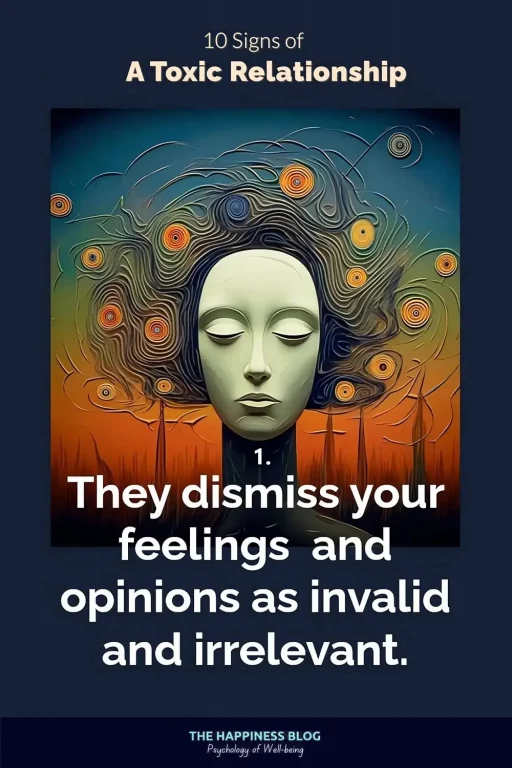
A sign you’re in a narcissistic relationship: You stop starting conversations because you know they will devalue or insult your emotions, opinions, and ideas.
3. You carry the emotional weight for two people.
All relationships involve emotional effort. In balanced relationships, both people contribute to the work of managing feelings, tracking relational tension, and keeping the peace, even if unevenly at times.
In a narcissistic relationship, the imbalance becomes constant.
You monitor their mood. You adjust your tone. You choose your words carefully and (literally) soften your words to avoid harsh reactions.
You stay alert because their mood shapes your day. That’s called walking on eggshells.
Meanwhile, they rarely perform this labor. They say and do what they want to, without bothering about your mood or mental state.
They may understand, on a cognitive level, that you’re upset. But that does not often lead to meaningful care or adjustment.
They only seem to care when your emotional state affects them. For one, they will scale back their insults if your response is so extreme that they are uncomfortable or embarrassed. This is called reactive abuse.
Overall, you do most of the emotional regulation in the relationship. You always try to keep them in a good mood so that they let you be.
Studies suggest narcissistic individuals have reduced affective empathy, even when their cognitive empathy remains intact (Baskin-Sommers et al., 2014).
- Do you know why narcissists admire powerful narcissists?
4. After every conflict, you become the problem.
In functional relationships, conflict leads to some shared accountability. Both people can usually reflect and adjust.
In a narcissistic relationship, the outcome becomes predictable. No matter how the conflict starts, it ends with your tone, your reaction, or your expectations being the issue.
This matches what trauma researcher Jennifer Freyd described as DARVO: Deny, Attack, Reverse Victim and Offender (Freyd, 1997).
The person confronted with their wrongdoing denies the issue, aggresses against you, and then flips the script to position themselves as the one being wronged.
Over time, you adjust to this pattern. You apologize early. You soften your concerns. You prepare to be misunderstood.
This is not a personality flaw. It is an adaptation to a repeated pattern.
5. You stop feeling safe expressing your needs.
In difficult relationships, expressing needs can lead to awkward or imperfect responses. Still, it remains possible.
In narcissistic relationships, expressing needs often leads to:
- dismissal
- ridicule
- irritation
- or being used against you later
So you start holding back.
You think through what to say. You edit it down. Then you often say nothing.
You rehearse conversations and still stay quiet.
This pattern, known as self-silencing, has been linked to depression and anxiety in long-term studies (Jack & Dill, 1992).
You were not always like this. You didn’t arrive in the relationship this way. The relationship shaped your response.
6. Your reality gets questioned repeatedly.
Disagreements are normal. People in difficult relationships disagree. They have different memories, different interpretations, different priorities. That’s normal.
But being told repeatedly that your perception is wrong, baseless, or crazy is not normal.
You keep hearing versions of these:
- “That didn’t happen like that.”
- “You’re overreacting.”
- “You’re too sensitive.”
This is commonly known as gaslighting, a well-documented psychological pattern in abusive relationships (Abramson, 2014).
Its effect builds slowly. You start doubting your memory. You second-guess your reactions. You start questioning what you felt just minutes ago.
Ultimately, you rely more on their version of events than your own.
In narcissistic relationships, reality shifts depending on what protects the narcissist’s position. The goal is always to control the story in their favor.
7. Nothing meaningfully changes in the relationship over time.
No relationship is perfect. But every relationship worth staying in will have both people reflect and adjust on their problems. Both try to grow in a genuine forward movement.
But with narcissists, the relationship and person do not change over time. They often promise to change but rarely deliver it.
The cycle tends to look like this:
Incident ↠ Conflict ↠ Remorse (sometimes) ↠ Promises ↠ Brief improvement ↠ Reversion to the same behavior.
The improvement phase creates hope. The pattern keeps repeating.
Therapists note that lasting change requires self-reflection and accountability, which directly conflict with narcissistic defense patterns (Malkin, 2015).
They may not always be lying on purpose, but the outcome remains the same.
You find yourself waiting for a version of the relationship that never arrives.
If you feel that nothing wrong will ever be fixed in this relationship, consult a relationship therapist.
Quick Comparison: Difficult vs Narcissistic Relationship
| Aspect | Difficult Relationship | Narcissistic Relationship |
|---|---|---|
| Problems | Varied, situation-based | Repetitive, patterned |
| Conflicts | Shared accountability | You become the problem |
| Emotional effort | Uneven but mutual | One-sided |
| Your needs | Can be expressed | Suppressed or punished |
| Reality | Sometimes disputed | Regularly challenged |
| Change | Possible over time | Promised, rarely sustained |
| How you feel | Frustrated but grounded | Confused, cautious, self-doubting |
FAQ
- Can a difficult relationship turn into a narcissistic one?
Patterns can shift over time. If control, invalidation, and lack of accountability become consistent, the dynamic may move in that direction. - Can narcissistic relationships improve?
Change requires sustained self-awareness and accountability. Without that, patterns tend to repeat. - How do I know it’s not just a rough phase?
Rough phases shift. Patterns repeat.
References:
- Malkin, C. (2015). Rethinking Narcissism.
- Kernberg, O. F. (1975). Borderline Conditions and Pathological Narcissism.
- Ronningstam, E. (2005). Identifying and Understanding the Narcissistic Personality.
- Abramson, K. (2014). Turning up the lights on gaslighting. Philosophical Perspectives.
- Jack, D. C., & Dill, D. (1992). The Silencing the Self Scale. Psychology of Women Quarterly.
- Freyd, J. J. (1997). Violations of power, adaptive blindness, and betrayal trauma theory. Feminism & Psychology.
- Campbell, W. K., & Foster, C. A. (2002). Narcissism and commitment in romantic relationships. Personality and Social Psychology Bulletin.
- Baskin-Sommers, A., Krusemark, E., & Ronningstam, E. (2014). Empathy in narcissistic personality disorder. Personality Disorders: Theory, Research, and Treatment.
Final Words
Narcissistic behavior may develop as a defense mechanism, often rooted in early experiences. The outward confidence can protect a fragile sense of self.
What matters for you is the pattern, not the label. A relationship can cause harm without a formal diagnosis.
The defining feature is this: one person’s reality, needs, and voice are consistently pushed aside to protect the other.
Pay attention to your experience. If you feel more confusion than clarity, more restraint than ease, more self-doubt than stability, that deserves your attention.
You don’t need to prove anything to recognize a pattern. Trust your own experience and notice the pattern.
√ Also Read: Unbelonging: The Pain of Being Everywhere and Nowhere
√ Please share this with someone.
» You deserve happiness! Choosing therapy could be your best decision.
...
• Disclosure: Buying via our links earns us a small commission.