
Today's Sunday • 7 mins read
“Children of narcissists learn that … if someone displeases you, it is okay to harm them and call it love.” ― M. Wakefield
Knowing how narcissists treat their children will break your heart. They often leave their children with guilt, shame, and a sense of indignity, and those feelings often last a lifetime.
Normal parents love their kids without conditions. They feel for their child’s struggles and guide them through life. This is not the case with narcissistic parents.
A parent is supposed to empower their child. Narcissistic parents flip that role. They become the source of their child’s disempowerment instead.
In the parent-child relationship, they play the villain.
How Narcissists Treat Their Children?
Narcissistic parents often abuse their children, both emotionally and physically. They set goals no child could realistically meet. They rarely feel satisfied with what their child achieves, and they keep raising the bar higher. Their children become a source of supply, not people to love unconditionally.
Narcissists have an inflated sense of self-importance by nature. They lack empathy and crave constant praise. That combination makes them possessive, controlling, and demanding as parents.
They are also reactive and easily wounded. They show little self-awareness or guilt for their harsh actions. This makes their children learn to fear them. They never know when or how a parent might react.
A narcissist’s parenting style tends toward tight control, sometimes bordering on dictatorship. This style plays a direct role in how narcissistic traits pass down.
Authoritarian, high-control parenting is tied specifically to grandiose narcissism in the next generation. Paternal overprotection tends to predict grandiose narcissism in sons. Maternal coldness tends to predict a more vulnerable form of narcissism in daughters (Green & MacLean, 2020).
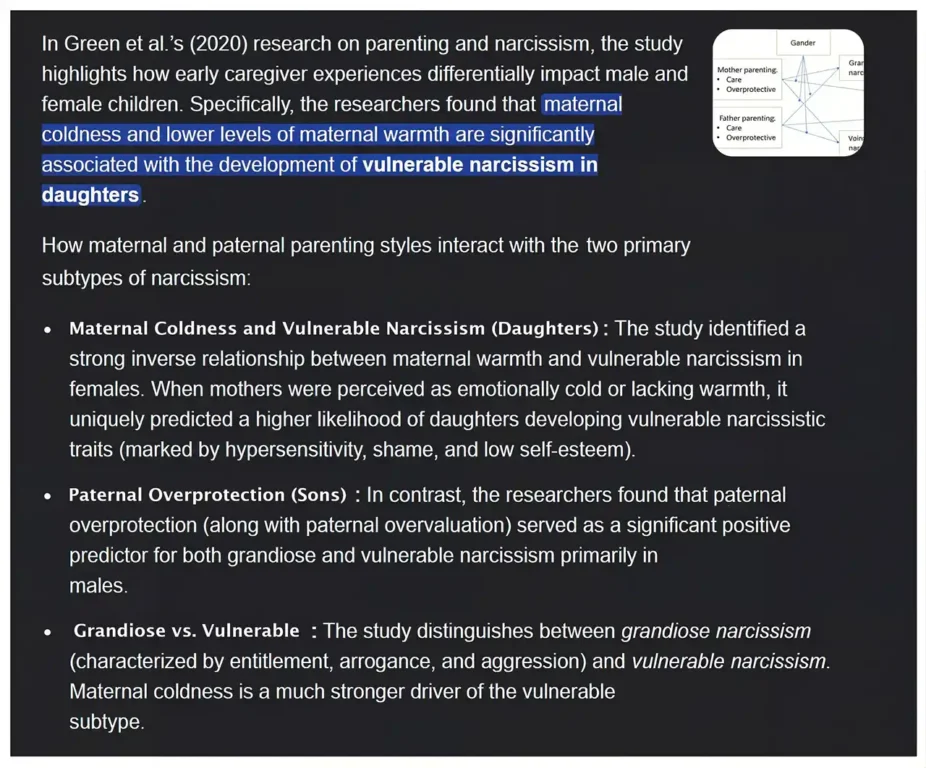
The parenting style itself becomes part of how the pattern spreads.
Narcissistic parenting can deeply damage a child’s development. They become mere tools for a parent’s needs.
A narcissist’s child is often expected to praise their parent for things they say or do. They are expected to support and respect the narcissist without question.
Narcissistic parents draw validation from a child’s achievements. So the child lives under constant pressure to perform. Meanwhile, that same parent may use the child as a sounding board for adult frustrations, placing grown-up burdens on small shoulders.
All of this can leave a child with low self-esteem and little confidence. Many grow up feeling powerless, unsure they can trust their own decisions.
Narcissists don’t see their children as separate people that have a right to experience life from their own angle. There is no option in their heads in which the kids will be in charge of their own lives ‘unaided’ by the narcissist. ― Diana Macey
How Do Narcissists Damage Their Children?
- Narcissistic parents erode a child’s self-esteem. They leave behind low self-worth and constant self-doubt.
- A narcissist’s child often does not learn how to set boundaries, express their needs, or voice their concerns.
- Since the narcissist may treat any raised voice as an act of defiance or insult, their children learn to stay submissive and silent.
This trouble with setting healthy emotional boundaries tends to follow children into adulthood. One qualitative study looked closely at adult children of narcissistic parents. It found recurring patterns of low trust, shame, and trouble asserting boundaries in adult romantic relationships (Lyons et al., 2023).
Even as adults, many don’t quite believe they’re allowed to refuse someone entry into their personal space. Saying “no,” or simply asking to be left alone, can feel nearly impossible.
Many adults raised this way keep replaying old mistakes. They struggle to forgive themselves for things that were never fully their fault. Sadly, some also pick up their parent’s behavior and carry it into their own relationships.
Research on this kind of transmission backs that up directly. Adults who recalled narcissistic or abusive parenting were more likely to show narcissistic traits themselves by early adulthood (Starbird & Story, 2020).
Generational Narcissism: Children of narcissistic parents can end up being narcissistic toward their own partners, spouses, and children. It’s a pattern they never chose, but inherited anyway.
Do Narcissists Realize The Harm They Cause Their Children?
Mostly, no. Narcissists often don’t grasp the harm they cause. A lack of self-awareness is only part of the reason why. The deeper issue is a specific gap in empathy.
Research on narcissistic traits has found a clear pattern: their affective (or emotional) empathy, the ability to feel what someone else feels, comes up impaired. But their cognitive empathy, the ability to understand what someone else thinks, often stays intact (Ritter et al., 2011).
Think of it this way: A narcissist can often tell exactly how their child feels. But they just aren’t moved by it.
Some narcissists truly don’t see the pain they cause. Others see it clearly and simply don’t care enough to change.
Then, narcissists put their own needs above everyone else’s. They tend to see their children as extensions of themselves, not as separate people. This mindset lets them decide and act on a child’s behalf without asking. That, in turn, leaves the narcissist feeling validated and superior.
Narcissists may push their children, physically or emotionally, to comply with their wishes. Often, the child is fulfilling a dream the parent never reached themselves.
These children work hard for approval. They rarely feel satisfied until a parent validates their success. Long after a narcissistic parent has died, their now-adult child may still catch themselves thinking, “I hope I made you proud today.”
The irony is, most narcissistic parents are never fully happy with what their child achieves. They rarely give the child full credit either. Instead, they boast to others about how they personally “made” their kids into achievers.
The child of a narcissistic parent tends to grow up feeling invalidated, disregarded, and used for someone else’s gain.
FAQs
1. Can A Narcissist Care About Their Child?
Yes, in their own way. A narcissist can care for their child much as they care for themselves. That’s because they often see the child as an extension of themselves, not a separate person.
Their love tends to be conditional and transactional. It stays tied to how proud or superior the child’s achievements make them feel.
2. Do Narcissists Discard Their Children?
Yes. Narcissistic parents can discard their children as part of a larger abuse cycle. This often happens once the child stops serving as a reliable source of admiration, especially when an adult child starts asserting their own needs and boundaries.
A narcissistic parent may pull away the moment they stop feeling sufficiently admired, respected, or served. The discard stage can leave lasting emotional and psychological scars behind.
Final Words
Narcissistic parents leave a long-lasting, painful scar on their children. They may triangulate one child against another to sustain their narcissistic supply, turning siblings against each other in the process.
Remember, they are dysfunctional parents who will rarely apologize, even after you show them how much hurt they’ve caused over the years.
Seek professional help if you are the child of a narcissist, in a relationship with one, or worried your own child needs protection from a narcissistic parent.
The detail most people miss: this cycle is not guaranteed to repeat. The same research that shows narcissistic traits passing from parent to child also points to what interrupts that transmission.
Awareness of the pattern helps. So does at least one steady, emotionally safe relationship, whether that’s a therapist, a partner, or a close friend.
Recognizing the pattern in yourself is uncomfortable work. It’s also the clearest exit most adult children of narcissists ever get.
√ Also Read: 10 Subtle Signs of Gaslighting In A Narcissistic Relationship
√ Please share this with someone.
» You deserve happiness! Choosing therapy could be your best decision.
...
• Disclosure: Buying via our links earns us a small commission.