
Today's Sunday • 12 mins read
Life spans were shorter during the classical Mediterranean era. People then lived with constant anxiety about their unexpected ends from the ruler’s whims, social unrest, or illness.
Stoic masters from that time offered some unforgettable quotes and practices to ease that fear and help people accept their fate.
But first, two questions every philosopher faces:
- How should I live while I live?
- How should I prepare for my end?
The Stoic philosophers had answers to both.
- To live well: practice the four cardinal virtues, and seize the day to fulfill one’s duties.
- To prepare for the end: cultivate calm acceptance through amor fati and memento mori.
As Seneca advised, “Let us postpone nothing. Let us balance life’s books each day.”
Warning: Reminders of the end can exacerbate existing symptoms in depression, OCD, and anxiety (Menzies & Dar-Nimrod, 2017).
21 Most Unforgettable Stoic Quotes On Death
The ancient Stoics wrote and preached a lot about death. We explore what the Stoics thought of death through some of their most impressive quotes.
1. Think of yourself as dead. You have lived your life. Now, take what’s left and live it properly. What doesn’t transmit light creates its own darkness.
— Marcus Aurelius, Meditations, 7.56
2. I cannot escape death, but at least I can escape the fear of it.
— Epictetus
3. That man lives badly who does not know how to die well.
— Lucius Annaeus Seneca
4. Given that all must die, it is better to die with distinction than to live long.
— Musonius Rufus
5. What is death? A scary mask. Take it off – see, it doesn’t bite. Eventually, body and soul will have to separate, just as they existed separately before we were born. So why be upset if it happens now? If it isn’t now, it’s later.
— Epictetus
6. You act like mortals in all that you fear, and like immortals in all that you desire.
— Lucius Annaeus Seneca
7. No evil is honorable: but death is honorable; therefore death is not evil.
— Zeno of Citium
8. Death is not an evil. What is it then? The one law mankind has that is free of all discrimination.
— Lucius Annaeus Seneca
9. Choose to die well while you can; wait too long, and it might become impossible to do so.
— Musonius Rufus
10. You may leave this life at any moment: have this possibility in your mind in all that you do or say or think.
— Marcus Aurelius, Meditations 2.11
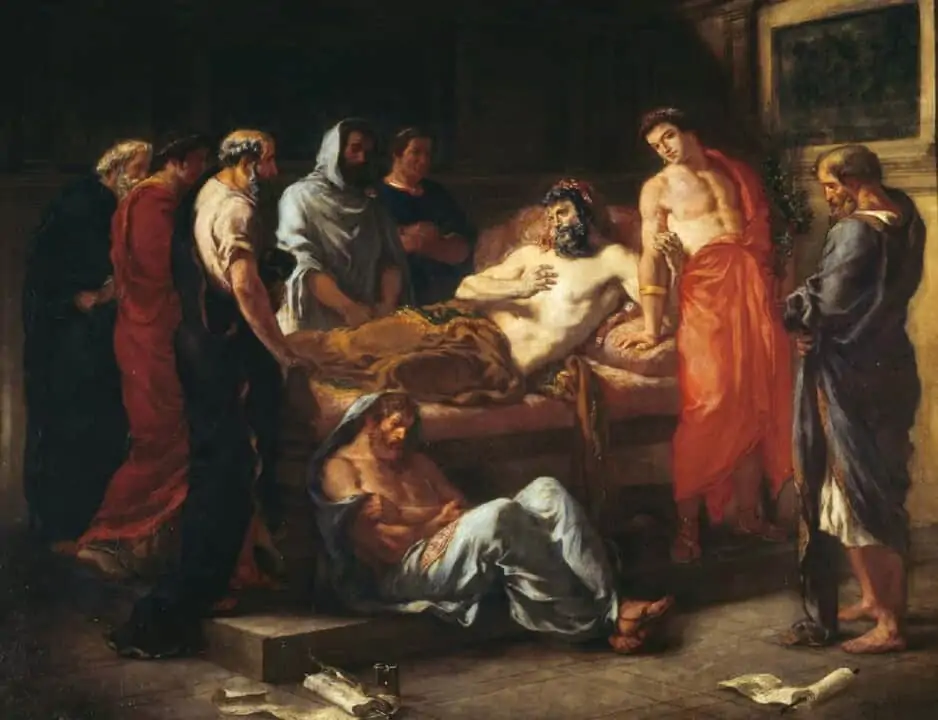
11. Before I became old I tried to live well; now that I am old, I shall try to die well; but dying well means dying gladly.
— Lucius Annaeus Seneca
12. Don’t behave as if you are destined to live forever. Death hangs over you. While you live, while it is in your power, be good. Now.
— Marcus Aurelius, Meditations 4.17
13. What upsets people is not things themselves, but their judgments about the things. For example, death is nothing dreadful (or else it would have appeared dreadful to Socrates), but instead the judgment about death that it is dreadful—that is what is dreadful. So, when we are thwarted or upset or distressed, let us never blame someone else but rather ourselves, that is, our own judgments. An uneducated person accuses others when he is doing badly; a partly educated person accuses himself, an educated person accuses neither someone else nor himself.
— Epictetus
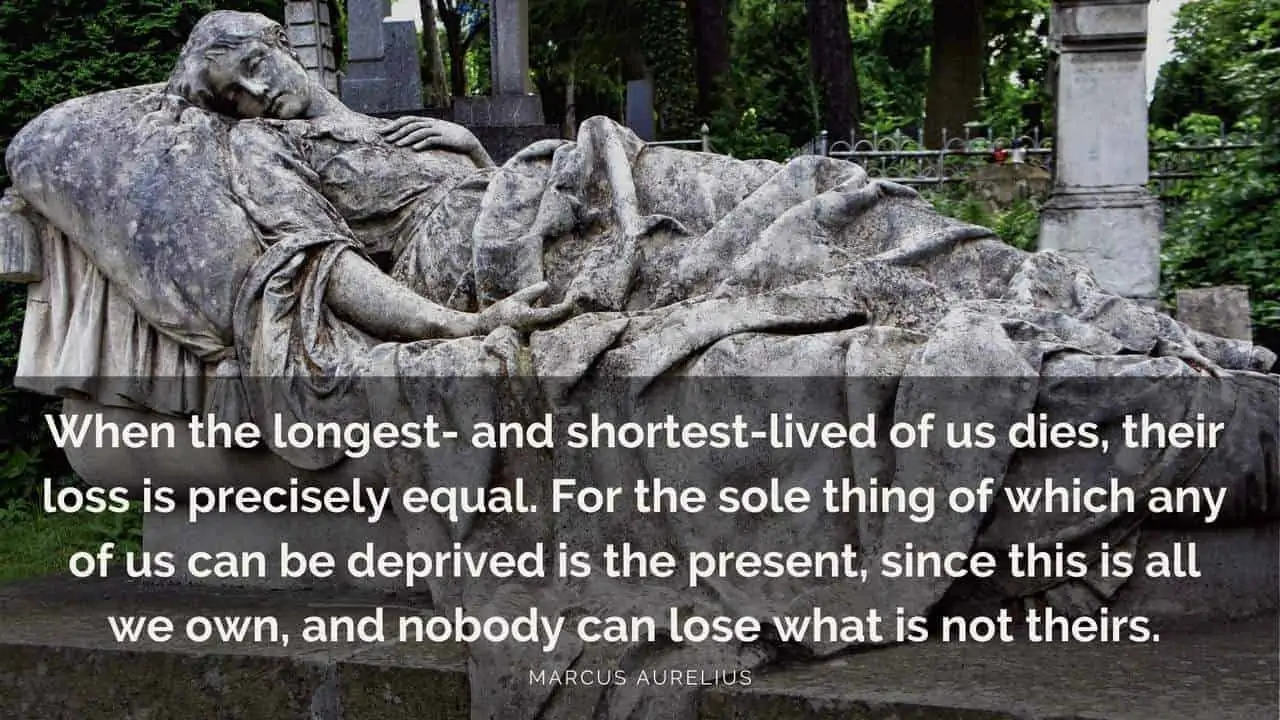
14. When the longest- and shortest-lived of us dies, their loss is precisely equal. For the sole thing of which any of us can be deprived is the present, since this is all we own, and nobody can lose what is not theirs.
— Marcus Aurelius, Meditations 2.14
15. No evil is great which is the last evil of all. Death arrives; it would be a thing to dread, if it could remain with you. But death must either not come at all, or else must come and pass away.
— Lucius Annaeus Seneca
16. Let death and exile, and all other things which appear terrible be daily before your eyes, but chiefly death, and you will never entertain any abject thought, nor too eagerly covet anything.
— Epictetus
17. Let us prepare our minds as if we’d come to the very end of life. Let us postpone nothing. Let us balance life’s books each day. The one who puts the finishing touches on their life each day is never short of time.
— Lucius Annaeus Seneca
18. Remember also that each man lives only the present moment: The rest of the time is either spent and gone, or is quite unknown. It is a very little time which each man lives, and in a small corner of the earth; and the longest surviving fame is but short, and this conveyed through a succession of poor mortals, each presently a-dying; men who neither knew themselves, nor the persons long since dead.
— Marcus Aurelius, Meditations 2.10
19. Accept death in a cheerful spirit, as nothing but the dissolution of the elements from which each living thing is composed. If it doesn’t hurt the individual elements to change continually into one another, why are people afraid of all of them changing and separating? It’s a natural thing. And nothing natural is evil.
— Marcus Aurelius, Meditations 2.17
20. Death is neither a good nor a bad thing, for that alone which is something can be a good or a bad thing: but that which is nothing, and reduces all things to nothing, does not hand us over to either fortune, because good and bad require some material to work upon. Fortune cannot take a hold of that which Nature has let go, nor can a man be unhappy if he is nothing.
— Lucius Annaeus Seneca
21. You can discard most of the junk that clutters your mind — things that exist only there. And you will immediately make vast space for yourself by grasping the whole universe in your thought, by contemplating the eternity of time, and by reflecting on the speed with which things change — each part of everything, the brief gap from birth to death, the infinite time before, and the equally infinite time that follows.
— Marcus Aurelius, Meditations 9.32

More Stoic Quotes On Death
“Think of yourself as dead. You have lived your life. Now, take what’s left and live it properly. What doesn’t transmit light creates its own darkness.”
― Marcus Aurelius, Meditations 7.56
Another of their thought-provoking ideas was that death claims a little part of us every day. Seneca wrote, “We are dying every day,” and all the days we have lived up to now are “already in the hands of death.”
Stop whatever you’re doing for a moment and ask yourself: Am I afraid of death because I won’t be able to do this anymore?
― Marcus Aurelius, Meditations. 10.29
Yet another was to be never afraid of death or how we die. There is no good or bad death; only our judgments about it are what is good or bad. Once we are not afraid of death, no fear or judgment related to our mortality can detract us from living a virtuous life.
Very well, what further concern have I? For my part has been fulfilled. The business belongs to someone else, that is, the helmsman. But, more than that, the ship goes down. What, then, have I to do? What I can; that is the only thing I do; I drown without fear, neither shrieking nor crying out against God, but recognizing that what is born must also perish.
—Epictetus, Discourses, II.5.13-14
Also, they felt we should not mourn the death of a loved one, but rather celebrate the life they lived and shared with us. Death is not a loss, but a return of the soul to the cosmos.
Never say about anything, “I have lost it,” but instead, “I have given it back.” Did your child die? It was given back. Did your wife die? She was given back.
—Epictetus, Handbook, 11
The Stoics kept reminding us that death is an equalizer — it brings the king and the pauper to the same level. This brings to my mind a quote that’s famous among chess players:
After the game, the king and the pawn go into the same box.
And Seneca said,
Death has no degrees of greater or less; for it has the same limit in all instances, the finishing of life.
—Seneca. Letters from a Stoic. Letter LXVI
What did Marcus Aurelius say about death?
- You could leave life right now. Let that determine what you do and say and think. (Meditations. 2.11)
- Because dying, too, is one of our assignments in life. There as well: “to do what needs doing.” (Meditations. 6.2)
- And what dying is—and that if you look at it in the abstract and break down your imaginary ideas of it by logical analysis, you realize that it’s nothing but a process of nature, which only children can be afraid of. (Meditations. 2.12)
- Even if you’re going to live three thousand more years, or ten times that, remember … that the longest-lived and those who will die soonest lose the same thing. The present is all that they can give up, since that is all you have, and what you do not have, you cannot lose. (Meditations. 2.14)
- And above all, that it accepts death in a cheerful spirit, as nothing but the dissolution of the elements from which each living thing is composed. If it doesn’t hurt the individual elements to change continually into one another, why are people afraid of all of them changing and separating? It’s a natural thing. And nothing natural is evil. (Meditations. 2.17)
- Death: something like birth, a natural mystery, elements that split and recombine.
Not an embarrassing thing. Not an offense to reason, or our nature. (Meditations. 4.5) - For every action, ask: How does it affect me? Could I change my mind about it?
But soon I’ll be dead, and the slate’s empty. So this is the only question: Is it the action of a responsible being, part of society, and subject to the same decrees as God? (Meditations. 8.2)
- That before long you’ll be no one, and nowhere. Like all the things you see now. All the people now living.
Everything’s destiny is to change, to be transformed, to perish. So that new things can be born. (Meditations. 8.21) - And consider the others … not just the deaths of individuals, like the family of the Pompeys.
That line they write on tombs—“last surviving descendant.” Consider their ancestors’ anxiety—that there be a successor. But someone has to be the last. There, too, the death of a whole house. (Meditations. 8.31)
- If it ends when it’s supposed to, it’s none the worse for that. And the person who comes to the end of the line has no cause for complaint. The time and stopping point are set by nature—our own nature, in some cases (death from old age); or nature as a whole, whose parts, shifting and changing, constantly renew the world, and keep it on schedule. (Meditations. 12.23)
- Don’t look down on death, but welcome it. It too is one of the things required by nature. Like youth and old age. Like growth and maturity. Like a new set of teeth, a beard, the first gray hair. Like intimacy and pregnancy and childbirth. Like all the other physical changes at each stage of life, our dissolution is no different. So this is how a thoughtful person should await death: not with indifference, not with impatience, not with disdain, but simply viewing it as one of the things that happen to us. Now you anticipate the child’s emergence from its mother’s womb; that’s how you should await the hour when your soul will emerge from its compartment. (Meditations. 9.3)
Amor Fati: What Does It Mean And How The Stoics Practice It?
FAQs
1. What did Seneca say on one’s end?
“The final hour when we cease to exist does not itself bring death; it merely of itself completes the death-process. We reach death at that moment, but we have been a long time on the way.”
2. What did Epictetus say on one’s end?
“I must die. Must I then die lamenting? I must be put in chains. Must I then also lament? I must go into exile. Does any man then hinder me from going with smiles and cheerfulness and contentment?”
“Death and pain are not frightening; it’s the fear of pain and death we need to fear.”
3. Who said, “Death smiles at us all?”
Not an actual person. While that is not a direct quote from Marcus Aurelius, it tells us in a terse sentence how he, as a Stoic, saw the end as nothing to be afraid of. Find out who said the most famous misquote of Marcus Aurelius: “Death smiles at us all, but all a man can do is smile back.”
4. Do Stoics believe in an afterlife?
The Stoics held that life’s end is a final and inevitable event, and there is no afterlife. They dismissed the idea of a temporary afterlife or an eternal afterlife in heaven or hell. They believed in the soul but held that each soul ended its journey when the body had lived out. They saw the end as natural, so they did not comfort people with promises of an afterlife.
Final Words
The four Hellenistic schools of philosophy were Epicureanism, Cynicism, Scepticism, and Stoicism.
Stoicism was founded by Zeno of Citium in Athens in the 3rd century BCE. Over centuries, it spread to Rome and flourished under Seneca, Epictetus, and the Emperor Marcus Aurelius.
Stoicism had a glorious run for about 500 years before fading after Marcus Aurelius. It revived as Modern Stoicism in the late 20th century, and remains relevant today.
Modern Stoics advise living each day fully, postponing nothing.
√ Also Read: Quotes That Marcus Aurelius Never Said or Wrote
√ Please share this with someone.
» You deserve happiness! Choosing therapy could be your best decision.
...
• Disclosure: Buying via our links earns us a small commission.
