Today's Saturday • 10 mins read
When a narcissist marries a narcissist, it can begin with strong attraction and shared ambition. Then they struggle with competition, entitlement, and difficulty resolving disagreements.
Though we can’t be sure of any inevitable outcome, research suggests that antagonistic traits, like rivalry and exploitativeness, may be more at play than other narcissistic traits.
Two confident, attention-loving people may enjoy each other’s energy. The troublesome question is what happens when both need constant reassurance, neither wants to admit a mistake, and neither chooses to compromise.
Let’s take a look into these narcissist-narcissist marriages and find out what research actually shows from the dramatic claims often made online.
First, Narcissistic Traits Are Different From a Diagnosis
Someone can have narcissistic traits without having narcissistic personality disorder (NPD). Being self-centered, seeking recognition, or reacting defensively to criticism does not, by itself, establish a personality disorder.
This distinction matters, as much of the relationship research measures narcissistic traits in community or student samples, rather than studying marriages between two people diagnosed with NPD. For example, a major newlywed study assessed grandiose narcissism using a personality questionnaire; it did not recruit couples on the basis of an NPD diagnosis (Lavner et al., 2016).
In this post, “two narcissists” refers primarily to two partners with elevated narcissistic traits. The research cannot establish a universal relationship pattern for couples with two clinical diagnoses.
Can Two Narcissists Be Attracted to Each Other?
Yes, they can. However, evidence that narcissistic people consistently choose similarly narcissistic spouses is limited.
Lavner and colleagues studied 146 newlywed couples and found only modest evidence of similarity in narcissistic characteristics. Most correlations between spouses’ narcissism scores were small and statistically nonsignificant. The researchers concluded that people higher in narcissism did not have a clear marital “type.”
Still, the initial appeal is understandable. Someone who values confidence, ambition, and recognition may find an impressive, socially assertive partner attractive. Research discussed in the same paper suggests that people higher in narcissism may place particular value on self-oriented partner qualities, such as confidence and ambition.
A useful explanation comes from the distinction between narcissistic admiration and narcissistic rivalry:
- Admiration: Seeking attention and approval through charm, confidence, and self-promotion.
- Rivalry: Protecting a superior self-image by devaluing others or treating them as competitors.
Across seven studies involving 3,560 participants, Wurst and colleagues found that admiration largely explained narcissism’s short-term romantic appeal, while rivalry largely explained its longer-term romantic difficulties.
That may explain how a narcissist-narcissist couple can feel highly compatible at first and experience serious friction later.
What Happens When Both Partners Have Narcissistic Traits?
The following are possible patterns, rather than stages every couple inevitably passes through. Some are practical illustrations of the research on admiration, rivalry, and entitlement; they have not all been separately tested in marriages where both partners score high in narcissism.
1. Mutual Admiration Can Become Competition
Initially, each person may enjoy being with someone who appears confident, accomplished, or desirable.
Trouble can arise when admiration becomes a scarce resource. One partner’s achievement may feel threatening to the other, especially if both interpret attention as proof of personal importance.
For example, a promotion could become an argument about whose career matters more. At a gathering, one partner might interrupt the other’s story to reclaim attention.
These examples illustrate the distinction identified by Wurst and colleagues: self-promotion can help generate attraction, while antagonistic self-protection is associated with relationship difficulties.
The practical question is whether both partners can celebrate an achievement without turning it into a ranking.
2. Everyday Compromise Can Become a Power Struggle
Marriage involves repeated negotiations about money, chores, family obligations, time, and affection.
If both partners expect special treatment, even a minor decision can become emotionally loaded. “Whose turn is it?” may become “Why should I have to?”
Entitlement and exploitativeness deserve particular attention here. In Lavner and colleagues’ newlywed study, wives’ higher scores on these traits predicted steeper declines in marital satisfaction and increases in marital problems for both spouses. Husbands’ corresponding scores did not show the same pattern in that sample.
That gender-specific finding should not be turned into a general claim that narcissistic wives are more harmful than narcissistic husbands. It came from one sample, and the researchers explicitly called for replication.
The useful lesson is to examine concrete expectations: Does each person believe the other should make sacrifices that they themselves refuse to make?
3. Disagreements May Be Harder to Repair
A disagreement does not have to damage a marriage permanently. What matters is whether the partners can acknowledge harm and repair the interaction.
Narcissistic rivalry complicates this process because it involves defending the self by putting others down. Research reviewed by Lavner and colleagues links rivalry with more revenge-focused responses to relationship transgressions and lower empathy, trust, and forgiveness.
In everyday terms, repair may stall when both partners insist:
- “You are too sensitive.”
- “I will apologize when you do.”
- “I only said that because you started it.”
These are illustrative examples, not diagnostic tests. The concern is the repeated absence of responsibility, especially when the same hurtful behavior continues.
4. Early Satisfaction May Hide Problems That Emerge Later
An exciting beginning does not tell us how a marriage will handle disappointment, routine, or competing needs.
The newlywed research is especially relevant here. Its analyses followed marital satisfaction and problems across six assessments, approximately from 1.5 to 4.5 years into marriage. Some narcissistic characteristics predicted worsening relationship quality over time, even when they were not associated with poorer initial functioning (Lavner et al., 2016).
However, this was not evidence that every narcissistic marriage follows a predictable “idealization, devaluation, discard” sequence. The findings varied across traits and spouses.
For a couple, the more useful measure is the direction of the relationship: Are honesty, respect, and cooperation improving, remaining stable, or steadily deteriorating?
5. Trust and Commitment Can Become Vulnerable
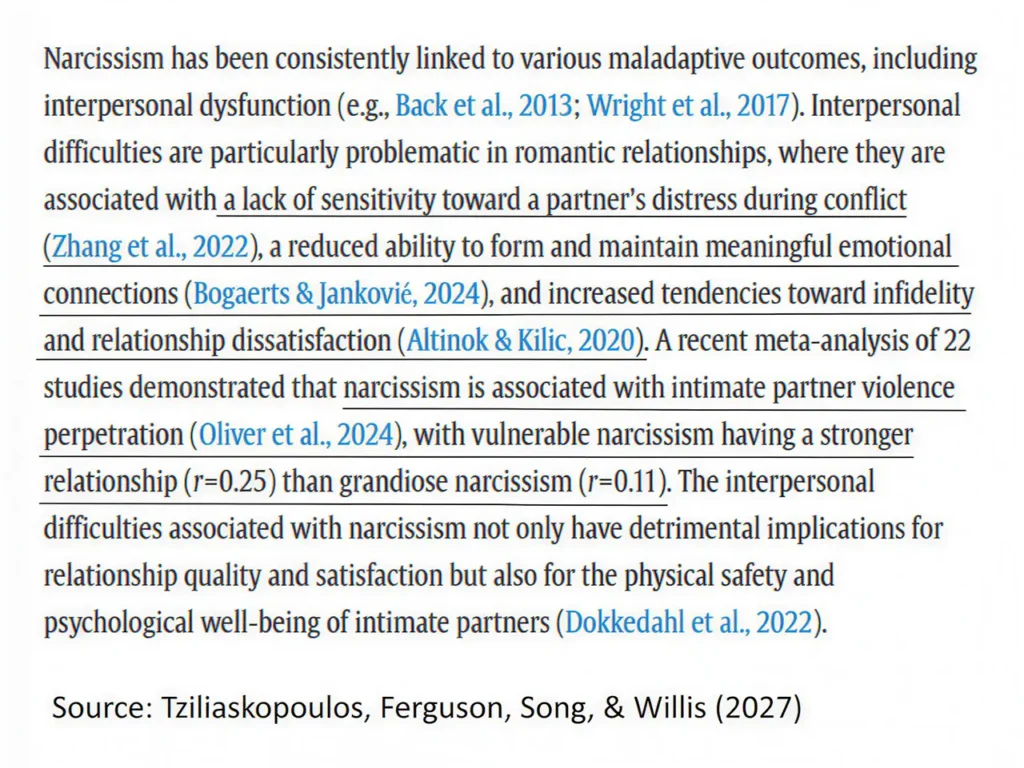
Research has linked narcissism with relationship game-playing, attention to alternative partners, and lower commitment in some circumstances. These associations are discussed in the newlywed study’s review of earlier research (Campbell & Foster, 2002; Campbell, Foster, & Finkel, 2002, as reviewed in Lavner et al., 2016).
However, narcissistic traits do not prove that someone will cheat, and having two narcissistic partners does not establish that infidelity is inevitable.
An important distinction: the experiment discussed there involved cheating on an anagram task, rather than marital infidelity. It should not be treated as proof that the same interventions prevent affairs.
Regardless of personality, responsibility for deception belongs to the person choosing it. A spouse is not responsible for creating conditions that make another adult faithful.
- Can You Stop a Narcissist From Cheating? Read to know the behavior patterns of narcissists in unethical situations.
Can a Marriage Between Two Narcissists Last?
The available research does not establish that marriages between two narcissists must end in divorce, nor does it provide a reliable relationship span for them.
It also does not justify assuming that similar narcissistic traits automatically make two people compatible. The newlywed study found limited partner similarity, while the broader relationship research shows that admiration and rivalry have different implications for romantic outcomes.
It would be more informative if the following were asked:
- Can either acknowledge a mistake without immediately redirecting blame?
- Can each person maintain friendships and independent interests?
- Are money, household work, and major decisions handled fairly?
- Can both partners accept a boundary without punishment?
- Does changed behavior follow apologies?
These questions focus attention on the actual marriage. A relationship’s duration alone tells you little about whether it is respectful or emotionally safe.
Can the Relationship Improve?
It is reasonable to seek help, but no partner should be promised that love, patience, or the right communication technique will resolve entrenched harmful behavior.
Research does challenge the idea that narcissistic behavior is completely unaffected by context (Finkel et al., 2009, as reviewed in Lavner et al., 2016).
For example, Finkel and colleagues found that activating communal concerns promoted relationship commitment among people higher in narcissism. That finding supports the possibility of context-sensitive behavior; it does not establish a treatment for marriages between two people with NPD.
For couples seeking improvement, practical starting points include:
- Describe behaviors precisely. “You called me names during our disagreement” gives a clearer target for change than “You are a narcissist.”
- Set reciprocal expectations. Agreements about spending, fidelity, privacy, and respectful communication should apply to both partners.
- Look for sustained accountability. A useful apology includes acknowledgment, repair where possible, and a reduction in the behavior over time.
- Seek professional assessment. A qualified mental health professional can help distinguish narcissistic traits from other difficulties and assess whether individual or couples therapy is appropriate.
If there are threats, coercive control, physical aggression, or fear of retaliation, prioritize confidential individual support and safety planning before joint counseling. Both partners having difficult traits never means both are equally responsible for abuse.
References:
- Lavner, J. A., Lamkin, J., Miller, J. D., Campbell, W. K., & Karney, B. R. (2016). Narcissism and newlywed marriage: Partner characteristics and marital trajectories. Personality Disorders: Theory, Research, and Treatment, 7(2), 169–179. DOI: 10.1037/per0000137.
- Wurst, S. N., Gerlach, T. M., Dufner, M., Rauthmann, J. F., Grosz, M. P., Küfner, A. C. P., Denissen, J. J. A., & Back, M. D. (2017). Narcissism and romantic relationships: The differential impact of narcissistic admiration and rivalry. Journal of Personality and Social Psychology, 112(2), 280–306. DOI: 10.1037/pspp0000113.
- Back, M. D., Küfner, A. C. P., Dufner, M., Gerlach, T. M., Rauthmann, J. F., & Denissen, J. J. A. (2013). Narcissistic admiration and rivalry: Disentangling the bright and dark sides of narcissism. Journal of Personality and Social Psychology, 105, 1013–1037. DOI: 10.1037/a0034431.
- Belfiore, C., & Hillebrandt, A. (2026). Study on narcissism and self-interested unethical behavior discussed in your linked article. DOI: 10.1016/j.paid.2026.113658. Full bibliographic details require verification against the original paper.
- Finkel, E. J., Campbell, W. K., Buffardi, L. E., Kumashiro, M., & Rusbult, C. E. (2009). The metamorphosis of Narcissus: Communal activation promotes relationship commitment among narcissists. Personality and Social Psychology Bulletin, 35, 1271–1284. DOI: 10.1177/0146167209340904.
Final Words
So, when a narcissist marries a narcissist, shared ambition and a desire for recognition may create an initial connection. But having similar traits does not guarantee empathy, compatibility, or conflict resolution in healthy ways.
Research suggests that narcissistic rivalry and entitlement are more concerning for relationship quality than confidence or attention-seeking alone.
There is no established rule that one partner will always dominate the other, and no evidence-based timeline for how long the marriage will last. The research discussed here cannot predict an inevitable divorce or a fixed relationship pattern. Assess the actual balance of power: who controls decisions and resources, whose boundaries are respected, and whether either partner fears retaliation.
Marrying someone with similar narcissistic traits is also no guarantee of fidelity. Research on cheating during an experimental task cannot establish how to prevent affairs (Belfiore & Hillebrandt, 2026).
Ultimately, judge the marriage by consistent behavior. Can both partners accept limits, acknowledge harm, and follow apologies with meaningful change? If coercion, threats, or abuse are present, prioritize safety and confidential support. Neither a personality label nor shared difficulties excuse mistreatment.
This article is for educational purposes and cannot diagnose either partner.
√ Also Read: Narcissist Silent Treatment: Why They Do It and How To Respond
√ Please share this with someone.
» You deserve happiness! Choosing therapy could be your best decision.
...
• Disclosure: Buying via our links earns us a small commission.