
Today's Monday • 10 mins read
The most powerful move in a conflict with a narcissist is to stop trying to win.
Winning requires engagement, and engagement is exactly what they want. Every defense you make, every point you argue, every effort you put in to get them to understand hands them more of the resource they came to collect: you.
The Gray Rock Method flips that logic. Instead of managing the narcissistic relationship, you manage what makes you appealing. You become a person not worth their effort.
What Is Gray Rocking
Gray Rocking means acting consciously and tactically boring and unresponsive, like a gray rock, to make a control‑wielding narcissist lose interest.
Narcissists thrive on validation from your reactions. By refusing them emotional drama or sharp responses, you become an unrewarding target, and they move on.
The name captures the principle: a gray rock holds no drama, no story, no heat, and no emotional surface. So nobody takes the gray rock home, and nobody thinks about it later.
The phrase “gray rock” was first used in a 2012 post by Skylar, titled “The Gray Rock Method of Dealing With Psychopaths.” Skylar argued that drama‑seeking personalities cannot tolerate boredom and will disengage if a target becomes “as unresponsive as a rock.”
Gray rocking denies attention‑seeking narcissists the very fuel they crave: validation from others.
Gray Rocking: Use GRACE To Make A Narcissist Lose Interest
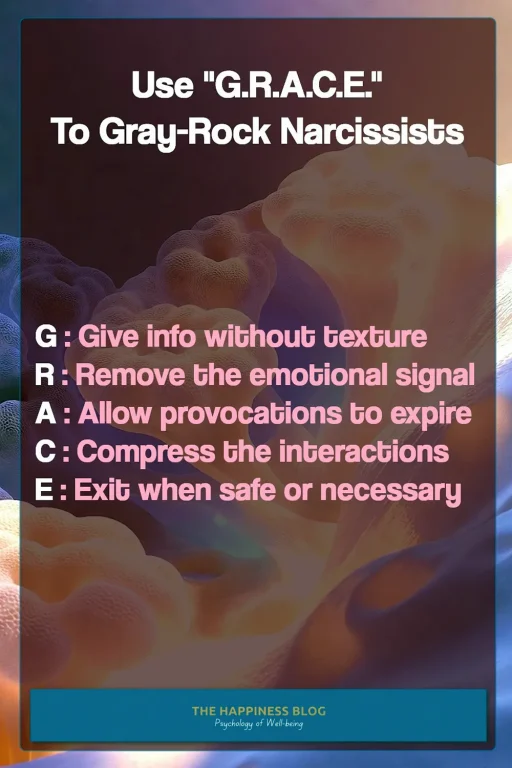
“GRACE” is a useful way to remember the steps to gray rock your narcissist:
- G — Give information without texture
- R — Remove the emotional signal
- A — Allow provocations to expire
- C — Compress the interaction
- E — Exit when safe or necessary
1. G — Give Information Without Texture
Respond to questions with facts and nothing more. “Fine.” “I don’t know.” “I’ll have to check on that.”
No color, no elaboration, no invitation to continue the conversation. The sentence ends and stays ended.
This is harder than it sounds. Most people instinctively fill the silence, soften their responses, and add context to seem cooperative. With a narcissist, that texture is the opening.
Every additional detail is something they can work with, reframe, or use to extend the interaction. Plain, complete, unremarkable responses close the door.
2. R — Remove The Emotional Signal
Neutral face, steady voice, relaxed posture. The goal is to give them something uneventful, with no highs or lows, as forgettable as the dull weather.
Any reaction confirms that they have reached you. A blank, calm surface confirms nothing useful to them.
This takes practice, particularly with someone who knows precisely which buttons to press. If you feel a reaction rising, slow down before you respond.
Take a breath before you answer. That pause means you are making the method work.

3. A — Allow Provocations To Expire
Narcissists and psychopaths are seasoned baiters. But a bait can only hook you if you bite.
In the same way, an insult only lands if you receive it.
When a provocation arrives, don’t receive it; let it sit there unanswered. Pause, nod slightly if needed, redirect your attention elsewhere, or exit the place.
Narcissists will needle you to get a reaction out of you. That gives them validation.
So they provoke you to react with a defense, an explanation, visible distress, or a counterstrike. Any of those reactions is a good result for the narcissist. They feel successful in having you engaged.
Do the unexpected: Decline to participate in their emotional drama.
That refusal to get provoked is the best response to the narcissist. It works because the non-reaction is the one outcome they have no script for.
Your repeated non-reactions make them realize they are failing in what they came for. Over time, they stop bothering you.
4. C — Compress the Interaction
The method works best in short exposures. The longer the interaction, the more opportunities there are for engagement to deepen.
“I have to get back to it” is a complete exit strategy. Another is a scheduled end time set before the interaction begins.
Shortness of your availability deletes the surface area your narcissist can work with. A ten-minute interaction has fewer openings than an hour-long one.
Where possible, prefer written communication over in-person contact. It gives you time to compose flat responses and removes the real-time pressure of face-to-face engagement.
5. E — Exit When Safe or Necessary
Leave interactions and disengage quickly when gray rocking fails or the situation escalates.
Use clear, neutral exits: “I have to go,” “I need to focus on work,” or “Let’s pick this up another time.”
If leaving immediately is unsafe, create distance by moving to a public space, ending the call, or switching to written messages.
Give the highest priority to your safety and emotional well‑being; disengage fully from the narcissists rather than slipping back into prolonged contact.
Does Gray Rocking Work
Gray rocking is aimed at harm reduction, and it often works.
Gray-rocking can help lower the severity and regularity of abusive behavior when you can’t cut off contact with the abuser. It reduces the cost of being close when being close is unavoidable, like with a coparent, a family member, or a colleague.
Gray-rocking also helps a victim stay calm and not get triggered into “reactive abuse” by the narcissist.
Over time, the narcissist learns it is not worthwhile to spend their time or energy to get a rise out of you. As a result, they get closer and have less contact with you.
Gray-rocking is not an official therapy technique, but many abuse survivors feel it helps them cope with manipulative and abusive people. Some therapists have examined it within the framework of narcissistic abuse recovery (Arabi, 2017).
What Gray-Rocking Does Not Do
Gray-rocking does not repair the relationship, motivate the abuser to change for the better, or produce guilt or remorse in them.
It does not work in every situation, though. Gray rocking is not a safety plan for situations involving physical abuse, coercive control, or escalating danger. In those situations, your top priority is to move yourself to a safe distance and seek professional support.
Why Standard Advice Falls Short With Narcissists
Most advice for dealing with difficult people focuses on you communicating something: say this, set this boundary, use this script. The underlying idea is that with the right words, you can reach someone.
That idea breaks down when the person across from you is not seeking a resolution. Highly narcissistic people do not typically enter interactions to connect or compromise.
They enter to regulate and control the narrative. They want to confirm, through your reaction, that they matter. Your clarity, your firmness, and your well-reasoned boundary all require you to engage.
And engagement is the narcissist’s supply.
Research consistently shows that narcissistic individuals rely heavily on external validation to regulate self-esteem (Morf & Rhodewalt, 2001).
Read it as this: A narcissist’s emotional state shifts depending on the reactions they can extract from others. Admiration, fear, conflict, angry reactions, and even contempt all serve the function.
For the narcissist, a negative reaction is a good enough validation; it confirms that their acts or words made an impact.
Genuine indifference gives them nothing to push against, build on, or interpret as meaningful. Narcissistic behavior persists because it gets reinforced. Remove the reinforcement consistently enough, and the behavior loses its purpose (Linehan, 1993).
The Risk of Gray-Rocking Nobody Talks About
This is where most posts on the Gray Rock Method stop, and where they need to go further.
Gray rocking asks you to suppress what makes you expressive, warm, reactive, and present. But these are the very qualities that make genuine relationships possible.
So, gray rocking long enough in a relationship may generalize the suppression of emotional expressions. The emotional flatness that helps in one relationship starts to seep into other interactions. People may start to see the habitual gray-rocker as a cold, unfeeling person.
Therapists who work with survivors of narcissistic relationships document a specific pattern. Clients who learn to hide their reactions, conceal good news, and mute their enthusiasm around a toxic person often find they cannot turn it back on (Walker, 2013).
The gray rock becomes the only face they know to show.
Watch for these signals if gray rocking might be affecting you:
- Emotional flatness in relationships where you feel safe
- Monitoring your words with people who have earned your trust
- A persistent sense that your authentic self has become inaccessible
- Inability to share good news or vulnerability without bracing for a negative reaction
These are learned patterns, and patterns can be unlearned. Once you recognize them, consider working with a therapist familiar with narcissistic abuse recovery to reverse them.
How To Stay Yourself While Gray-Rocking
The antidote to disappearing inside the method is being deliberate about where you show up fully.
Use gray rock with the person who drains you. Then walk out of that interaction and be entirely yourself with someone who has earned it.
Talk about what you are excited about. Let yourself be annoyed, surprised, or delighted with others you meet.
Keep a journal of the times you used gray-rocking where it wasn’t required.
The gray rock method works because you have decided that this particular person does not get access to your real reactions. That decision is setting up a personal space boundary. Maintain that boundary with that person.
But then go out and meet people where you can be your full emotional self, without guarding. You need to meet people because being alone can make gray-rocking your default pattern, but being with others can change that.
References
- Arabi, S. (2017). Becoming the Narcissist’s Nightmare: How to Devalue and Discard the Narcissist While Supplying Yourself. CreateSpace.
- Linehan, M. M. (1993). Cognitive-Behavioral Treatment of Borderline Personality Disorder. Guilford Press.
- Morf, C. C., & Rhodewalt, F. (2001). Unraveling the paradoxes of narcissism. Psychological Inquiry, 12(4), 177–196.
- Walker, P. (2013). Complex PTSD: From Surviving to Thriving. Azure Coyote Publishing.
Final Words
The Gray Rock Method is better understood as a boundary: a conscious choice about who you will not allow access to your authentic self.
People in relationships with narcissists spend years, even decades, trying to get understood and genuinely seen by someone whose personality structure makes that impossible.
Gray rocking reorients that. It stops directing effort toward a person who has no good use for it and redirects it toward protecting the self that has been doing the trying.
For many people, gray-rocking is the first time they place their own inner life outside the reach of the one who was never capable of respecting it. That tactical boringness is a real boundary to have.
√ Also Read: Is Narcissism A Choice or Are Narcissists Victims?
√ Please share this with someone.
» You deserve happiness! Choosing therapy could be your best decision.
...
• Disclosure: Buying via our links earns us a small commission.