Today's Thursday • 12 mins read
— By Dr. Sandip Roy.
A wife always had trouble pleasing her narcissistic husband. If she made an omelette for breakfast, he would demand a poached egg. And an omelette if she poached an egg. Determined to please him, she made both one day. As he sat down to eat, he looked at the two eggs and said, “You poached the wrong egg.”
Abusers like narcissists use trauma bonding to emotionally bind people. They train their targets in seven stages to crave the toxic relationship despite being abused.
A trauma bond is like an invisible rubber band between the narcissist and their target. So strong is its pull that the sufferer cannot walk out despite relentless insults and mistreatment.
They get so addicted to the narcissist that even after breakups, they have strong urges to return.
The targets never realize that they have been gradually trained in seven stages to feel exactly that way.
Only when they have healed do they realize that they had put up with it much longer than necessary.
7 Stages of Trauma Bonding That Narcissists Trap You With
Trauma bonds are made of abuse, neglect, and punishment, with rare moments of love and care.
Take this quiz to find out if you have been trauma-bonded.
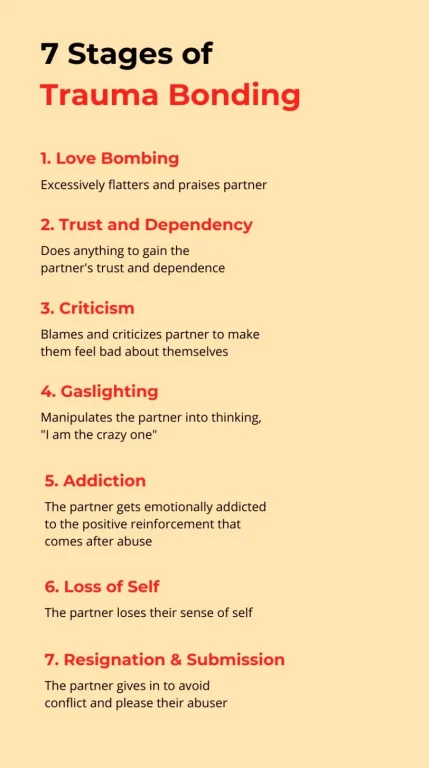
These are the 7 stages of trauma bonding in a relationship:
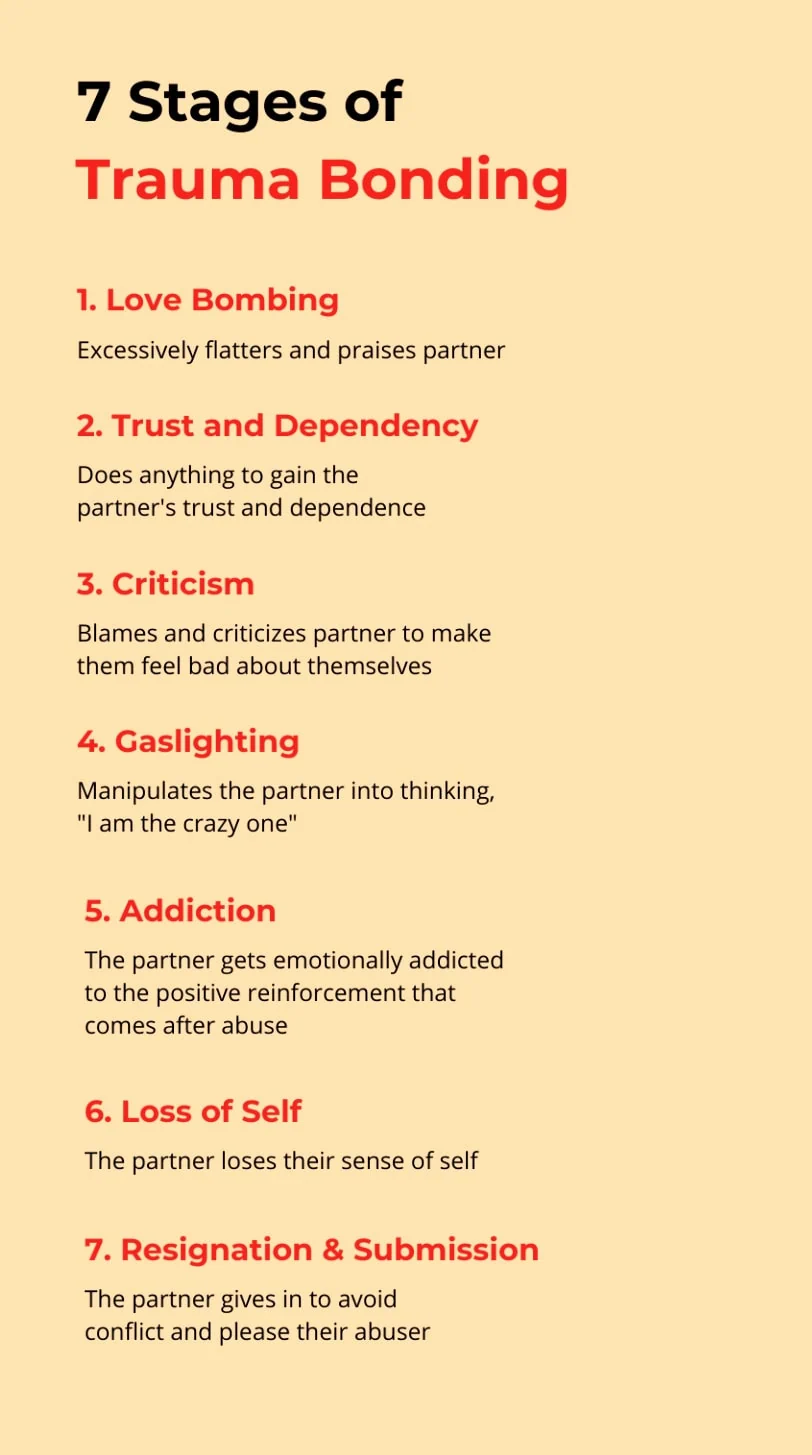
1. Idealization Stage: Creating The Illusion of a Perfect Relationship
In the first stage, called idealization or love-bombing, the narcissist showers the target with constant attention, gifts, and compliments, creating an illusion of a perfect partner.
This intense phase makes the unsuspecting target fall for how the narcissist makes them feel: special, important, and beautiful.
In fact, the love-bombing stage does not look like abuse at all. But it is the most strategic move that starts the trauma bonding process.

2. Trust and Dependency Stage: Building A Strong, Unique Connection
Once the person targeted has been charmed by the excessive showering of love, they begin to grow a deeper trust in the abusive person.
The abuser skillfully manipulates the situation, giving sympathy, support, and understanding to solve the target’s problems, making the target feel dependent on them.
The trust and dependency stage often involves subtle coercion or gestures of “loving” control. They target making the target slowly dependent on the abuser for making all their decisions and choices.
For example, they may say, “I won’t have my lunch unless you eat something.”
This dependency isn’t just emotional; it may extend to financial or other aspects. Even if someone leaves the relationship, they might go back just because they need money, not because they want to.
That is one reason we must have financial boundaries in our relationships.
The abuser creates a seemingly strong and unique connection, making the target believe they’ve found an irreplaceable relationship.

3. The Abuse Cycle Stage: Start of Control, Devalue, Gaslighting, Discard
The abuse cycle stage starts with the target being gradually exposed to greater and more intense emotional and physical trauma.
When Dutton and Painter (1981) first proposed “traumatic bonding,” they explained why these powerful emotional attachments form:
- Power imbalances: Most trauma-bonded relationships have a power imbalance. The more powerful partner exploits and hurts the vulnerable one in these relationships.
- Intermittent good-bad treatment: The controlling partner builds a trauma bond through alternating cycles of aversive arousal (punishment) and relief (reinforcement).
i) Control
In the beginning, the abuser subtly takes control over various aspects of the target’s life.
The first abusive incident might seem like a one-time mistake, happening during a time of novelty and optimism in the relationship.
Its relative lack of severity, coupled with the abuser’s remorse, can actually strengthen the emotional connection.
The target may not yet believe that the abuse will be repetitive and inescapable, even when the abuser tells them something like:
“Why did you have your lunch when you know I haven’t eaten anything since morning?”
ii) Devalue
As the relationship progresses, the abuser begins to devalue the target. They may belittle, criticize, or demean them, eroding their self-esteem.
The constant belittling lowers the target’s self-esteem, making them more self-critical and giving negative self-reinforcement.
Repeated incidents of greater severity shift the target’s thinking into believing that the hostile behavior will never stop unless they do something to prevent it.
But by then, they have already been trauma-bonded.
iii) Discard
Once trust and dependency have been established, the abuser may suddenly become distant, cold, and controlling.
This sudden shift creates a lot of distress and confusion in the target. Yet, they stay optimistic that their abuser will revert to their earlier, loving behavior.
This stage can further deepen the trauma bond, as the target clings to the hope of a return to the loving phase.
iv) Gaslighting
Alongside control, devaluation, and discard, the abuser uses gaslighting.
It is a cunning plot to gradually make the target doubt their own memories, feelings, perceptions, judgments, and interpretations.
Gaslighting degrades the target’s mental balance and sanity. They become overreliant on the abuser to grasp their own reality, which further cements the trauma bond.
The cycle of abuse can have long-lasting effects on the target’s psyche, making them behave like helpless dogs that whimper when electrically shocked.
4. Intermittent Reinforcement Stage: The “Slot Machine” Effect
This stage involves intermittent reinforcement or inconsistent reinforcement, a powerful tool in trauma bonding, leading to a hard-to-break emotional connection.
i) Intermittent Reinforcement Tactics
Intermittent reinforcement is a psychological tactic where the abuser alternates between kind and cruel behaviors. This binds the target to the abuser.
- Think of a dog that is given a treat when it fetches a ball, but not every time.
- So, it keeps wagging its tail, expecting to be given the chance to get the ball.
- Now, the dog’s main goal becomes retrieving the ball, rather than getting the treat.
Similarly, the target’s addiction to the rare shows of kindness keeps them dutifully serving their abuser, overlooking the frequent cruelty.
Trauma bonding appears to be most potent when physical punishment is given at random intervals and mixed with moments of kindness and permission.
Fischer (1955) experimented with young dogs to suppress their social responses and found that the indulged-punished group showed 231% more human orientation than a consistently indulged group.
Rajecki and his team concluded that inconsistent treatment, meaning both abuse and love from the same source, leads to a heightened desire to be close to the object of attachment (Rajecki, et al., 1978).
ii) “Slot Machine” Effect
Intermittent reinforcement keeps targets engaged, as the unpredictability of rewards and punishments creates a “Slot Machine” effect.
It is how gambling houses create intermittent reinforcement by allowing near-wins, occasional wins, and “timed” payouts.
The uncertainty of the next win keeps players engaged and motivated to keep playing.

iii) Emotional Toll On The target
The target’s emotional health worsens as they work harder to gain the abuser’s affection, only to be met with unpredictable responses like “half-praises” and “half-apologies.”
Feelings of helplessness and hopelessness become pervasive, leading to depression, anxiety, or other mental health symptoms.
The combination of isolation, self-blame, and intermittent reinforcement creates a toxic environment where the target feels trapped, dependent, and emotionally broken.
iv) Gender and Cultural Factors
Gender and cultural factors may add layers of complexity to this stage.
The usually more powerful male narcissists and patriarchal societies are more likely to trauma bond women (sisters, daughters, and wives) in their relationships.
v) Target’s Response and Behavior
The abuser rewards certain behaviors. These shows of affection are unpredictable, rare, and random.
The victim cannot predict when they will receive praise again, or how long they will have to endure the ill-treatment. So they eagerly keep doing everything to please their “master,” and get them to show them love and validation as a reward.
That false sense of control (that they can make the narcissist treat them better) makes it hard to leave the narcissist.
The uncertainty and inconsistency in the abuser’s responses create a cycle where the target becomes increasingly desperate for approval, further deepening their dependency on the abuser.
vi) Scientific Insights
- Intermittent reinforcement occurs when a reinforcer is not given (the reward) every time the desired response occurs (Rollinson, 2011).
- When something has been learned because of intermittent reinforcement, the response seems to be remembered better and is more vigorous (Mills & Nankervis, 2013).
5: Submission Stage: Resignation To The Abuser’s Will
“By the time the woman realizes that the abuse is inescapable, the traumatically produced emotional bond is quite strong.” – Dutton & Painter (1993)
In the submission stage, the target may become resigned to their situation, feeling totally dependent, trapped, and helpless, making it almost impossible to break free.
The abuser has, or will soon have, systematically isolated the target from her friends, family, colleagues, and other social support systems. This might be subtle and gradual, with them criticizing, belittling, or gossiping about the target’s friends or family.
It can also get more overt. The abuser can start to dictate what their target should wear, go, buy, eat, talk to, or socialize with.
They ultimately start controlling the other person’s whereabouts and communications, dictating that they be always location tagged, reveal all their passwords, and share every detail of their past.
Of course, this 24/7 monitoring comes with scoldings for doing the wrong things or doing things wrongly.
This social isolation increases dependency on the abuser, making the target feel like there’s no one else to turn to.
Over time, the target starts blaming themselves for the abuse, internalizing the abuser’s criticisms and accusations.
They may believe that they are at fault, that they deserve the abuse, or that they can change the abuser’s behavior by being “better.”
This internalization of blame intensifies the abuse cycle, further deepening the trauma bond and making it more challenging to recognize the abuse for what it is.
Overall, this stage increases the abuser’s control and decreases the target’s autonomy.

6: Autonomy Erosion Stage: Loss of Self-Identity
In this stage, the target’s sense of self becomes profoundly eroded. It seems as if their entire existence revolves around their abuser.
They lose the ability to recognize or express their needs, desires, or boundaries. They are always trying to satisfy and outdo their “service” to their abuser.
Their identity becomes enmeshed with the abuser, and they prioritize the abuser’s needs and feelings over their own.
This loss of self is not merely a fading away of individuality; it’s a transformation where the target’s thoughts, feelings, and actions are dominated by the abuser’s influence.
Leaving the relationship becomes nearly impossible without significant outside intervention or support.
Even when the abuser’s true nature is revealed, the target may be reluctant to break up, and they may return to the relationship if they manage to break away.
This stage represents the completion of the trauma bond, where the target’s autonomy is lost, and the bond becomes a defining aspect of their identity.
It’s a profound and tragic loss of a person’s self that often requires intensive support and therapy to overcome.

7: Emotional Addiction Stage: Loyalty-Seeking Abuser Alignment
In this final emotional addiction stage, the target’s attachment to the abuser becomes more entrenched as they start to seek their abuser’s approval and validation.
They may begin to believe that they deserve the mistreatment or that the abuser’s actions are justified.
This loyalty is not merely passive acceptance; it’s an active alignment with the abuser’s worldview.
The stage is often compared to Stockholm Syndrome, where kidnapped targets sympathize with and support their captors.
The abused person becomes extremely loyal to their abuser, rationalizing their actions, protecting them from criticism, and even participating in their abusive behaviors.
They adopt the abuser’s distorted view of reality, accepting claims that the hurtful actions are beneficial and protective.
This alignment solidifies the trauma bond, making it more challenging to recognize the abuse and seek help.
Moreover, cultural contexts and faith-based dynamics can make things worse for trauma bond targets.
How does a trauma bond begin?
A trauma bond begins through a complex process that typically involves the following stages:
- Initial Connection: Often, the relationship starts positively, with the abuser showering the target with affection and attention. This “love-bombing” stage makes the target feel special and valued.
- Trust and Dependency Development: The abuser skillfully manipulates the situation to create trust and dependency. They may exploit vulnerabilities and create a seemingly strong connection, making the target feel reliant on them.
- Inconsistent Reinforcement: The abuser begins to alternate between kindness and cruelty. This inconsistency keeps the target on edge, wanting to work harder to gain the abuser’s affection. It can lead to addiction-like symptoms, where the target craves the abuser’s validation.
- Manipulation and Control: Tactics like gaslighting, isolation, and control are used to further cement the bond. The target may start to question their memories, feelings, and perceptions, becoming reliant on the abuser for their understanding of reality.
- Erosion of Self-Worth: The target’s self-esteem and self-worth may be eroded, leading to a belief that they deserve the abuse or cannot find better. This mindset further entrenches the trauma bond.
The formation of a trauma bond is a gradual and insidious process, often happening without the target fully realizing what’s occurring. The combination of emotional highs and lows, manipulation, and control creates a powerful connection that can be challenging to break.
- Download a more detailed PDF of this post: 7 Stages of Trauma Bonding: Simply Explained
Final Words
Leaving a bad relationship is hard. The longer you are in a trauma-bonded relationship, the harder it might be to leave. You might keep going back to the same person who hurt you.
So, as soon as you realize you have been trauma-bonded, do these two things:
- Stop justifying their behavior (doing so makes you an enabler), and
- Distance yourself from the relationship with help from supportive people.
Reach out to therapists and counselors who specialize in relationship trauma.
Please tap into social support groups (even if it means talking to your local Alcoholics Anonymous), if you do not have the money. They can guide you on how to support yourself as you break out of your trauma bond.
√ Also Read: Narcissistic Shame: Why & How Do Narcissists Feel Shame?
√ Please spread the word if you found this helpful.
» You deserve happiness! Choosing therapy could be your best decision.
...
• Disclosure: Buying via our links earns us a small commission.