Today's Wednesday • 8 mins read
— By Dr. Sandip Roy.
Empathy is the ability to recognize and understand another person’s emotional states and to feel a similar emotion to them. It has two clear forms:
- Cognitive empathy (CE) is the ability to recognize and understand the emotions and intentions of others; also called perspective taking.
- Affective empathy (AE) is actually feeling similar emotions to another person; also known as emotional empathy.
Both forms boost emotional intelligence. Greater empathy improves emotional communication and makes it easier to spot both healthy and toxic relationships.
Perhaps the best finding on empathy is this: Empathy is a skill that can be learned.
People with low empathy can be taught to act with greater empathy. And it has advantages.
Studies show empathy training improves patient satisfaction and treatment adherence in doctors. Teaching empathy to children from a young age reduces bullying and strengthens social skills.
Below are 15 evidence-backed ways to increase empathy and connect more deeply:
1. Don’t Minimize The Other Person’s Emotions
Simply acknowledge their feelings. They have a right to feel the way they want to.
Don’t oppose, minimize, or reject their feelings. All emotions are valid, even if you would react differently.
Validation doesn’t mean you have to agree with them. You can disagree and still accept their experience as real.
Use simple, specific responses that name the feeling and show you’re present.
- Example: “I hear that you’re frustrated. That sounds hard.”
- Micro-script: “I can see why you’d feel that way.”
Also, avoid immediate problem-solving or correcting their perspective; first offer acceptance, then ask if they want help or just someone to listen.
2. Observe The Nonverbal Cues
A lot of conversation is about the words left unsaid.
Pay attention to the unspoken emotional cues. Facial expressions, body language, and tone of voice may reveal more intimate insights into their emotions.
Helen Riess & Gordon Kraft-Todd (2014) devised a tool with the acronym “E.M.P.A.T.H.Y.”
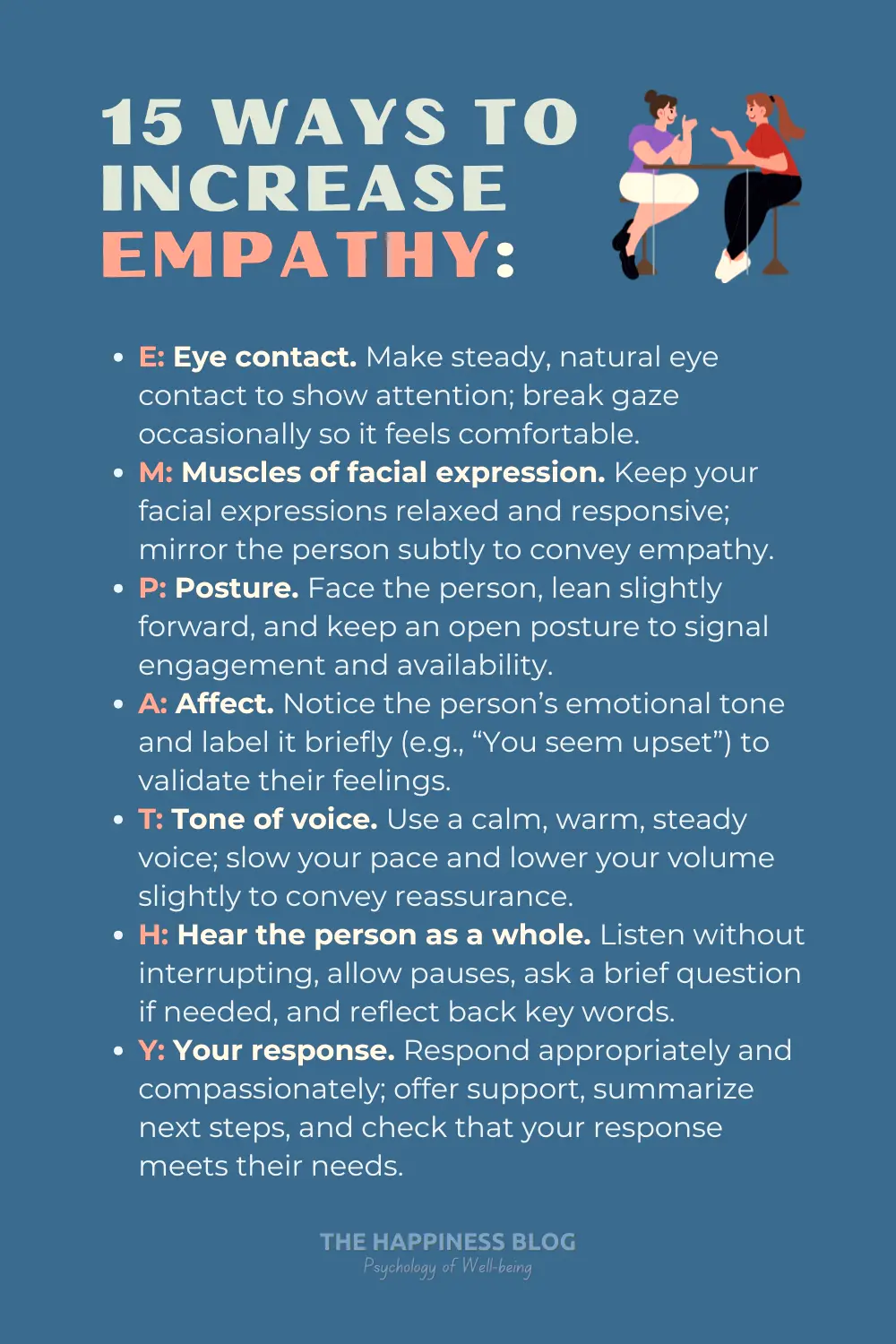
- E: Eye contact. Make steady, natural eye contact to show attention; break gaze occasionally so it feels comfortable.
- M: Muscles of facial expression. Keep your facial expressions relaxed and responsive; mirror the person subtly to convey empathy.
- P: Posture. Face the person, lean slightly forward, and keep an open posture to signal engagement and availability.
- A: Affect. Notice the person’s emotional tone and label it briefly (e.g., “You seem upset”) to validate their feelings.
- T: Tone of voice. Use a calm, warm, steady voice; slow your pace and lower your volume slightly to convey reassurance.
- H: Hearing the person as a whole. Listen without interrupting, allow pauses, ask a brief clarifying question if needed, and reflect back key words to make sure you understood (e.g., “So you’re worried about the test results and feeling overwhelmed”).
- Y: Your response. Respond appropriately and compassionately; offer support, summarize next steps, and check that your response meets their needs.
This easy-to-remember checklist helped medical professionals at Massachusetts General Hospital orient to key aspects of perceiving and responding to nonverbal emotional cues.
3. Suspend Your Judgment
Listen with an open mind. Don’t assume, don’t judge.
Set aside assumptions, biases, and quick evaluations so you can hear the whole story. Don’t label or shame the person, even if you disagree with them or see that their facts are wrong.
- Example: “Tell me more. I want to understand.”
- Micro-script: “I’m not judging; I just want to hear what happened.”
4. Consider Different Perspectives
Two people may not see the same thing the same way. So, don’t assume there’s only one correct view.
Remind yourself that others can experience the same situation differently. Ask them to explain their thoughts and feelings, and create a safe space for honest expression.
- Example: “Help me see how you experienced that.”
- Micro-script: “I want to understand your view.”
5. Practice Perspective-Taking Exercises
Deliberately imagine another person’s situation, especially someone from a different background or culture, to widen your empathy.
Use brief daily exercises: picture their day, challenges, and emotions for 5–10 minutes. For example, imagine being a person of the Maori tribe of New Zealand, living their life.
- Example: “What would this feel like if I had their history?”
- Micro-script: “I’m trying to see this from your side.”
6. Learn The Art of Active Listening
Give them the gift of your full attention: face the person, close or silence your phone, and ask before taking calls.
Listen to understand, not to reply. Allow space for “agreeing to disagree” so people feel safe sharing.
- Example: “I’m here. Tell me more.”
- Micro-script: “Can I finish listening before I respond?”
7. Train To Maintain Your Focus
Attention drifts. Sometimes, even skilled listeners lose focus when topics feel unfamiliar or uninteresting.
When it happens, gently return your attention without guilt. Use cues: make eye contact, note a change in tone, or mirror a microexpression to re-engage. Quickly imagine having their experience to restore your presence.
- Example: “You looked upset when you said that. What happened?”
- Micro-script: “I lost my focus. Please continue.”
8. Ask Clarifying Questions
If you miss something, wait for a pause and ask them to repeat the part you didn’t catch. Don’t interrupt their flow. Use questions that invite more detail, not shut it down.
- Example: “Can you repeat the part about what happened next?”
- Micro-script: “Could you say that again?”
9. Ask To Know, Not To Suggest
Ask to understand them, not to steer them. Choose open-ended questions.
Open-ended questions invite feeling and thought. Closed-ended ones block out some choices.
- Closed: “Did you enjoy the movie?”
- Open: “How did the movie make you feel?”
- Micro-script: “What was that like for you?”
10. Dig Deeper (But Not Too Much)
Invite deeper conversation by creating a safe space. Ask about feelings, lessons, or how the experience shaped them. Stop if they pull back; don’t probe for the sake of probing.
- Example: “What did that feel like for you?”
- Micro-script: “Only if you want to, tell me more.”
Don’t probe too much into their emotional world; it can make them close up.
11. Highlight Similarities (Just Briefly)
Share a relevant point of overlap to build a connection, but avoid turning the focus to yourself. Similarity strengthens rapport; difference still allows empathy.
- Example: “I’ve felt something like that before.”
- Micro-script: “That reminds me of when I…” (keep it short)
12. Read Fiction and Watch Emotional Films
Narrative exposure trains the theory of mind. Regularly reading character-driven fiction or watching emotionally rich films deepens your ability to imagine others’ inner lives.
- Practice: pick one short story or film a week and reflect on the protagonist’s feelings.
- Micro-script: “How would that feel if I were them?”
13. Cultivate Self-Awareness
Self-awareness is knowing who we truly are, how others view us, and how we fit into the world.
So know your emotions, triggers, and limits. Greater self-awareness helps you respond rather than react and prevents your issues from blocking connection.
- Practice: Brief daily reflection. Name one emotion you felt and why.
- Micro-script: “I notice I’m getting defensive; I’m stepping back to listen.”
14. Double-Check Understanding
Repeating back what you just heard can make sure you understand their stand. This is called paraphrasing.
Paraphrase what they said to confirm you heard them accurately, and also show your presence. Keep the tone natural so it feels conversational, not interrogative.
- Phrases: “So, if I understand you…” or “Just to make sure I’m on the same page…”
- Micro-script: “So you felt X when Y happened—am I right?”
15. Volunteer or Help Others
Community service can expose you to diverse life experiences and help build empathy. Choose hands-on roles with direct contact with people, like meal service, shelters, or visiting seniors.
- Start small: one shift a month, and reflect on what you learned afterward.
- Micro-script: “I’d like to help. What’s needed?”
Final Words
Finally, and I guess it’s already clear, empathy is a learnable skill.
Like any skill, empathy gets stronger the more you work at it. Pick a couple of these to start with, see how they feel, and gradually weave them into your daily interactions.
When you have the right amount of empathy, you can connect more deeply with the people who support you and figure out which relationships are toxic and need to end.
• • •
√ Also Read: Dangers of Empathy: 5 Ways Empathy Can Hurt You Bad
√ Please share it with someone if you found this helpful.
» You deserve happiness! Choosing therapy could be your best decision.
...
• Disclosure: Buying via our links earns us a small commission.