Today's Monday • 9 mins read
— By Dr. Sandip Roy.
Most advice about narcissists follows a familiar arc. Recognize the signs. Set boundaries. Leave if you can.
What it rarely addresses is whether any piece of the behavior itself can be changed. Not the personality, not the diagnosis, but the moment-to-moment pattern of lying and self-serving deception that makes narcissists so exhausting to be around.
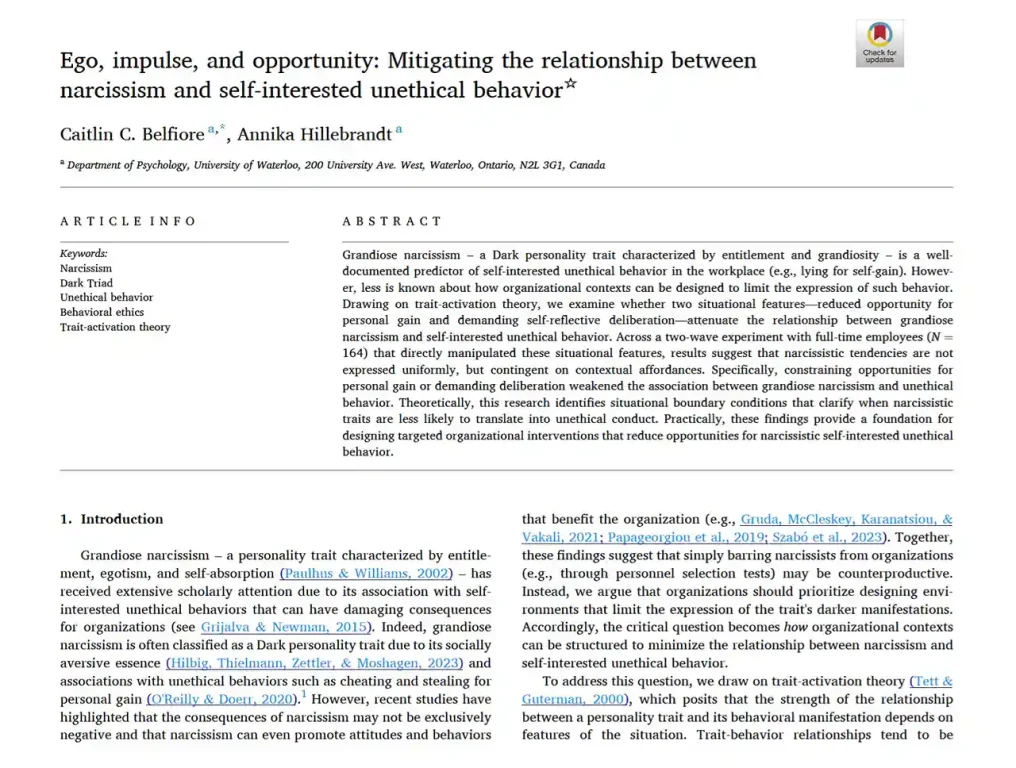
A 2026 study from the University of Waterloo offers a genuinely interesting, narrow answer: yes, under specific conditions, in a specific setting.
So what did the researchers exactly test, and how far does their conclusion land?
Do Narcissists Lie and Behave Unethically More Often?
The short answer is yes, narcissists lie and act unethically more often. This part of the picture is well-established.
Grandiose narcissism, the kind that’s marked by entitlement, egotism, and self-absorption, is one of the more consistent predictors of self-interested, unethical behavior in organizational research (Grijalva & Newman, 2015).
O’Reilly and Doerr (2020), while studying lying, cheating, and stealing among grandiose narcissists, found that their sense of entitlement predicts a broad willingness to bend rules and manipulate outcomes when it serves their self-image.
None of that is new or contested. What’s less settled, and what this Waterloo study actually investigated, is narrower: not whether narcissists behave unethically, but whether specific features of a situation can weaken that tendency.
What “Cheating” Meant in This Study
This matters enough to state plainly before anything else: this study has nothing to do with romantic infidelity. The word “cheating” in the research refers to lying about a score on a word puzzle for a small cash bonus, in a controlled lab task.
It’s worth being upfront about that gap, because a study on anagram self-reporting and a study on romantic betrayal are measuring very different things, even if both technically involve “cheating” in the dictionary sense.
Caitlin Belfiore and Annika Hillebrandt ran a two-part study with 350 full-time employees recruited through the research platform Prolific, split roughly evenly between the U.S. and Canada (Belfiore & Hillebrandt, 2026).
Participants first completed a narcissism assessment. Two days later, 176 returned for the second part, and after excluding participants who failed attention checks, the researchers analyzed data from 164.
In that second session, participants were randomly assigned to one of three conditions and given an anagram task: unscramble nine words in two minutes, with an unusual twist.
The third word in the sequence was unsolvable. Reporting a score of three or higher was only possible by lying. Across the full sample, 42% did.
- In the control condition, participants were paid per word they reported unscrambling, roughly ten British pence each, creating a small financial incentive to inflate the number.
- In the reduced personal gain condition, participants received a flat bonus regardless of their reported score, removing the incentive to lie.
- In the deliberation condition, participants had to wait through a mandatory one-minute reflection period before submitting their score.
In the control condition, narcissism predicted lying about the score. In the other two conditions, that link dropped to statistically non-significant. Both changes to the situation, not to the person, weakened the relationship between narcissism and dishonest self-reporting.
Why This Might Work: Entitlement and Impulsivity
Why are narcissists more wired for unethical behavior? The researchers frame the result around two traits well-documented in narcissism research generally:
- Entitlement is one. Narcissists tend to believe ethical standards apply to other people more than to themselves (O’Reilly & Doerr, 2020), and when an opportunity for personal gain appears, that belief can narrow their attention toward their own interest. Removing the incentive removed the thing entitlement had to act on.
- Impulsivity is the other. Narcissists tend to rate themselves, and to be rated by others, as more impulsive than average (Vazire & Funder, 2006), and unethical behavior in general is more likely when decisions are made quickly, without time to reflect (Shalvi, Eldar, & Bereby-Meyer, 2012). A one-minute forced pause interrupted whatever made the fast, unreflective choice to lie feel easy.
Both effects held up even after the researchers controlled for Machiavellianism and psychopathy, the other two traits in the “Dark Triad,” suggesting that this pattern is more specific to narcissism than to other dark personalities.
Two Conditions That Weakened Narcissistic Dishonesty
The research found two specific strategies that weakened the narcissism-dishonesty link. Both approaches avoid directly confronting the narcissist or asking them to change their personality.
1. Get rid of the personal gain incentive.
When the narcissist’s rewards weren’t based on what they reported, the feeling of entitlement stopped pushing them toward dishonesty.
Since there was nothing to win by lying, the natural urge to act in self-serving ways went away.
At work, this could mean pay systems that aren’t just based on individual performance, or where personal rewards depend on long-term team success instead of short-term personal numbers.
The same logic would suggest that in relationships, fewer situations with an easy, immediate payoff for lying might matter too, though that’s not something this study tested directly.
2. Make them take a pause to think.
When people had to slow down and think before reporting information, it interrupted the impulsive behavior. The required break created a condition that ran counter to how narcissism tends to operate.
In real life, this might include mandatory waiting periods before making big decisions, cooling-off times during arguments, or any system that stops the narcissist from acting on their first instinct. The thinking period doesn’t have to be long.
In this study, just one minute was enough, though the researchers note how much participants actually deliberated, as per the self-reports, was barely significant.
What made the deliberation condition work was that all the participants in that group had to sit and wait for the entire minute, regardless of how they felt about it. It was not because they felt more thoughtful.
Both findings held up even after controlling for other Dark Triad traits, including Machiavellianism and psychopathy, suggesting the effects are specific to narcissism rather than dark personality traits in general.
One more detail worth knowing: the researchers also checked whether removing the incentive or adding the pause made people in general more honest, independent of narcissism. It didn’t.
Neither condition significantly changed dishonesty rates on its own. What each condition did was specifically break the link between narcissism and dishonesty, not raise honesty across the board. That’s a meaningful distinction.
This isn’t a general-purpose honesty intervention that happens to work on narcissists. It’s something narrower: two situational changes that seem to matter mainly for people high in narcissistic traits.
What Might Reasonably Carry Over
With those limits in mind, the basic idea, that entitlement requires an opportunity to take action and impulsivity requires speed to take advantage of, is reasonable outside a lab, though it hasn’t actually been tested there.
Applied cautiously:
Workplace setting: The research actually took place in a workplace setting, so this is the context where applying it makes the most direct sense. Compensation structures that aren’t purely tied to individual short-term results, and systems that require a mandatory waiting period before major decisions, are a sensible, evidence-adjacent thing to test.
Personal relationships: In a personal relationship, the same logic suggests it’s worth avoiding situations where being dishonest is easy, private, and gives the narcissist a quick benefit. It also suggests that decisions made when someone is rushed and stressed are riskier than choices made with time to think things through.
But this comes from the study’s logic, not from something the study actually found. Nothing here should be read as proof that a specific change will really lower the chance of infidelity in a relationship with a narcissistic partner, which is a much more serious and differently motivated action than an anagram score.
What the Study Doesn’t Show
A few limits are worth stating clearly rather than as a footnote, because they bear directly on how far this finding should be trusted to generalize.
The stakes in this study were trivial. Ten pence a word is not remotely comparable to the stakes involved in an affair, a major financial decision, or a family conflict. It’s entirely possible that the same interventions would work less well, or not at all, when something a person actually wants is on the line and the personal cost of getting caught is real rather than nonexistent.
The sample size for the actual test was modest: 164 people, predominantly North American, drawn from a paid research platform rather than from any clinical or relationship context. The behavior measured was a one-time, low-stakes lie about a puzzle score, not a pattern of deception sustained over months or years, which is what most people mean when they ask whether a narcissist in their life can change.
The study focused specifically on grandiose narcissism by design. It excluded vulnerable narcissism, the more anxious, low self-esteem, and defensive type, since prior research suggests that type isn’t linked to this kind of unethical behavior in the first place. So this finding hasn’t actually been tested on vulnerable narcissists and shouldn’t be assumed to apply to them.
That said, the study is interesting and well-designed. Removing the reward and adding the pause each worked on its own, without needing the other. That shows how much situational design can change whether grandiose narcissists are likely to lie.
Resources:
- Belfiore, C.C., & Hillebrandt, A. (2026). Ego, impulse, and opportunity: Mitigating the relationship between narcissism and self-interested unethical behavior. Personality and Individual Differences.
- Grijalva, E., & Newman, D.A. (2015). Narcissism and counterproductive work behavior (CWB). Applied Psychology.
- O’Reilly, C.A., & Doerr, B. (2020). Conceit and deceit: Lying, cheating, and stealing among grandiose narcissists. Journal of Research in Personality.
- Vazire, S., & Funder, D.C. (2006). Impulsivity and narcissism.
- Shalvi, S., Eldar, O., & Bereby-Meyer, Y. (2012). Speed of decision making and unethical behavior.
Final Words
The default assumption about narcissists is that their behavior is simply fixed. This study is a genuinely useful data point against that assumption in one narrow domain: opportunistic dishonesty in low-stakes conditions in a workplace-recruited sample.
It is not evidence that narcissistic infidelity can be prevented through incentive structures or cooling-off periods, and it shouldn’t be read or shared that way.
If you’re dealing with a narcissistic partner, family member, or friend and wondering whether their behavior can change, this study offers a small, real reason to think situational design matters more than most narcissism advice acknowledges.
It does not offer a formula, and treating the underlying mechanism (entitlement needs opportunity, impulsivity needs speed) as a lever you can pull in a relationship is a reasonable hypothesis worth holding loosely, not a research-backed guarantee.
√ Also Read: Signs of A Narcissist: 20 Narcissistic Behavior Red Flags
√ Please share this with someone.
» You deserve happiness! Choosing therapy could be your best decision.
...
• Disclosure: Buying via our links earns us a small commission.