
Today's Thursday • 10 mins read
— By Dr. Sandip Roy.
Generally, people see narcissists as those who love themselves too much, are highly selfish, and exploit others without guilt.
You may be surprised that all of us have some narcissism. Those with too much narcissism are often toxic people. Those with a “drop of narcissism” are better achievers and leaders. This is positive narcissism.
Narcissism is a personality trait that, at its extreme, becomes a diagnosable disorder. Psychologists define a narcissist as a “relatively stable individual … consisting of grandiosity, self-love and inflated self-views” (Campbell & Hoffman, 2011).
The term “narcissism” comes from the Greek myth of Narcissus, who fell in love with his own reflection and wasted away gazing at it.
Who Is A Positive Narcissist?
A positive narcissist has a charismatic aura, an ability to persuade others, a strong sense of self-confidence, unconventional leadership skills, a drive to overachieve, and intellectual empathy.
Positive narcissism is not a formal clinical term or diagnosis. It is a useful way to describe someone who has a healthy level of self-regard but shows mild narcissistic tendencies in how they operate.
They are self-assured and emotionally intelligent. They are ambitious, self-driven, and take pride in their achievements. They are assertive, yet willing to collaborate.
They know their strengths and their limits, and they learn from their mistakes. They often produce admirable work and bring others along with them.
“Healthy narcissism is a positive sense of self that is in alignment with the greater good.” — Wikipedia

Since around 2021, research has pushed harder on the distinction between adaptive narcissism and maladaptive narcissism, including through tools like the Five-Factor Narcissism Inventory (Sherman & Miller, 2015).
- Adaptive narcissism includes traits like leadership, self-sufficiency, and a sense of entitlement that motivate achievement.
- Maladaptive narcissism includes exploitativeness, entitlement as a demand for special treatment, and an inability to tolerate criticism.
A “positive narcissist” is someone whose narcissistic traits fall predominantly on the adaptive side.
An Example of A Positive Narcissist
Kobe Bryant was a positive narcissist.
Professor Todd Kashdan writes in his post, What would life be like without a single drop of narcissism:
Kobe’s narcissism wasn’t about arrogance or entitlement. It was a steadfast belief in his capabilities and an unyielding drive to excel. This man would claim half the team’s court before games to sharpen his skills. That meant 17 professional basketball players on the Lakers had to cram into the other side.
He was the earliest arrival in the gym, refining shots, mastering footwork, pushing his endurance. And he played long after his teammates wrapped up. His dedication manifested in five NBA championships, two Olympic gold medals, and an enduring legacy.
Steve Jobs is another example, though a more complicated one.
He was charismatic and magnetic. His ideas reshaped how we consume digital content.
But several of his behaviors were textbook narcissistic: a sense of entitlement that led him to treat others cruelly, a belief that he was uniquely special and should associate only with people of high status, and a need for praise so strong that he reportedly felt slighted when President Obama did not call him after the iPad launch.
Many people choose to remember Jobs as a positive narcissist, forgiving his darker tendencies because of his genuine creative genius.
His 2005 Stanford commencement address remains one of the most-watched speeches in history. The message was simple: follow your own instincts, not other people’s expectations. That fits the positive narcissist profile precisely.
6 Signs of A Positive Narcissist
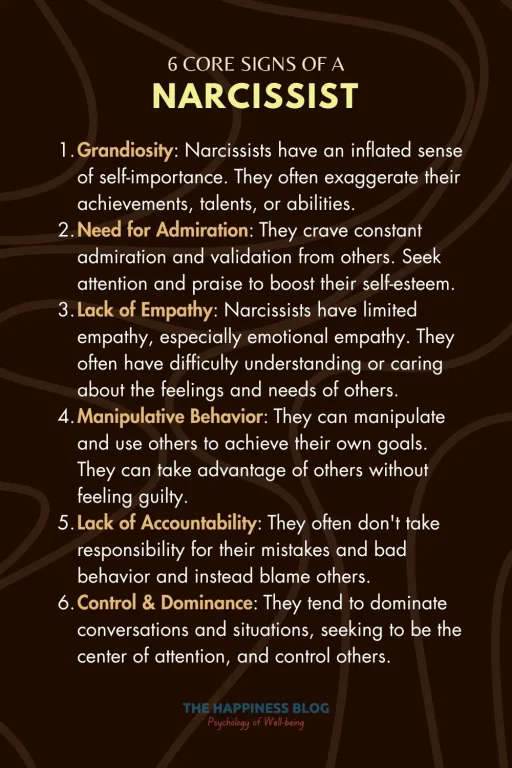
Positive narcissists share a recognizable set of traits that are diluted versions of six core narcissistic patterns: grandiosity, a need for admiration, lack of empathy, manipulative behavior, lack of accountability, and a drive for control and dominance.
In a positive narcissist, those six patterns show up at lower intensity:
- Grandiosity ↠ Measured Grandiosity
- Need for Admiration ↠ Appetite for Admiration
- Lack of Empathy ↠ Selective Empathy
- Manipulative Behavior ↠ Instrumental Behavior
- Lack of Accountability ↠ Blame Deflection
- Control and Dominance ↠ Drive for Dominance
Here is what each one tends to look like in practice.
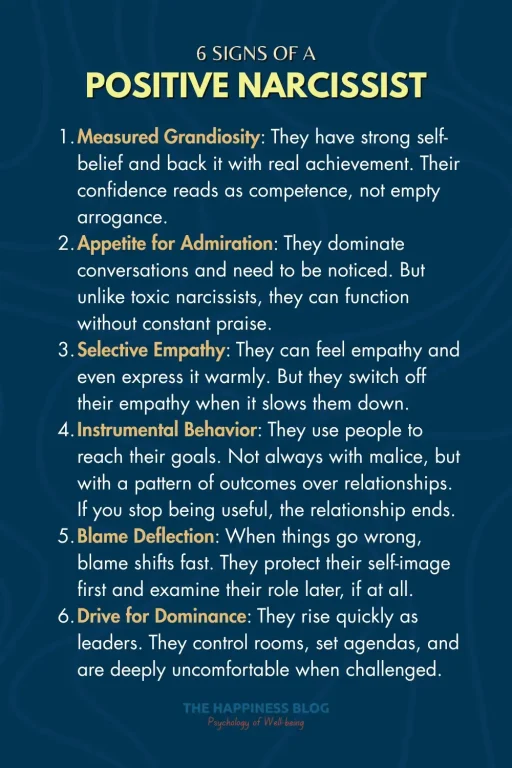
1. Measured Grandiosity
Positive narcissists come across as intelligent and attractive. They make bold decisions that others might label as impulsive, but they are not easily rattled by criticism or negative judgment.
They trust their own instincts to stick to their choices. They feel almost zero guilt about cutting off people who are not useful to their larger goals.
In a pathological narcissist, grandiosity is a defense: a brittle shield over deep insecurity. In a positive narcissist, it looks more like earned confidence. The self-belief is real. The track record often backs it up.
2. Appetite for Admiration
Positive narcissists tend to dominate conversations and grow impatient when the focus shifts to someone else. They believe they deserve more attention than the average person.
This is not always arrogance. Sometimes it is simply the confidence of someone who has repeatedly backed themselves and won.
They seek praise and recognition, but they are not completely undone by its absence. A pathological narcissist needs constant admiration to function. A positive narcissist prefers it, pursues it, but can operate without it.
3. Selective Empathy
Positive narcissists are not without empathy. They can feel it and, when motivated, express it warmly.
But they switch off their empathy when it slows them down.
This selective empathy is one of the more unsettling traits in a positive narcissist, precisely because it is not obvious.
When a goal is in their sight, other people’s feelings become secondary. So they can seem deeply caring in one moment and completely indifferent the next.
The difference depends on whether your feelings are useful to them at that moment.
4. Instrumental Behavior
Positive narcissists are often criticized for treating people as tools to help them reach their goals.
They do not always act with conscious malice, but they do follow a constant pattern of prioritizing outcomes over the people who help them get there. If someone stops being useful, the relationship quietly ends.
Even the milder end of the narcissistic spectrum carries a measurable tendency toward using others for personal gain.
Their relationships can be superficial because they are always working toward something larger.
5. Blame Deflection
When things go wrong, positive narcissists are quick to find an external cause. They rarely sit with the discomfort of having made a mistake. Blame shifts fast: to circumstances, to other people, to timing.
This is less extreme than the pathological version, where accountability is never accepted under any condition.
A positive narcissist may eventually acknowledge a mistake privately, or once enough time has passed. But in the immediate aftermath, their self-image takes priority. Protecting it matters more than accuracy.
6. Drive for Dominance
Positive narcissists rise quickly as leaders in unfamiliar groups. They are comfortable taking up space, directing conversations, and setting the agenda.
Others often follow, partly because the confidence is convincing and partly because resisting it takes more energy than most people want to spend.
In extreme cases, a perceived threat to their self-image can trigger narcissistic rage: a sharp, reactive anger that can occasionally tip into unintentional physical aggression. The need for control, when seriously challenged, does not stay quiet.
[To be sure, look for the 20 Definitive Signs of A Narcissist.]
Positive Narcissism: Healthy Qualities of A Narcissist
Most experts agree that narcissism exists on a spectrum and expresses itself in both pathological and normal forms (Campbell & Hoffman, 2011).
Normal narcissism is marked by a stable sense of self that holds up under pressure. Healthy narcissists accept positive feedback, do not take criticism too personally, and take risks without needing outside permission. Their confidence is a genuine operating mode, not just performance.
Pathological narcissism is marked by a fragile self-image that collapses under criticism. Research has found a positive correlation between pathological narcissism and cyberbullying (Goodboy & Martin, 2015) and cyber-victimization (Zerach, 2016).
Narcissism has two main clinical subtypes: grandiose and vulnerable (Miller et al., 2011).
- Grandiose narcissists are status-obsessed, dominating, and aggressive.
- Vulnerable narcissists feel chronically inadequate and tend to see others as hostile.
Positive narcissists typically lean toward the grandiose end, but without the full pathological picture. Those who lean toward grandiosity tend to be mentally tougher, less prone to depressive symptoms, and quicker to recover after setbacks.
Positive narcissists generally score high on extraversion. They are outgoing, sociable, and magnetic. Their first impressions are almost always good, which is what allows them to rise fast in unfamiliar groups.
They pursue goals with rare tenacity. They also respond to provocation fast. The drive to stand out pushes some of them to produce work that genuinely does. Still, they prioritize their own well-being, which makes burnout less likely.

Robert Raskin found a small but significant relationship between narcissistic traits and creative output (Raskin,1980).
Some of them are surprisingly empathetic and kind. That’s partly real warmth and partly a desire to be liked. Either way, people respond with gratitude, which the narcissist takes as confirmation of their own good nature.
All of this: the confidence, the resilience, the social magnetism, is what allows positive narcissists to rise quickly as leaders.
How Does Positive Narcissism Develop?
When we are born, we all have narcissism built in. Infants have no sense of “others.” They experience everyone and everything as an extension of themselves.
A developmental shift begins around age two. The child’s brain starts to register itself as a separate identity. From that point, the child explores the world outside with curiosity and growing independence.
When that shift cannot be completed properly, usually because of early parental stress or abuse, the child stays stuck in the narcissistic operating mode and tends to grow into a narcissist.
Positive narcissists are aware of their narcissistic tendencies and work to fix them. They make a conscious effort to tune in to other people’s pain, resist the urge to demean others, and, at times, put others’ needs before their own.
That self-awareness and genuine desire to stop being narcissistic separate them from the more harmful narcissists.
Can A Single Question Identify A Narcissist?
The Narcissistic Personality Inventory (NPI), developed in 1979 by Robert Raskin and Calvin Hall, is the most widely used scale to measure narcissism.
There is also a Single-Item Narcissism Scale (SINS) that identifies narcissists by asking just one question:
“Are you a narcissist?”
People who answer “Yes” are significantly more likely than others to score high on the full 40-item NPI. Narcissists, it turns out, are often quite willing to tell you what they are.
Are High Achievers Narcissists?
High achievers are often labeled narcissists because they pursue self-serving goals and routinely steamroll over others to get there. But that label is not always accurate.
Many high achievers show narcissistic traits: a strong sense of self-importance, a need for admiration, and an absorption in success. That does not make them clinical narcissists.
The difference lies in whether those traits are stable and self-aware or brittle and destructive.
A positive narcissist who achieves at a high level is often conscious of the cost their drive places on others. A pathological narcissist is not.
Final Words
The popular image of the narcissist is a manipulator: seductive, dishonest, and ultimately hollow. That picture is accurate for the pathological end of the spectrum.
But at the healthier end, you find people with strong self-belief, genuine creative drive, and the social confidence to lead.
Their relationships can be thin, their empathy selective, and their patience for others limited. But they produce really creative things, take real risks, and often raise the bar for those around them.
What makes narcissism a problem is not always the trait itself but the insight the person has into it. A positive narcissist knows what they are and uses that self-knowledge to operate better. That is the line that matters.
√ Also Read:
- The Truth About Narcissist-Empaths
- This Is How Narcissists Treat Their Children
- Covert Narcissist Test: Are You A Narcissist Or A Touchy Introvert?
√ Please share this with someone.
» You deserve happiness! Choosing therapy could be your best decision.
...
• Disclosure: Buying via our links earns us a small commission.